Spending Data Reflects Shifting Federal Cloud Market
Published: March 24, 2021
Federal Market AnalysisCloud ComputingForecasts and SpendingInformation Technology
Cloud spending by civilian agencies favors IaaS while the DOD favors SaaS.
Key Takeaways
- Federal spending on SaaS passed spending on IaaS in fiscal 2018, a trend that continued into fiscal years 2019 and 2020.
- Civilian agencies as a whole still spend more on IaaS than SaaS.
- Defense customers continue to spend more on SaaS than on IaaS.
There is some evidence that the federal government’s pivot to the cloud has been widespread and successful over the last few years. One area where this is the case is the use of Infrastructure-as-a-Service (IaaS) and Software-as-a-Service (SaaS) by federal agencies. According to the available spending data, a change took place in fiscal 2019 that suggests the federal market quietly reached a new level of maturity.
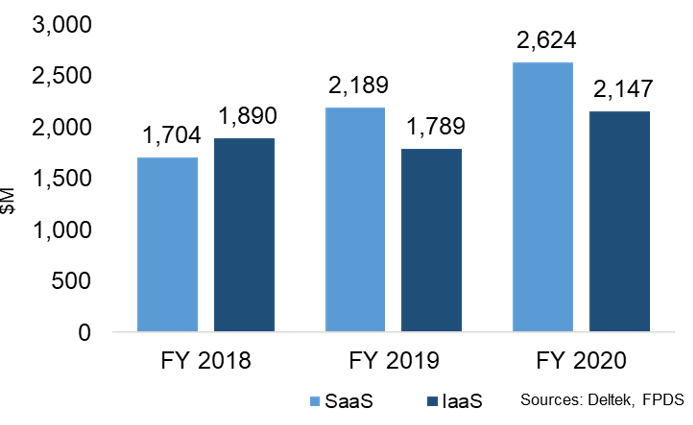
From 2010 to 2018, agency spending on IaaS always outpaced spending on SaaS. Then, in fiscal 2019, the totals for those two service delivery types switched places. For the first time agencies appeared to spend more on SaaS solutions than they did on cloud-based infrastructure. When I first saw this data I thought we should give it another year before suggesting that the consumption of IaaS by the federal government had reached a new level of maturity. That year has now passed and despite the detrimental impact of COVID-19 on the market government spending in favor of SaaS remains intact. It is possible to suggest therefore that according to the data federal agencies appear to have contracted for all of the cloud-based infrastructure they need for normal business processes. The use of SaaS-based capabilities, on the other hand, appears to still be evolving.
Do these trends hold true across all of the government?
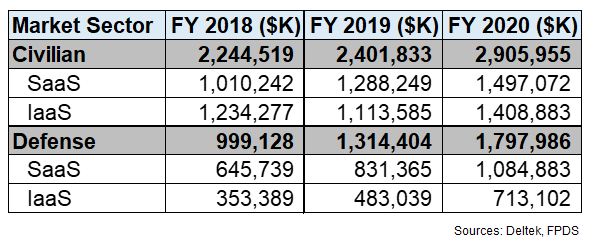
The data above shows clearly that although the gap between the two is narrowing, agencies in the Civilian sector continue to spend more on IaaS each year than they do on SaaS. The Department of Defense, by contrast, still spends more on SaaS than it does on IaaS.
How to explain this discrepancy? The most likely answer is that Defense customers continue to use their legacy computing environments more than commercial cloud environments. This may have to do with feeling more secure using tried-and-true methods, or with bureaucratic inertia, or with a lack of satisfactory options. After all, the whole reason behind the Joint Enterprise Defense Infrastructure (JEDI), contract is to provide IaaS capacity, right? Spending this year and the next will tell if the DOD is on a similar path as the Civilian sector, that is, toward more balance between the use of IaaS and SaaS.