Federal Investment in Quantum Information Science
Published: October 28, 2021
Federal Market AnalysisBudgetDOEInformation TechnologyNSFResearch and Development
The Department of Energy and National Science Foundation will make a significant investment in Quantum Information Science (QIS) in Fiscal Year 2022.
Key Takeaways
- Growth in federal QIS investment promises to offer a growing number of business opportunities at both the DOE and NSF.
- The DOE requested a combined total of $311.5M in budgetary resources for QIS-related work in FY 2022.
- The NSF requested a combined total of $260M in budgetary resources for QIS in FY 2022.
The Government Accountability Office (GAO) recently weighed in on the subject of Quantum Information Science (QIS) and its importance for the future. For those not familiar with QIS, quantum offers a new computing paradigm based on physics capable of doing calculations many times faster than even today’s supercomputers. As QIS evolves past lab-based R&D, new computing platforms will begin to appear in our lives that change everything we do. Artificial Intelligence capabilities enabled by quantum processors will be able to drive our vehicles, automate shipping and logistics, and even fight wars.
All of this is currently theoretical, of course. As the GAO notes, “quantum technologies … will likely take at least a decade and cost billions to develop for more complex uses.” The long-term outlook for QIS should not distract industry from business possibilities emerging today. As the GAO notes in its recent report, “federal agency officials … told us about the need for the U.S. to develop a strong quantum workforce and address supply chain issues in order to maintain its leadership position in quantum technology hardware and software development.”
Establishing and maintaining the national leadership called for by the GAO is going to take a vast level of investment and several agencies are not waiting to dedicate those budget dollars to QIS work. This post provides an overview of the budgets allotted for QIS at the Department of Energy and National Science Foundation. As one might expect, the requirements related to QIS are highly-technical and specialized, so not all industry partners will have the capability to provide support. Many companies, however, do have the expertise and technology to do quantum-related work today. This post is intended to help them understand the market a little better.
Quantum Investment at the Department of Energy
The DOE requested a combined total of $311.5M in budgetary resources for QIS-related work in FY 2022, and as the chart below shows, these efforts span multiple disciplines.
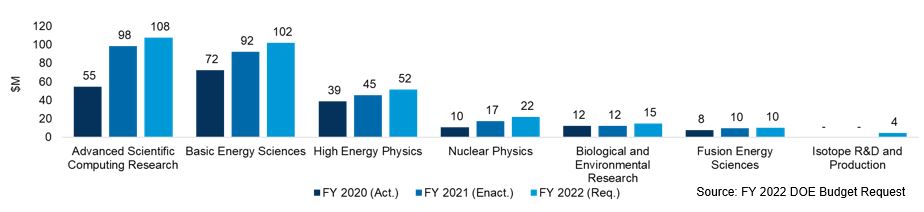
Focusing on the largest program, Advanced Scientific Computing Research (ASCR) supports the discovery, development, and deployment of quantum computational and networking capabilities to analyze, model, simulate and predict complex phenomena. In FY 2022, the ASCR will fund DOE’s five National QIS Research Centers, quantum testbed activities, basic research and the first steps toward establishing a dedicated scientific quantum network connecting the National QIS Centers to the DOE’s 17 national laboratories.
This work will require all sorts of programmatic and scientific support with much of it centered in the DOE’s national laboratories. The labs are run by prime contractors which employ subcontractors so small companies should dig into the GovWin IQ database to find the identities of the contractors running DOE’s laboratories in order to inquire about possible support work.
Quantum Investment at the National Science Foundation
Like the DOE, the NSF also invests heavily in QIS. In fact, the NSF requested a combined total of $260M in budgetary resources for QIS in FY 2022, with the lion’s share of that money going to fund the Mathematical and Physical Sciences program.
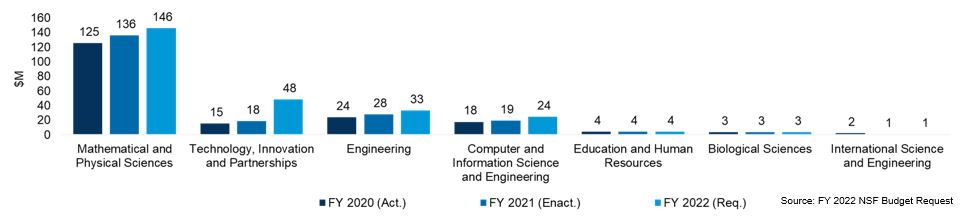
QIS R&D at the NSF explores the ways quantum phenomena can be harnessed to promote vastly increased information processing, transmission, and measurement.
FY 2022 investment in the Mathematical and Physical Sciences program leverages QIS to further the goals of the National Quantum Initiative, including the development of proof-of-concept devices, applications, tools and/or systems. As for the Technology, Innovation and Partnerships program, in FY 2022 it will use its budget to advance quantum science applications to administration priorities, including innovation in biotechnology and climate science. Lastly, the Computer and Information Science and Engineering investments program supports the development of novel quantum algorithms, programming languages, architectures and circuits.
Here again are various areas of work related to QIS that many companies can support. With QIS-related budgets expected to rise and QIS becoming a national security priority, the field promises to offer a growing number of business opportunities at both the DOE and NSF.