Federal Cybersecurity Market Growth is Driven by Diverse Forces
Published: November 03, 2021
Federal Market AnalysisCybersecurity
Multiple factors are driving contracting opportunities to support federal agencies in meeting their cybersecurity priorities.
The federal information security landscape continues to present sustained and complex challenges. Persistent threats, coordinated attacks, rapidly changing technologies, increasing interconnectivity and dependence on technology and data place securing federal information and infrastructure among the highest national security priorities. White House policy directives, legislative mandates, and evolving technologies are converging to drive agency cybersecurity efforts and supporting procurements.
Deltek’s report Federal Information Security Market, 2021-2023 examines the trends and drivers shaping the federal information security marketplace and provides a forecast for the next three years.
Taking a comprehensive perspective on the federal cybersecurity market, we see five major categories of drivers that continue to create demand for government-wide and agency budget investments:
- Threat Environment – The complex and diverse threats to networks, devices, data and infrastructure.
- Technology Policy – Security compliance, standards, and management policies addressing government-wide priorities.
- Acquisition Policy – Information security is a growing requirement within acquisition policy.
- Technology Solutions – Technical remedies to improve security and emerging technologies that require security for greater adoption.
- Organizational and Workforce Strategies - Efforts to establish the leadership, organizations, programs, and skilled workforce to meet the cybersecurity challenge.
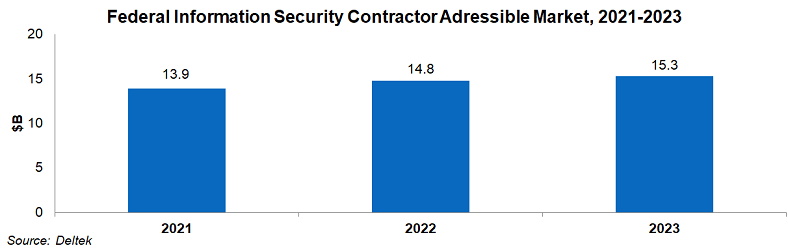
Driven by the plans and efforts to enhance agency cybersecurity postures across the federal government, Deltek forecasts the demand for vendor-supplied information security products and services by the U.S. federal government will increase from $13.9 billion in FY 2021 to $15.3 billion in FY 2023 at a Compound Annual Growth Rate (CAGR) of 4.8%. (See chart below.)
Key Findings
- Budget Growth. Cybersecurity budgets across federal agencies continue to show growth potential, driven by both operational and government-wide cyber policy directives. The DOD topline cyberspace activities budget for FY 2022 shows a modest increase from the FY 2021 level.
- Sweeping Policies. Provisions in the May 2021 White House Cybersecurity Executive Order are having sweeping impacts, driving advances in vulnerability and incident detection; endpoint detection and response; and supply chain risk management, including software security. Supply chain provisions will impact acquisition rules and contract requirements.
- Ubiquitous Zero Trust. Zero trust architectures and supporting efforts permeate nearly every aspect of federal IT and security. High-profile cybersecurity incidents, increased telework and dispersed workforces have coalesced to focus and accelerate pursuit of zero trust capabilities.
- IT Modernization. The pandemic forced agencies to accelerate IT modernization efforts including cybersecurity investments such as Virtual Private Network (VPN) deployments and end-user protections. Government-wide efforts continue to shift the mix of technologies and approaches. Agencies are using Technology Modernization Fund (TMF) projects to fund high-priority cybersecurity enhancements.
- Operational Enablers. Many federal agencies are exploring the use of artificial intelligence (AI) for continuous monitoring across networks, to automate cybersecurity functions and aid decision-making capacity.
- Evolving Industry Standards. DOD’s ongoing review of their Cybersecurity Maturity Model Certification (CMMC) program will likely result in program adjustments. However, the interim DFAR rule adding CMMC requirements remains in effect.
Challenges to progress are compounded by complex federal IT environments, where legacy IT operates alongside modern and emerging technologies. The increased use of mobile capabilities and cloud-based technologies, combined with the pursuit of emerging technologies such as machine learning and artificial intelligence, requires agencies to address current security needs while anticipating future requirements.
Agencies are working to address cybersecurity priorities while in the midst of lingering operational challenges from the disruptive impacts of the COVID-19 pandemic. The paradigm shift to larger remote workforces adds to the challenge. These factors drive the demand for broad technological transformation and cybersecurity modernization efforts that, though challenging, present promising opportunities over the next several years.
Get more of our perspective in the full report, Federal Information Security Market, 2021-2023.