Mobility R&D Programs See a Small Boost in NITRD’s FY 2025 Budget Supplement
Published: December 06, 2024
Federal Market AnalysisInformation TechnologyMobilityNetwork ServicesWireless
Advanced Communication Networks and Systems (ACNS) Program Component Area (PCA) funding receives a 33% increase.
Last week, the Networking and Information Technology Research and Development Program (NITRD) released its annual supplement to the President’s FY 2025 Budget Request.
This article focuses on the Advanced Communication Networks and Systems (ACNS) Program Component Area (PCA) portion that addresses mobility-related technologies.
The ACNS R&D program focuses on communication networks and systems such as wireless, optical or quantum communication technologies and services provided through multiple Interagency Working Groups (IWGs). This includes networking architectures, programmability, resilience, security, interoperability, performance and wireless spectrum capabilities.
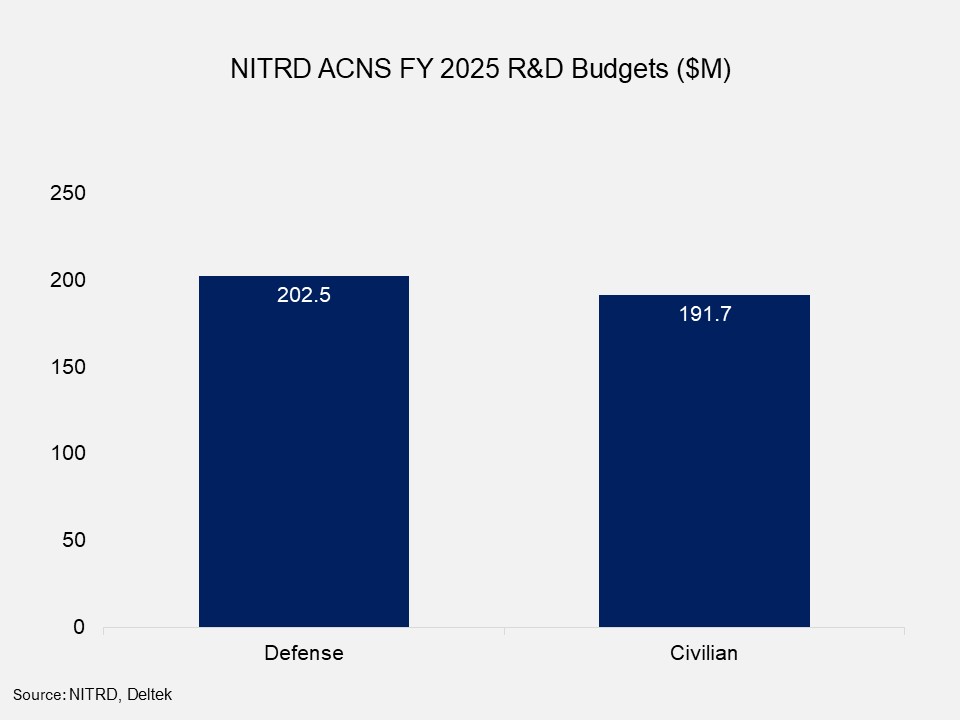
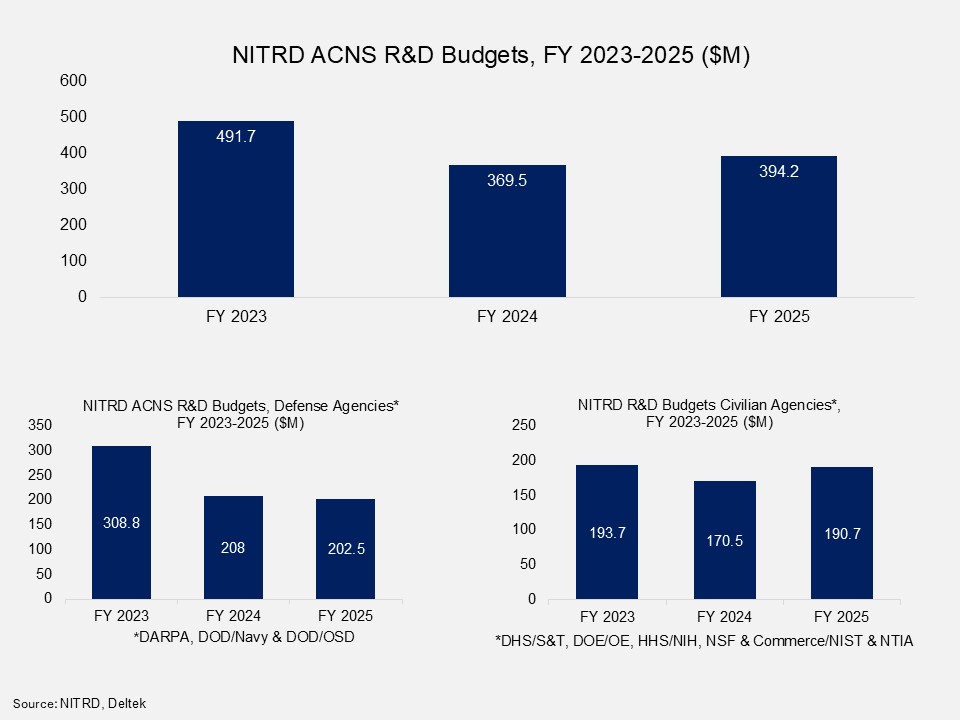
The ACNS requests $394.2M, nearly half of the PCA’s overall $792M budget. This represents a 33.4% increase over FY 2024 and provides a relatively equal distribution among defense and civilian agencies. Agencies providing mobility and connectivity R&D under the ACNS PCA include the Office Department of Defense Office of the Secretary of Defense (DOD/OSD), DOD/Navy, the Defense Advanced Research Projects Agency (DARPA), the Department of Energy (DOE) Office of Electric (OE) Department of Homeland Security (DHS) Office of Science and Technology (S&T), Health and Human Services (HHS) National Institute of Health (NIH), the National Science Foundation and the Department of Commerce National Institute of Standards and Technology and National Telecommunications and Information Administration (NTIA).
-7hSa.jpg)
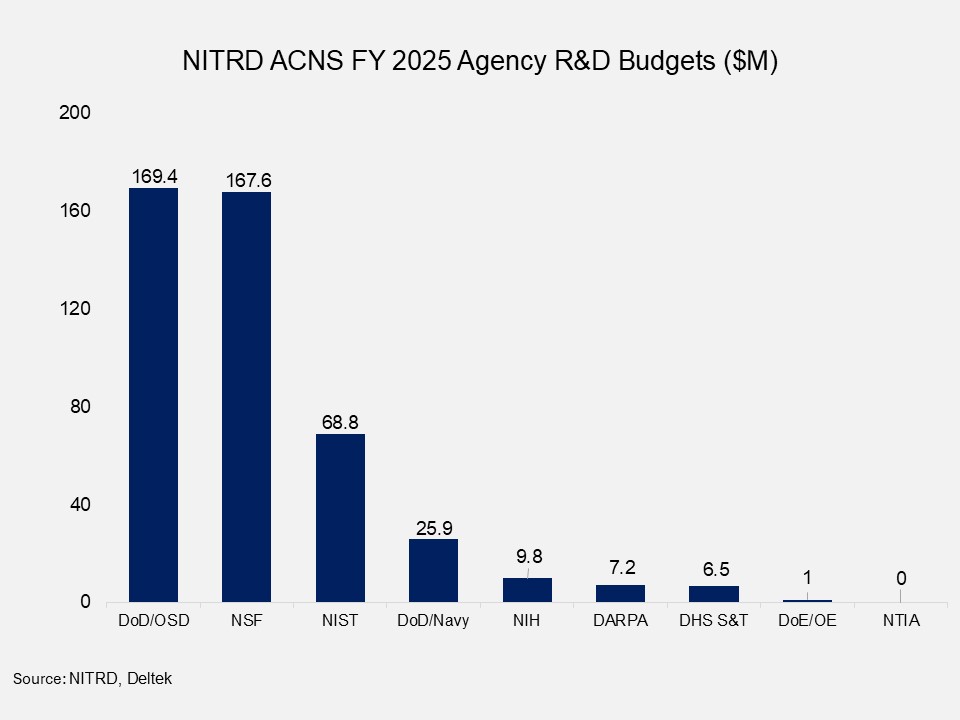
A look at agency distribution shows that Defense agency funding (OSD, Navy and DARPA) continues steadily declining over the past three years. However, the OSD received a $37.8M increase this year resulting from a data collection reporting oversight. For FY 2025, NSF received nearly 43% ($167.6M) of the ACNS budget while DARPA, DHS/S&T, HHS/NIH and Commerce appropriations were significantly smaller. DARPA ACNS funding dropped by $46.2M following the completion of the Data Privacy in Virtual Environments (DPrive) program combined with transitions within the Mission Integrated Network Control (MINC) and Space-Based Adaptive Communications Node (Space-BACN) programs.
ACNS continues prioritizing wireless connectivity and providing equal access to Internet resources through its Interagency Working Groups (IWG), the Large Scale Networking (LSN) IWG and the Advanced Wireless R&D (AWRD) and Wireless Spectrum R&D (WSRD) IWG. The LSN IWG focuses on networking technologies and services, including architectures, network infrastructures, grid and cloud middleware research, and communication protocols. For FY 2025, the LSN IWG program priorities (with participating agencies in parentheses) include:
- Incorporating machine learning and artificial intelligence aspects of feedback-based learning techniques to enhance communication layer adaptation via Convergent Networks. (Navy)
- Bolstering network security protocol authentication, confidentiality and integrity through Tactical 5G implementation and Cryptographic Protocol Analysis and Verification technologies. (Navy and NSA)
- Improving delivery of Evidence-Based Parenting Services and technology needed for families in Child Protective Services to use telehealth. National Institute of Health (NIH)
- Developing predictive models of multi-system diseases through data integration methods using Predictive Analytics via Networked Distributed Algorithms for Multi-System Diseases. (NIST)
- Increasing the nation’s competitiveness in NextG and computing technologies through R&D for Next Generation Wireless measurement science and standards for future-generation wireless systems and Resilient & Intelligent NextG Systems. (NIST and NSF)
- Improving computer and information science and engineering research community access to public cloud resources via CloudBank. (NSF)
- Leveraging Advanced Wireless for Scientific Applications to design and optimize scientific infrastructure, experiments and services. (DoE/SC)
The AWRD/ WSRD IWG coordinates federal spectrum-related R&D activities to guide R&D investments. FY 2025 priorities include:
- Enhancing RF/wireless systems under the Next Generation Wireless/Spectrum Sharing and Sensing program to ensure private, high-speed communication through future networks (6G and beyond) by leveraging, integrating and implementing artificial intelligence and machine learning (AI/ML) technologies including AI Institute for Future Edge Networks and Distributed Intelligence (AI-EDGE) R&D. (NIST, NSF)
- Improving the security and reliability of the nation’s next-generation nuclear reactors and maintaining global stability and security by leveraging the Idaho National Laboratory 5G connectivity and cybersecurity efforts. (DOE)
- Focusing on communication capabilities for first responders by utilizing the Public Safety Communication Innovation Laboratory. (DOE, NIST).
- Transforming spectrum management through strategic research and workforce development and collaboration. (DOD, DOI, NASA, NSF and NTIA)
- Establishing the U.S. economic competitiveness by prioritizing R&D to transition management of the future radio and optical spectrum and improve interagency coordination and deployment of commercial wireless technologies. (NSF, NTIA)
- Accelerating domestic development of 5G and Future G technologies including open Radio Access Networks and open disconnected and software-centric products and solutions. (NTIA, OSD))
Looking Ahead
During his last administration, then President Trump’s goal was to become the leading provider of 5G cellular communications networks, stating “Secure 5G networks will absolutely be a vital link to America’s prosperity and national security in the 21st century.” Considering this, it is not unreasonable to anticipate an upward swing in mobility investments and technologies in the coming years. The NITRD supplement Appendix C provides a more in-depth list of key programs and activities across multiple agencies providing potential contracting opportunities in this market. For more information on federal mobility spending trends, see my previous article Trends in Mobility and 5G Spending FY 2021-2023.
Updated to include Trends in Mobility article.