Escalating Data Center Energy Consumption Drives Future Energy Opportunities
Published: January 08, 2025
Federal Market AnalysisArtificial Intelligence/Machine LearningData CenterEnergy Efficiency
The Department of Energy's (DOE) projected tripled energy consumption rates by 2028 will create contracting opportunities across multiple vertical markets
The accelerated electrical consumption from the surge in data centers and Artificial Intelligence (AI) technologies continues driving the Department of Energy's (DOE) need to develop new ways to meet future energy demands.
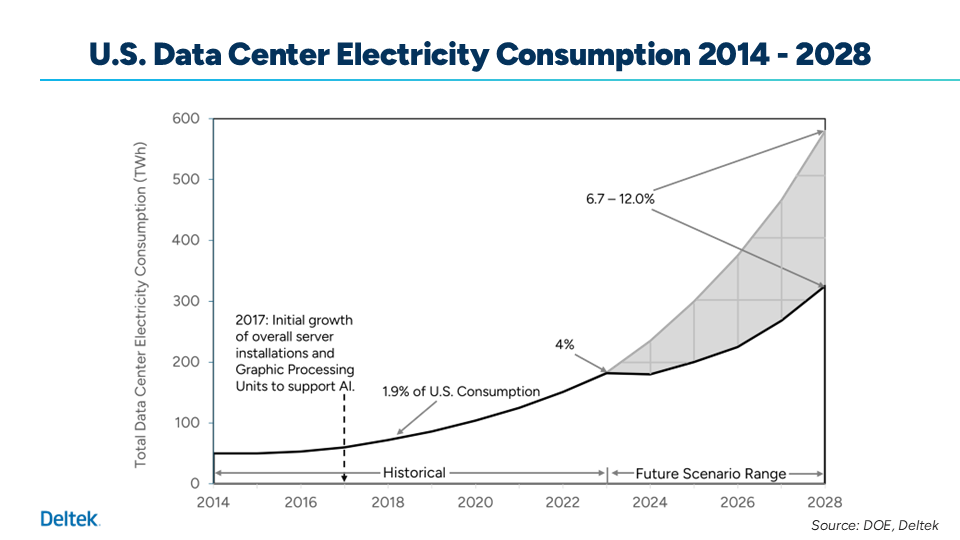
In December, the Lawrence Berkley National Laboratory's (LBNL) 2024 United States Data Center Energy Usage Report showed that the energy demand from data centers had tripled in the past ten years primarily due to AI advancements.
The AI for Energy Report's projected 9% increase in the number of U. S. data centers by 2029 aligns with the LBNL forecast of electrical energy consumption tripling again by 2028. This underscores the strain on the nation’s aging grid and the urgent need for new energy solutions.
“The United States has seen an incredible investment in Artificial Intelligence and other breakthrough technologies over the last decade and a half, and this industrial renaissance has created greater demand on our domestic energy supply,” said U.S. Energy Secretary Jennifer M. Granholm. “We can meet this growth with clean energy. Lawrence Berkeley National Laboratory’s report on data center energy usage crucially underscores why the Department of Energy has developed and is deploying technologies to enable continued economic growth across American industries.”
According to the LBNL report, annual data center energy consumption remained relatively flat between 2014 and 2016. However, in 2017, the growing number of data centers and the installation of accelerated Graphic Processing Unit (GPU) servers to support AI development increased electricity usage to 1.9% of the country’s total electrical consumption. Only five years later, AI hardware requirements helped push the rate to 4.4% in 2023. Based on this, LNBL projects U.S. data center electrical consumption to reach 12% of total U.S. consumption by 2028, three times that of 2017. Furthermore, the computational power loads generated by AI computations, training and usage generates tremendous heat loads, which requires additional electricity for the cooling centers. All of this is in addition to demand from manufacturing and other industries.
In September, I reported on the Department’s need to invest trillions of dollars in of dollars in energy infrastructure to accommodate the burgeoning power demands while achieving clean energy goals. Meeting the rising energy demands is also prompting DOE research and development (R&D) into alternative clean energy sources and cooling methods like liquid cooling. President Elect Trump announced last fall plans to “achieve a massive increase in domestic energy supply.” While details have not been published, the plan could include fewer regulations, reductions or revisions in climate-related policies and clean energy initiatives as well as reduced funding under the Bipartisan Infrastructure Law and the Inflation Reduction Act.
Nevertheless, continued skyrocketing energy demands will create potential contracting opportunities in R&D, infrastructure design, development and construction. These will inevitably lead to prime contracting, subcontracting and embedded IT opportunities in AI and quantum computing development, implementation and utilization. In the meantime, contractors should ensure existing and future data centers remain compliant with federal regulations and reporting requirements while seeking innovative methods to mitigate the drain on the nation’s energy resources.
Subscribers can stay abreast of changing policies, contracting opportunities and strategic planning tips through Deltek's Federal Market Analysis and GovWin IQ products.