Federal AI Spending Trends and Patterns, FY 2023-2025
Published: July 23, 2026
Federal Market AnalysisArtificial Intelligence/Machine LearningInformation TechnologySpending Trends
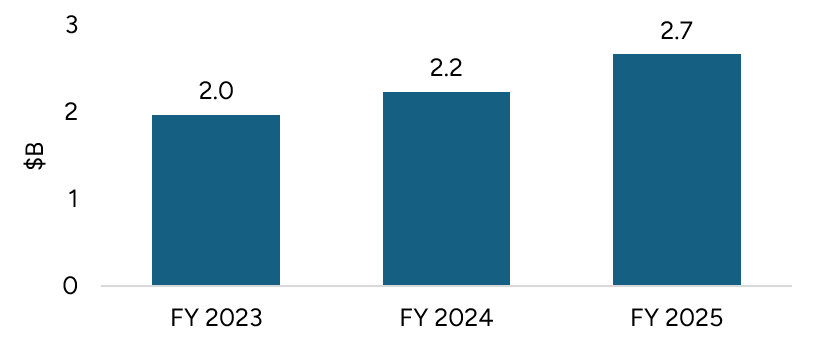
Federal contract obligations totaled $6.9B from FY 2023 to 2025, an increase of 35% over the three-year period.
AI adoption continues to evolve and expand as new applications emerge across industries. This trend is also evident within federal agencies, where 35% spending growth from FY 2023 through FY 2025 reflects increasing investment in AI technologies.
The team conducted its latest annual analysis of AI spending data across three complete fiscal years. Spending trends from FY 2023 through FY 2025 provide valuable insight into how federal agencies invested in AI and offer a glimpse of how AI spending is likely to evolve in the near term.
Total Federal AI Spending, FY 2023-2025
Source: SAM.gov, Deltek
Spending among both the Defense ($5.1B total) and Civilian ($1.8B total) sectors grew among the three years. However, despite AI spending totals centered in the Defense sector, growth among Civilian agencies outpaced that of Defense with a 105% increase vs 17% in the three-year period. The increase among Civilian agencies was driven by both an expansion of AI use among the number of agencies by FY 2025, as well as accelerated growth within top Civilian departments.
AI spending over the three-year period also reflects the continued development and scaling of AI capabilities across federal agencies. For the first time, AI obligations in the IT category led total spending with $3.4B in FY 2023-2025, followed by the R&D category with $3.1B. This swing signals the technology’s shift out of the experimental phase and its operationalization in the federal space. Remaining categories that round out AI spend include Professional Services with $396M in the three years, followed by Defense & Aerospace with $23M.
Analysis of AI goods and services procurements from FY2023 through FY2025 shows agencies used acquisition methodologies relatively evenly. Slightly more than half of all obligations were competed outside of established contract vehicles or schedule programs. Among contract vehicles, Alliant II accounted for the largest share of spending, with $1.8B in obligations.
Moreover, agencies utilized a variety of contract types for AI from FY 2023 to 2025. Cost Plus Fixed Fee obligations totaled $2.4B in the three years, followed by Firm Fixed Price with $2.2B, Cost Plus Award Fee with $1.9B, and Time and Materials with $151M. Note that Cost Plus Fixed Fee and Firm Fixed Price types simultaneously grew in the three-year period, with 55% and 52% increases, respectively. Time and Materials obligations saw a 43% decrease in the three years.
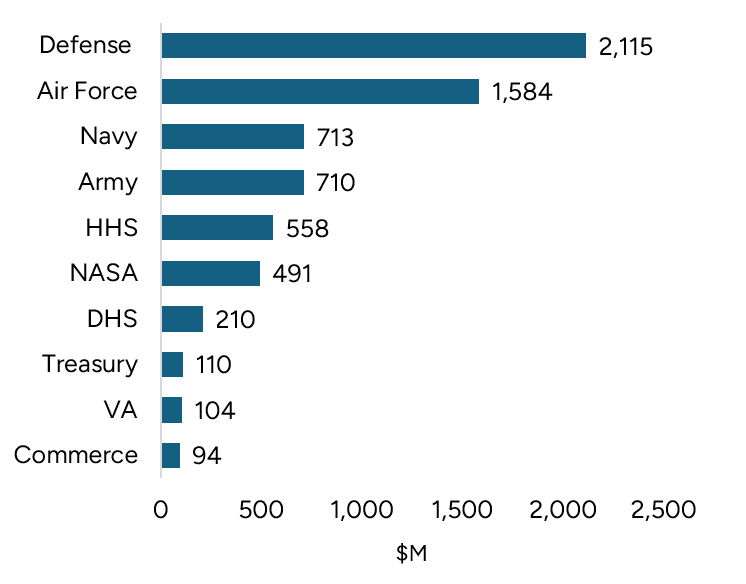
Federal AI Spending by Top Departments, FY 2023-2025
Sources: SAM.gov, Deltek
The top 10 departments represent 97% of total obligations from FY 2023-2025, signifying a continuance in agency AI maturity gaps within the federal space. Those departments that are larger in budget, size and likely with greater AI governance, are spending the most on AI.
Federal agencies which led increased AI obligations within the three-year period include Treasury (+201%), HHS (+174%) and NASA (+147%). Outside of top departments, Energy jumped in AI spending, from $275K in reported obligations in FY 2023 to $9.6M in FY 2025, driven by purchases of Copilot licenses in FY 2025 at the Federal Energy Regulatory Commission and an AI tool under the Secretary of Energy.
Small business awards in AI obligations grew 28% from FY 2023 to 2025, from $717M to $918M. Air Force led in small business awards over the three years with $904M, followed by Defense agencies with $388M. Noticeably, small business awards grew the most among Defense agencies, Army and Navy, with 83%, 88% and 85% growth in the three years, respectively.
For a deeper dive and expanded analysis of historical federal AI spending trends, look for Deltek’s upcoming report, Federal AI Market, 2026-2029, scheduled for publication at the end of August 2026.