IT Spending Prospects in the Fourth Quarter of FY 2026, Part 2
Published: August 06, 2026
Federal Market AnalysisContracting TrendsForecasts and SpendingInformation TechnologySpending Trends
Federal contracting data indicates what IT contractors may anticipate during this federal fourth quarter.
Last week, I reflected on what contractors might expect for fourth quarter (Q4) Information Technology (IT) spending in fiscal year (FY) 2026 if agencies spend 90% of what they spent in all of FY 2025 and made up for typical underreporting in Q3 of this year.
This week, I will look at where we are at the end of Q3 FY 2026 and explore recent monthly trends in Q4 itself. The data below is current through August 5, 2026, as reported by federal agencies.
Total IT Spending Continues to Rise
As I noted last week, total federal IT contract obligations have climbed steadily over the past several years, growing from $105B in FY 2021 to $128B in FY 2025, which was a record year for IT contract spending.
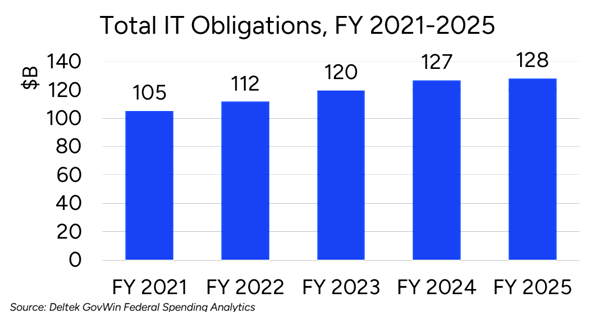
Even with the uncertainty in the market, FY 2025 finished strongly, albeit with a slower relative rate of growth compared to earlier in the period. The question is whether the growth momentum will continue throughout FY 2026, especially in Q4.
Total IT Spending by Fiscal Quarter
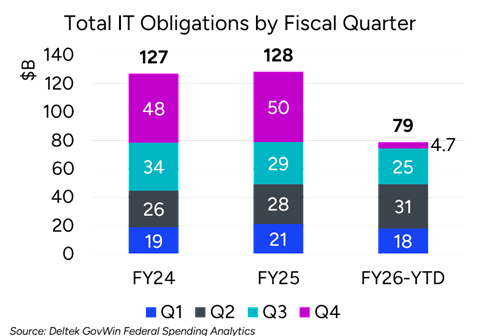
Federal spending on IT grew from $127B in FY24 to over $128B in FY25. It is noteworthy that most fiscal quarters saw growth from FY24 to FY25, except for Q3 FY25. However, Q1, Q2 and Q4 FY25 more than made up for the reduction in Q3. For FY 2026 year-to-date (YTD), spending in Q1 stalled amidst a government shutdown and delayed appropriations, but Q2 gained steam and carried momentum into Q3. Defense reporting traditionally lags by up to three months, so this means that Q3 of FY26 is underreported.
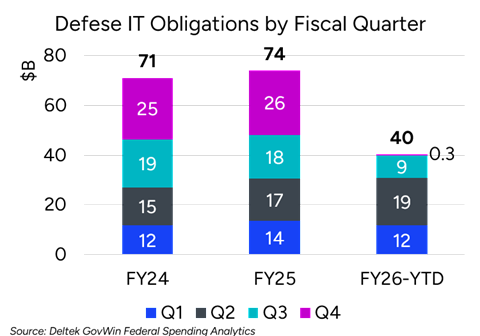
Splitting out Defense IT spending shows that this segment is the dominate portion of the total federal IT market. Defense IT spending accounted for 55-58 percent of total federal IT spending in FY 2024 and FY 2025. Here we see the growth in Q1, Q2 and Q5 of FY 2025 was largely propelled by Defense components. We also see that Q2 continues to be an increasingly strong quarter for Defense IT spending, with $2B in Q2 growth each year. Again, Q3 FY26 for Defense is underreported, likely significantly, and reporting for Q4 (i.e., July) FY26 is only beginning to trickle in.
Focusing on the Civilian segment provides a complementary view. While the Defense segment above grew in FY 2025, the Civilian agencies spent $2B less in FY 2025 than they did in FY 2024. However, the $54B spent in FY 2025 is higher than the $53B Civilian sector reported in FY 2023. Much of the drop in FY 2025 Civilian spending may be attributed to Trump Administration economization and efficiency efforts, including consolidating IT contacts and reduced spending on IT-related consulting services.
Even with quarterly fluctuations from year to year, with $39B in year-to-date FY26 obligations, the Civilian agencies are more than 70% of the way to meeting or beating their total IT spend in FY25.
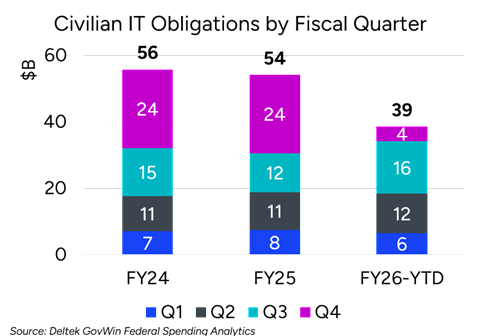
It is also worth noting that at this same point in 2025, Civilian agencies had reported $31B in IT obligations, so FY 2026 Civilian IT spending is already $8B ahead for the year, and Q2 and Q3 were a big part of that. Further, at this point last year, Civilian agencies had reported $1B in July (Q4) obligations, compared to $4B for July 2026. Does this point to a strong Q4 and rebounding FY26 for the Civilian sector? Time will tell.
Federal Fourth Quarter IT Spending in Focus
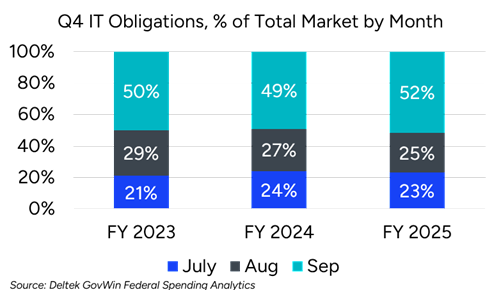
Focusing on Q4 spending specifically, both the Defense and Civilian segments generally follow a similar proportional pattern where roughly 50% of their Q4 IT obligations come in September. In FY 2024, we saw some spending shift to earlier in the quarter, from September and August to July 2024. FY 2025 saw a continued drop in August spending and a significant bump in September spending, relative to the other months of Q4 and compared to previous years.
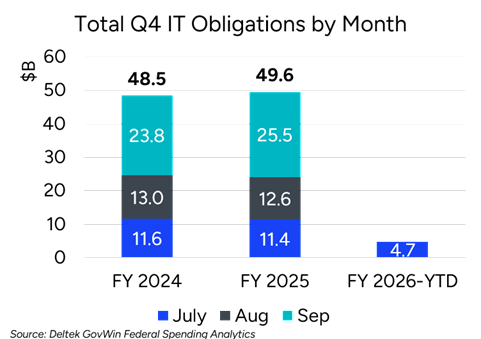
Looking at the IT dollars spent across the federal market, including the Defense segment, FY25 saw 2.2% in topline growth across the market, from $48.5B to $49.6B. This modest growth occurred entirely in September, with July and August showing reductions from FY24 to FY25. Agencies have reported $4.7B in IT obligations in July of FY26.
Breaking out the above data into Defense and Civilian segments provides a view of the relative proportions in total Q4 spending between the two segments.
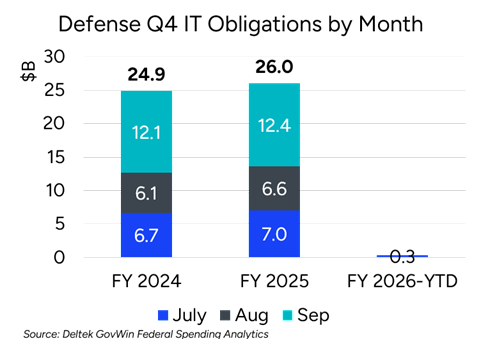
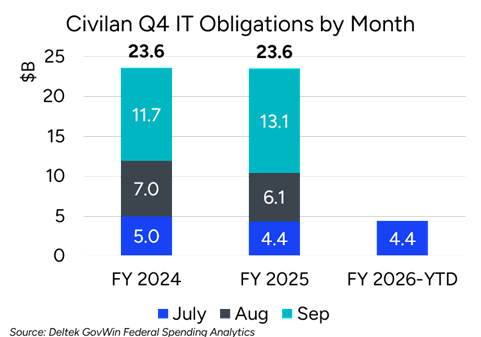
As noted earlier, growth in IT spending in FY 2025 came in the Defense sector and this is evident in each month of Q4 FY25, while the Civilian sector held steady from FY24 to FY25, given a big September.
Looking at FY 2026 YTD, the nominal $300M in Defense IT obligations reported in July 2026 demonstrates the reporting lag mentioned earlier. In stark contrast, the Civilian agencies have reported roughly $4.4B in IT obligations in July 2026, and that puts them on par with July FY25, with some lagging reporting still likely to come.
Final Thoughts
There are several reasons to be guardedly optimistic about the prospects for Q4 and FY 2026 overall. First, so far in FY26, agency IT spending is ahead of where things were at this time last year, totaling $74B vs. $63B in 2025. Some of this is Defense IT spending, but not all. Total Civilian IT obligations for Q1-3 of FY26 is 11% above the FY25 level and 6% above FY24. Even with the reporting lag, Defense IT spending is up +$3B versus this same point in 2025.
If the momentum from Q3 and July carries into August and (more likely) September, Q4 FY26 should be a healthy “busy season” in the federal IT market and FY 2026 should finish well.