SBA's Proposed Size Standard Overhaul Could Reshape Federal Small Business Contracting Opportunities
Published: August 27, 2026
Federal Market AnalysisAcquisition ReformContract AwardsContracting TrendsInformation TechnologyMergers & AcquisitionsNAICS CodesPolicy and LegislationSmall BusinessSubcontracting
Proposed changes would reclassify 114,541 firms as small businesses, reshaping the competitive landscape for existing small businesses.
Updated to include impact matrix.
On August 20, the Small Business Administration (SBA) announced a sweeping overhaul of the Small Business Size Standards that, if adopted, would reclassify 114,541 firms and significantly expand the pool of companies eligible for federal small business programs.
However, the effects on federal agencies, existing small businesses and reclassified firms will differ. A key contention among critics is that the change may improve small business contracting metrics simply through reclassification rather than through increased small business awards. Because the contracts held by the newly classified firms would count toward the statutory contracting goals, agencies could potentially achieve those goals even if the number of traditional small business awards remain unchanged. Further, the proposal does not provide additional set-aside dollars. It only increases the number of firms competing for those dollars.
The SBA published FR-54096, Small Business Size Standards: Revised Size Standards Methodology, which changes how the standards are calculated and applied, and FR-53741, Small Business Size Standards, which details the new standards. Comments on both are due September 21, 2026. Under the Small Business Jobs Act, the SBA must also hold at least two public forums in different U.S. geographic areas as part of the review process before they can revise size standards. If finalized, the proposed rule is expected to be a deregulatory action item under Executive Order 14192.
Overall, the proposed revisions will:
- Reclassify 114,541 firms as small businesses, 37,002 of which are current federal contractors holding 105,665 contracts valued at $71B. If finalized, contracts held by newly reclassified firms would become eligible to count toward agencies’ statutory small business contracting goals and certain subcontracting goals.
- Remove small business status for firms in 24 industry groups, forcing them to compete as large businesses, subsequently reducing contract opportunities.
- Allow small businesses to retain their status longer under the increased caps.
- Expand newly qualified firms’ access to financial assistance programs including SBA 7(a) and 504 loans, Economic Injury Disaster Loans and Regulatory Flexibility Act compliance relief.
- Potentially reduce reliance on mentor protégé relationships, joint ventures and teaming arrangements.
- Protect the small business industrial base by enabling firms to remain eligible for small business programs longer.
Proposed Changes
The size standard methodology update proposes changes to the NAICS code level used to calculate the small business size standards by applying two criteria for justifying the four-digit grouping. Overall, 276 of 297 groups meet at least one criterion, 176 meet both, and the remaining 21 do not meet either and will default to 5-digit-level classification instead. The criteria are:
- Cross-country: The group is at or below the lowest level of the NAICS hierarchy where the U.S., Canada, and Mexico all agree on the classification; currently 189 of 297 eligible groups qualify.
- Cross-reference: The 2022 NAICS manual's cross-references connect every 5-digit industry within the group, directly or indirectly, indicating that a single, unified size standard is appropriate for all the industries nested within that 4-digit group, rather than each 5- or 6-digit industry getting its own separate size standard.

The SBA size standard overhaul merges the annual receipt-based standard and employee-based standards into a single system, reduces the six-digit NAICS codes to a combination of four-digit and five-digit codes and eliminates all subsidiary exceptions. This includes the exception for Information Technology Value Added Reseller (ITVAR) under NAICS 541519. While every NAICS code is not addressed directly in the proposed rule, consolidating industry categories would increase many size standards, some by nearly 3,000%. The proposed rule would not reduce any industry size standard, even where analysis recommended, allowing 45 industries to retain their current standards. The table below provides the changes for select industries.
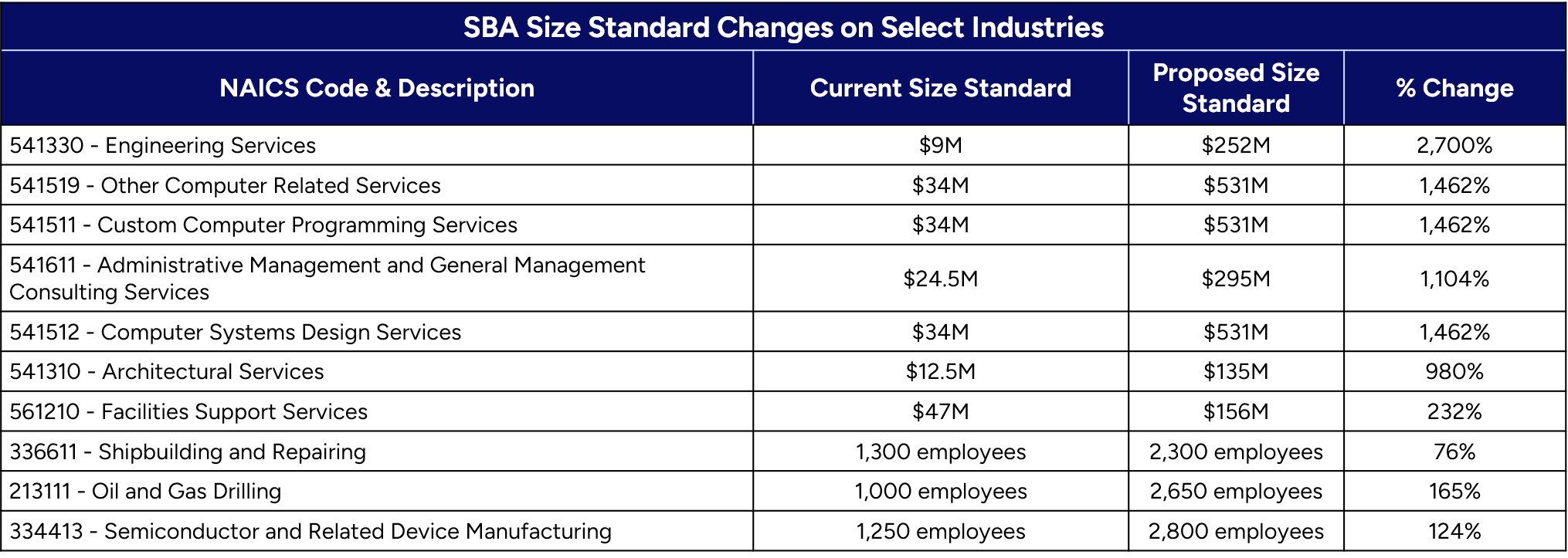
If adopted, the proposed rule will also:
- Move 64 industries from receipt-based standards to employee-based standards and six industries from a mixed basis, reducing the year-to-year fluctuations driven by contract awards; winning a contract increases the receipts, but not the number of employees.
- Combine and increase maximum receipt-based and employee-based thresholds, allowing small businesses to retain their status longer and maintain their small business competitive position; minimum standards would still apply.
- Revise the standard averaging model to ensure size thresholds accurately reflect the realities of local economic competition.
- Add a productivity-growth adjustment on top of inflation versus relying on the five-year cyclical receipt-based inflationary adjustments.
Federal Government Implications
From the government point of view, this will provide a larger pool of qualified small businesses, particularly in industries characterized by rapid productivity growth, such as IT, data analytics, engineering, cybersecurity, and quantum computing, while potentially increasing pricing competitiveness. Although the proposed rule does not explicitly address 8(a), Service-Disabled Veteran-Owned, Women-Owned and HUBZone programs, the expanded contractor pool could help agencies better achieve their mandatory small business contracting goals. Because eligibility for those programs generally requires a firm to qualify as small under its assigned NAICS code, the proposal would indirectly expand the pool of potentially eligible participants.
Streamlined standards will also reduce administrative work for procurement and contracting officials and simplify the evaluation process for loan officers determining eligibility for 7(a) loans.
Contractor Implications
From a federal contractor perspective, however, the revisions will have multiple impacts with mixed consequences, including the following scenarios.
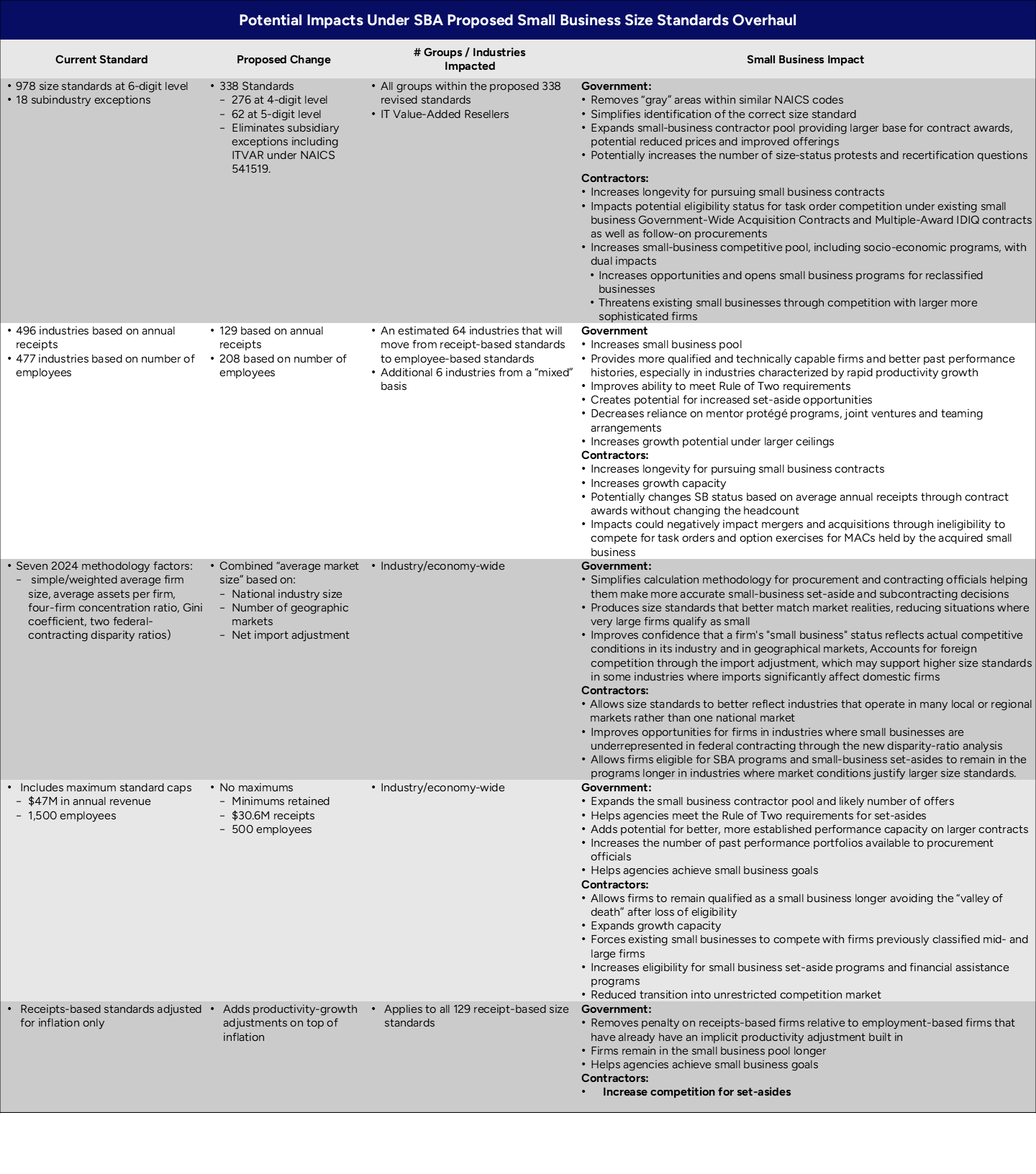
Expanded Competitor Pool
Proposed size standard revisions would expand the small business competitive pool, including socioeconomic program participants. This means firms that have exceeded their current size standards, were previously ineligible or have exited these programs, could qualify to enter or reenter those programs if they meet all other eligibility requirements. This could also affect eligibility for task order competition under existing small business Government-Wide Acquisition Contracts (GWACs) and Multiple-Award IDIQ contracts when size recertification is required or during agency on-ramp competitions and follow-on acquisitions.
While benefiting the newly eligible firms, the changes would force existing small businesses to compete against contractors with more substantial financial resources, larger workforces and more mature proposal development teams. Furthermore, reclassified firms would no longer be dependent upon existing small businesses to participate in small business set-asides, reducing dependence upon mentor protégé relationships, joint ventures and teaming arrangements and potential subcontracting opportunities. These could potentially push existing small businesses out of the socioeconomic programs and the federal contracting marketplace. It may also reduce overall profits for all small businesses due to the increased competition.
Increased Growth Potential
All small businesses would have expanded growth potential under the increased standards, extending eligibility for future contract awards and continued federal revenue, especially those nearing their current ceilings. Increased annual receipt standards will mitigate the double-edged sword from winning contracts; winning contracts increases average annual receipts but not employees. The increased employee-based size standard will enable increased staffing to compete for and perform on larger contracts and allow them to retain their status longer. Firms closest to their thresholds, however, may face the largest challenge from the increased competition.
For example, removal of subsidiary exceptions, including ITVAR under 541519, will place those procurements under the broader 5415 code and replace the current 150-employee size standard threshold with the $531M in annual receipts ceiling under the proposed 5415 industry group. This would increase opportunities for newly reclassified IT resellers.
Mergers and Acquisitions
Size standard changes could also affect how companies that acquire a small business compete for task order awards under GWACs, Multiple Award Schedules (MAS), Multiple Award Contracts (MACs), IDIQs, and other contract vehicles. Previously, when a large contractor acquires a small business, the contractor could continue competing for new task orders under its small business contracts even after being recertified as “other than small” due to the acquisition. In January 2026, the SBA revised the rule reversing that policy and rendering the contractor ineligible to receive task orders, exercise options on MACs following a merger or acquisition occurring after January 17, 2026. Exceptions to this include:
- When two small businesses merge, the resulting firm remains eligible to compete for small-business set-aside MACs and receive option exercises even if the combined size is above the size standard.
- Contractors holding single-award set-aside contracts remain eligible for task order awards and option exercises on those contracts.
Finalization of the overhaul could encourage mergers between small businesses and expand their competitiveness while retaining eligibility for small business programs longer. Conversely, it could reduce the value of their small-business portfolios for firms seeking to acquire the firm. Large buyers may have fewer small business set-aside opportunities following an acquisition. Due diligence in evaluating mergers and acquisitions is an absolute must.
The rule also requires the sellers and buyers to recertify within 30 days of a change in ownership. So, under the proposed rule, large firms seeking to acquire a small business must consider how this affects their ability to compete for future task orders or receive option awards for the acquired contracts.
Future Implications
Typically, these changes do not apply to existing contracts, but contracting officers have discretion to apply new size standards for new acquisitions. The revised standards could become applicable for existing contracts during option exercises and follow-on procurements, but that won’t be known until the revision is finalized. This may benefit contractors nearing their size thresholds by allowing them to maintain their small business eligibility longer.
Acquisition strategies for follow-on contracts and new opportunities could also shift away from existing or planned competition types, especially with increased contracting officer discretion under the small business changes under the Revolutionary Federal Acquisition Regulation Overhaul (RFO). Impacts on mergers and acquisitions, offers and awards and potential procurement scenarios such as contract bundling, during the interim period, remain unknown, creating uncertainty for existing and potentially reclassified businesses.
For now, firms must submit their comments before the September 21st deadline to influence final decisions. Ensure compliance with all current size standard requirements and explore mitigation strategies should the revisions be adopted.
See the attached document for tables of proposed categories and excluded industries.