Could FY 2026 Be A Record Year for Federal Contract Spending?
Published: August 20, 2026
Federal Market AnalysisArchitecture, Engineering, and Construction (AEC)Contracting TrendsDefense & AerospaceForecasts and SpendingInformation TechnologyOperations and Maintenance (O&M)Professional ServicesResearch and DevelopmentSpending Trends
The data for FY 2026 so far shows strong agency spending across most contracting categories, with signs emerging for a strong fourth quarter.
At this time of year, many in the federal contracting marketplace are contemplating how the current federal fiscal year will finish and whether agencies will spend a bunch in the fourth quarter, as has been the case historically.
Over the last several weeks, I have been examining federal contract spending data around information technology (IT). First, I considered what contractors might expect for Q4 FY26 IT spending if agencies spend 90% of what they spent in all of FY 2025, adjusted for quarterly fluctuations and any underreporting in Q3 of this year. Second, I looked at the spending status at this point in FY 2026 and monthly trends in Q4 to put some data behind expectations and get a sense of the potential opportunity. Then I explored potential Q4 FY 2026 IT contract spending with small businesses in particular.
This week, I will zoom out to look at the total federal contracting market across all goods and services categories to assess how the market has performed over the last few years and how FY 2026 is looking so far. Spoiler alert: FY 2026 is showing signs of a strong year overall, and the fourth quarter (Q4) so far is tracking ahead of last year at this point in the quarter.
Total FY 2026 Contract Spending is Running Ahead of FY 2025 Levels
Total federal IT contract obligations have climbed steadily over the past five years, growing from $662B in FY 2021 to $813B in FY 2025, which was a record year for federal contract spending. The one year that saw a reduction over this period was FY 2024, which came in at $1.2B below FY 2023. This reduction was due to a $8.2B drop in Defense spending, which the $7.0B increase in Civilian spending could not overcome.
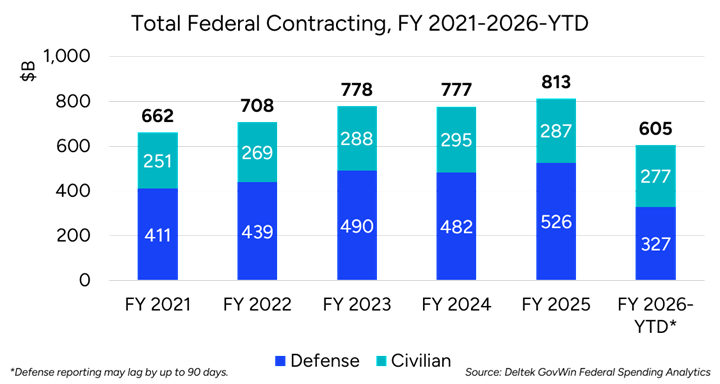
With the (some might say surprising) strong performance in FY 2025 in the rear-view mirror, the question turns to how FY 2026 is looking so far? Through mid-August of this year, federal agencies have reported $605B in total obligations. Defense reporting traditionally lags by up to three months, so this means that FY26-YTD is underreported.
At this point in 2025, total reported contract obligations were running in the $456B range – $259B for Defense and $197 for Civilian – so at the total market level we are roughly $150B ahead of where we were a year ago, and that upward trend is true for both the Defense and Civilian segments. Looking at the chart above, we see that Civilian agencies are currently within $10B of what they spent in all of FY 2025. With six weeks left in the fiscal year, it is conceivable that the Civilian segment could exceed FY 2025 levels. Given the Defense reporting lags, it is still too early to tell how that segment will perform. However, given the influx in defense funding from the One Big Beautiful Bill Act, which the Pentagon plans to spend by the end of 2026, we could also see a record FY 2026 in the Defense segment once the data dust settles.
Total Contract Spending by Fiscal Quarter Points to a Strong Q4 FY 2026
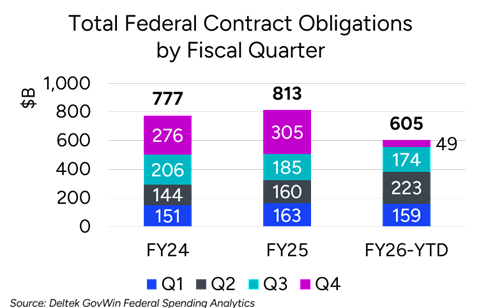
Federal contract spending grew from $777B in FY24 to over $813B in FY25, and the FY25 growth came across all quarters except Q3. Even with the $21B Q3 drop, Q1, Q2 and Q4 of FY 2025 more than made up for the reduction.
For FY 2026 year-to-date (YTD), spending in Q1 stalled amidst a government shutdown and delayed appropriations, but even with the FY 2026 shutdown headwinds Q1 was only $4B below Q1 FY25 and $8B above FY24. Further, Q2 FY26 added $233B in obligations to put the Q1-Q2 FY26 level more than $33B above the FY25 level. It is possible that some of that Q2 FY26 spending boost also got an early start on spending that might have otherwise come in Q3, given the year-to-year $9B reduction in Q3 FY26 from FY25. The $49B in spending for Q4 FY26 YTD puts the current year’s spending more than $20B above the Q4 FY25 spending at the same time last year, and that bodes well for a strong finish to FY 2026. As noted above, total FY25 contract obligations reported at the same time last year was $456B, compared to $605B this year, so we are about $150B ahead for FY26 YTD.
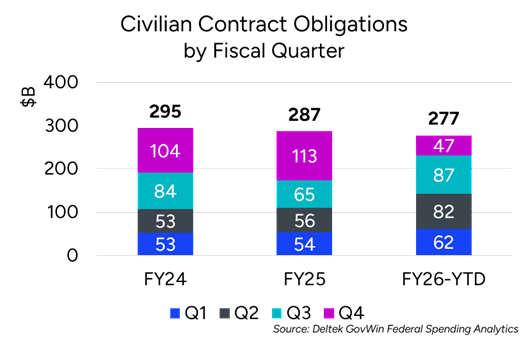
Breaking out the contract spending between Civilian and Defense segments gives a bit more granularity, even with the traditional Defense reporting lags, which means that Q3 and Q4 of FY26 is underreported.
Looking at Civilian spending, we see that FY25 came in $8B below FY24. Even with a huge Q4 of $113B that level could not fully overcome the $19B drop in Q3 from the FY24 level. FY 2026 is a different picture. Even with the shutdown that began FY26, Civilian agencies reported increase spending in Q1 and Q2, and that momentum continued into Q3 and Q4. Civilian agencies had reported roughly $24B in Q4 FY25 obligations at this time last year. In Q4 FY26 YTD, Civilian agencies have reported $47B in total obligations – nearly double what was spent at the same point in FY25.
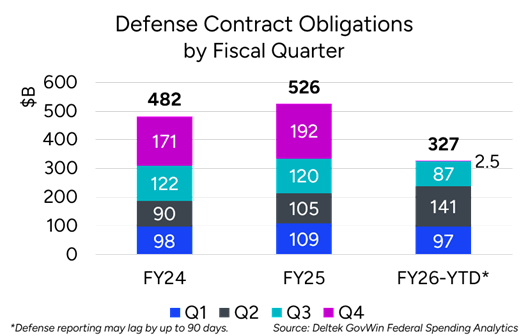
The Defense segment is a bit more sporadic and challenging to interpret, given the reporting lag. As shown in the FY21-26 chart above, FY 2025 was a record year for Defense contract spending at $526B, and all quarters showed strong growth except Q3, which had a relatively slight $2B reduction.
The FY 2026 picture, as it develops, appears to show that Q1 spending is around the FY24 level while Q2 came in very strongly by historical comparisons. The $238B in aggregate Q1 and Q2 FY26 Defense spending is $24B above FY25 spending for the same quarters. Looking at Q3 and Q4, at this point in FY25 Defense reported roughly $44B and $1.8B for Q3 and Q4, respectively, compared to $87B and $2.5B so far in FY26. So even with the reporting lag that vary from year to year, Defense contract spending for Q3 and Q4 FY26 is $43B ahead of FY25 levels at the same point in the year.
Finally, comparing Q1-Q3 aggregate contract spending from FY 2024 through FY 2026 YTD shows a picture of a resilient and robust contracting market across both segments, with FY 2026 on its way to potentially being another record year. Even with the reporting lag that understates its Q3 FY26 obligations, the Defense segment is well within striking distance to top FY 2025 level, and the Civilian segment has exceeded Q1-Q3 FY25 aggregate spending by more than $55B.
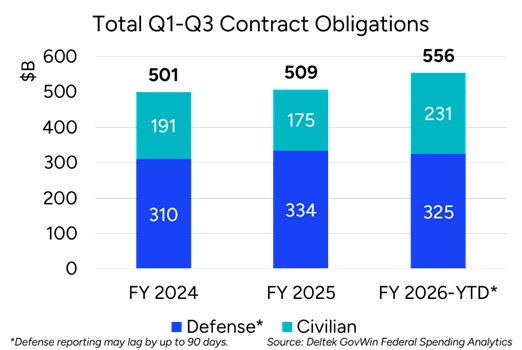
At this point last year, Civilian and Defense agencies had reported $173B and $257B in aggregate Q1-Q3 contract obligations, respectively, so the FY26-YTD reported spending levels for both Civilian and Defense segments are well above where agencies were for Q1-Q3 FY25 as reported at this point in the fiscal year last year, even with the Defense reporting lag impacting FY26-YTD. The Civilian segment is $58B ahead and Defense is $68B ahead for aggregate Q1-Q3 spending.
Civilian Segment Q4 FY26 Spending So Far Points to a Strong Finish
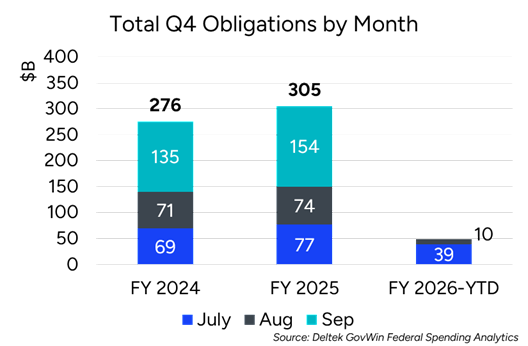
Zeroing in on Q4 spending specifically, total federal contract obligations in Q4 for FY 2025 grew by nearly $30B compared to FY 2024, with each month of the quarter showing strong gains over the previous year.
For Q4 FY26-YTD, (i.e.,. July through mid-August), agencies have reported $39B so far, but that is understated due to the Defense reporting lag, which we will see below.
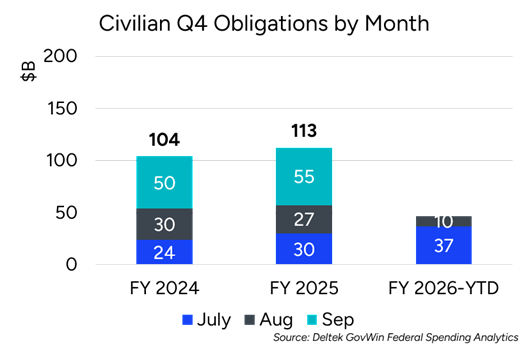
Disaggregating the Civilian and Defense segments reveals what a strong Q4 may be underway for the Civilian segment, provided the spending momentum continues through the remaining weeks of the quarter. At $37B in spending in July FY26, Civilian agencies have exceeded their July FY25 spending of $30B. They have also reported $10B in August FY26 obligations to date, compared to $27B in August of last year, so about halfway through the month August is looking reasonably strong.
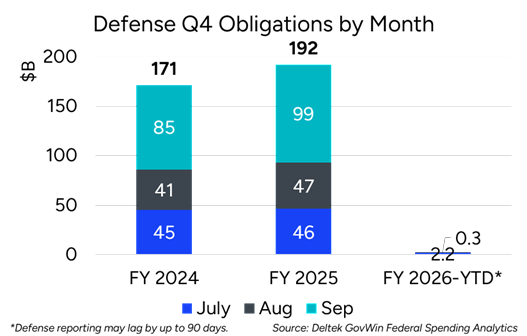
The Defense segment also performed well in Q4 of FY 2025, compared to FY 2024, including a very strong $14B bump in September 2025. We will not likely get a decent view of how Q4 FY26 will turn out until well after the end of the fiscal year, but so far in July and August we are seeing roughly $2.5B in spending reported, clearly demonstrating their well-known reporting lag.
Federal Agencies Continue Spending on Their Top Categories
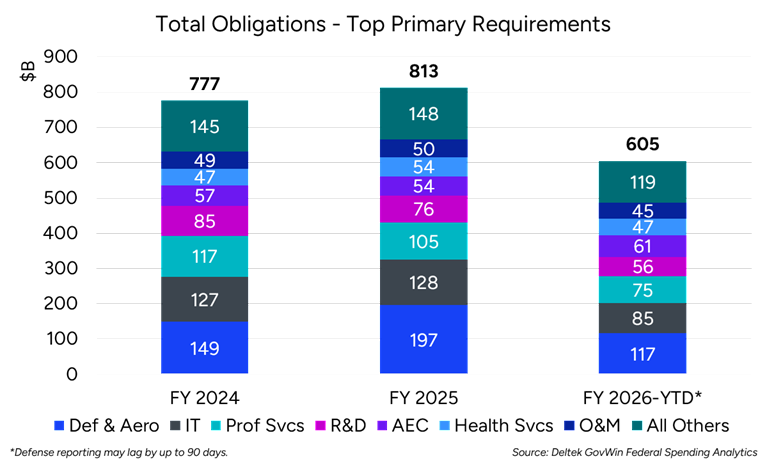
Breaking down the spending by the primary requirement funded under federal contracts shows that agencies remain consistent in the main categories for which they seek contracted goods and services. Across the market, the top primary requirement categories are Defense and Aerospace, Information Technology (IT), Professional Services, Research and Development (R&D), Architecture Engineering and Construction (AEC), Health Services and Operations and Maintenance (O&M).
For FY 2025, agencies reported increases from FY 2024 in each of these top categories except Professional Services, R&D, and AEC, which fits with many of the policy and organizational priorities and changes initiated by the Trump Administration. The current fiscal year is off to a decent start, with each of the top categories appearing well within the range to meet or exceed their FY 2025 levels. Time will tell.
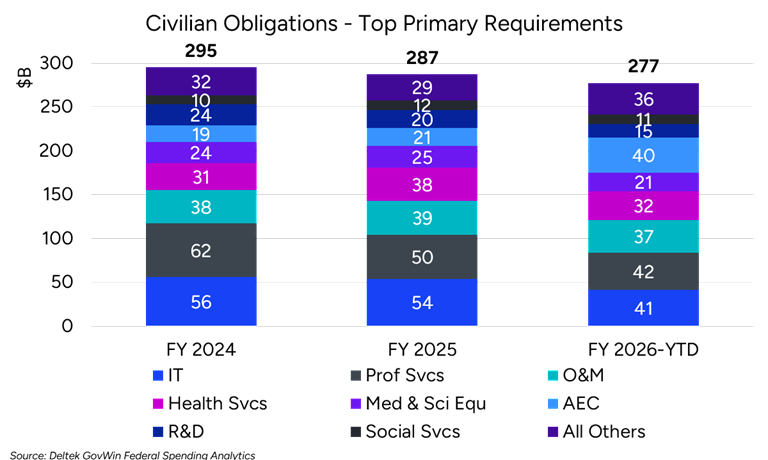
Examining Civilian agency spending separately shows FY25 spending gains among O&M, Health Services, Medical and Scientific Equipment, AEC, and Social Services, while IT, Professional Services, and R&D saw reductions. Given the administration’s economization efforts to reduce Professional Services contracting it is no surprise that FY25 spending under this category fell by $12B, marking P.S. reductions as the major reason that total FY25 obligations came in $8B below FY24.
For FY26-YTD, each of these top categories are well within reach of their FY25 (or even FY24) levels. It is noteworthy that Civilian AEC spending so far in FY26 has already exceeded the final FY25 level and has more than doubled total AEC spending in FY24.
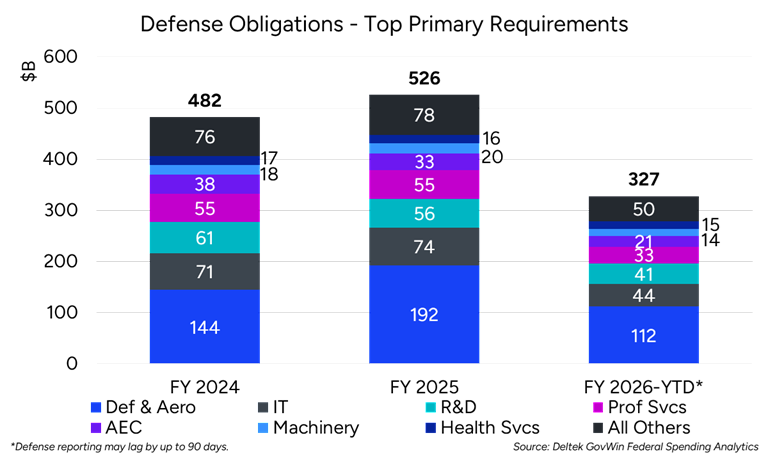
In stark contrast, Defense segment spending across its top categories in FY 2025 outperformed FY 2024 levels almost across the board, leading to historically high contract spending for the segment. Only R&D, Health Services and AEC saw mostly modest declines as spending shifted mostly to the Defense and Aerospace area to support readiness priorities.
Turning to FY26-YTD, if we consider that just $2.5B in Defense obligations has been reported in Q4 so far, then the $327B in FY26-YTD spending points to a strong FY26 overall.
Closing Thoughts
While it is still too early to tell how FY 2026 will finish out and how it will stack up to previous years, based on the reported contracting data so far it appears to be tracking very well across both the Civilian and Defense segments. From most angles, both segments are ahead of where they were at this same point in the last fiscal year, so that is a promising signal. Yet, as usual, a strong performance in the remainder of Q4 will be the ultimate key to strong full fiscal 2026. Both segments are ahead of where they were at this point in FY 2025 – especially the Civilian segment – so time will tell if we might be on track to attain another record year in federal contracting.