GAO: Military should seek more money for facility maintenance
Published: September 10, 2026
USAFArchitecture Engineering and ConstructionARMYDEFENSEUSMCNAVYOperations & Maintenance
By not requesting enough money, the result is an estimated $285 billion in maintenance backlogs in FY 2025.
With continuous use, military facilities across the globe have slipped into poor conditions, but the War Department and military services have not requested full funding for facility maintenance needs, according to a new report.
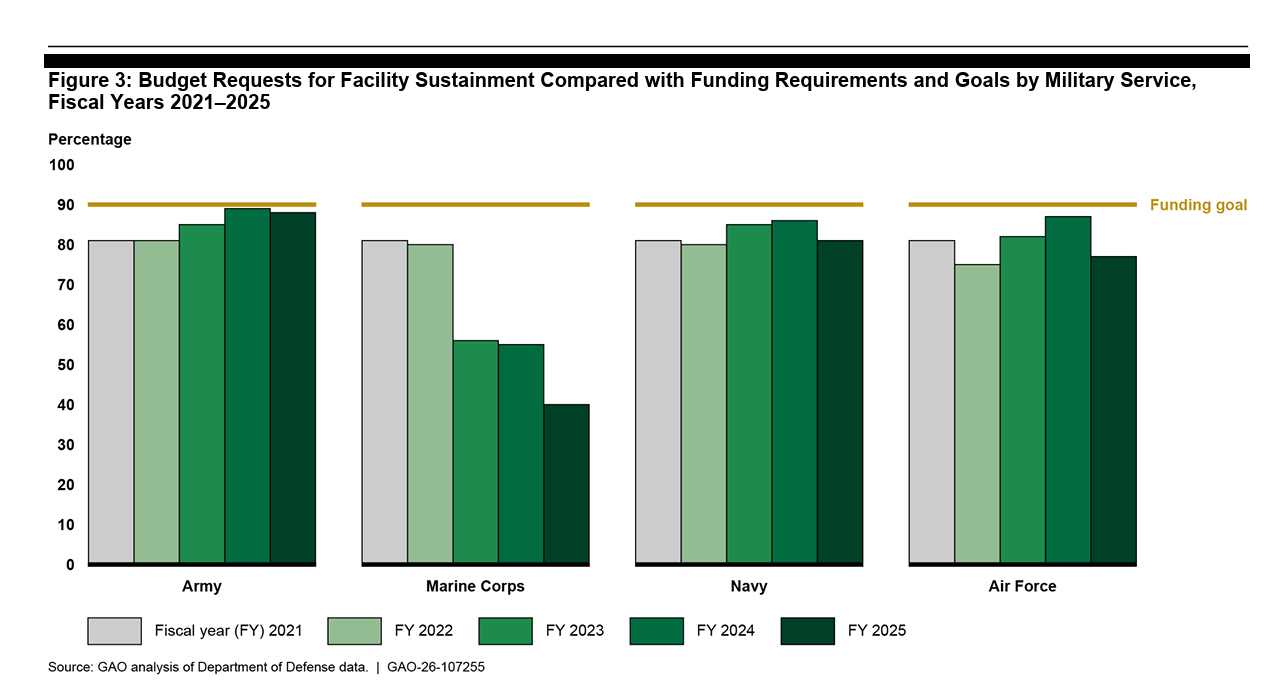
The Under Secretary of Defense for Acquisition, Technology, and Logistics issued a memorandum in 2014 on sustainment. The services should seek to fund regular maintenance to at least 90 percent of the amount estimated by the Facilities Sustainment Model (FSM). The Government Accountability Office reported that the military services fund about 80 percent of these needs. The result has led to an estimated $285 billion of maintenance backlogs in FY 2025, according to the August 2026 GAO report.
“By requesting less funding for installation maintenance and improvement projects than its models and experts recommend, DOD has chosen to accept some degree of risk that mission or quality of life will be negatively affected,” GAO reported.
Based on data, GAO found:
- Army. Roughly $140 billion in valid military construction and facility repair projects that have not yet received funding as of April 2025.
- Navy. About $70 billion in military construction requirements and $37 billion in repair project requirements as of April 2025. The figures do not include the Marine Corps. Navy officials also stated that the backlog is larger than has been measured. The provided list of projects are only requirements that have been identified as valid.
- Marine Corps and Air Force. Neither have measured unfunded military construction and facility repair needs. Officials said there were substantial unfunded needs as of May 2025.
Where the money goes
- Army. These installations had the highest average sustainment funding, as Fort Benning in Georgia received 83 percent of the level recommended by FSM and Fort Wainwright in Alaska received 78 percent.
- Navy. Naval Base Guam received 62 percent, and Naval Station Norfolk received 61 percent of FSM-recommended funding.
- Marine Corps. Twentynine Palms in California received 59 percent and Marine Corps Base Hawaii received 60 percent of the FSM recommendations.
- Air Force. These installations had the lowest reported facility sustainment funding levels, with Andersen Air Force Base in Guam receiving 37 percent and Minot Air Force in North Dakota Base receiving 40 percent of the FSM recommendations.
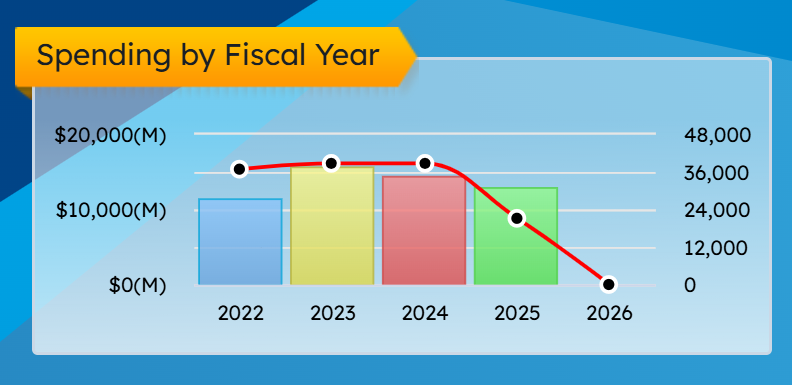
Contract spending for facilities maintenance and improvements reflect the same trends. Reviewing GovWin Defense contract spending over the past several fiscal years, military spending has decreased from FY23 to FY25. The department awarded more than $145 billion with spending slipping to $123 billion in FY25.
The department and military services awarded 14,006 contracts in FY23 and 12,025 contracts in FY25. All the military services followed the same decrease since FY23, despite a slight U.S. Air Force spending increase in FY24.
The contract dollar value is largely less than $1 million, followed by contracts valued between $1 million and $10 million.
Spending remained steadier through Task Order awards over the same period. The largest amount of spending was awarded through the Logistics Civil Augmentation Program (LOGCAP) contract vehicle, followed by GSA Multiple Award Schedules.
The Army is beginning the process of soliciting LOGCAP VI. A Solicitation is anticipated to be released in FY27. See GovWin Federal Tracked Opp 254094: LOGISTICS CIVIL AUGMENTATION PROGRAM VI (LOGCAP VI) for more information.
Unlike previous iterations, the Contracting Office has confirmed they intend to release a separate Solicitation for the Small Business requirement in the future. GovWin Federal Tracked Opp 267106: LOGISTICS CIVIL AUGMENTATION PROGRAM VI SMALL BUSINESS SUITE (LOGCAP VI SBS) has the latest information. A Solicitation timeframe is unclear.
Military officials agreed with GAO's recommendations regarding funding and FSM.
In all, service officials told GAO that interim fixes cost more in the end.
“The long-term costs for maintaining aging facilities are more than the short-term costs DOD saves through lower budget requests for improvement projects that would renovate or replace these facilities,” the report states.