Market Update: Q1-Q2 OTA Spending in FY 2026 vs. FY 2025
Published: August 26, 2026
Federal Market AnalysisUSAFARMYDEFENSENAVYOther Transaction Agreements (OTAs)Policy and LegislationSmall BusinessSpending Trends
DOD is getting better at using OTAs.
Soon after the second Trump Administration came into office, it directed the Department of Defense (DOD)* to begin making greater use of Other Transaction Agreements (OTAs) and Commercial Solutions Openings (CSOs) to rapidly award contracts for commercial products and capabilities. This directive eventually translated into a November 2025 memorandum from the Secretary of Defense (SecDef) focused on accelerating the procurement of prototypes and capabilities for the warfighter using OTAs.
Approximately ten months have passed since this memorandum was released, providing sufficient time for data on OTA-related procurement to be reported for the first half of fiscal year 2026. This week’s article reviews that data to see if DOD components have responded to the SecDef’s directive.
Q1/Q2 OTA Spending
Here is the data for the reported spending on OTAs in the first half of FY 2025 vs. FY 2026.
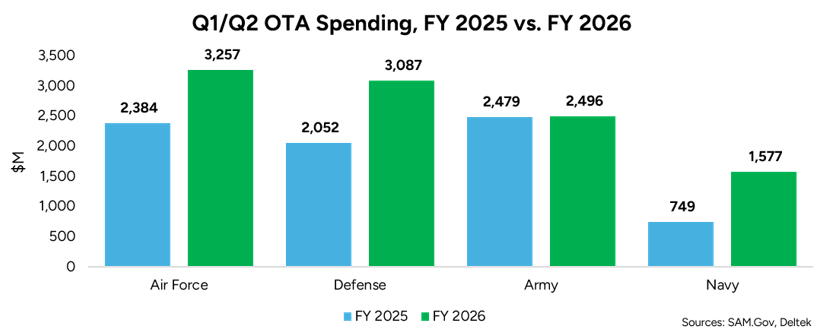
Total first half fiscal year OTA spending in FY 2025 came to just under $7.7B. In FY 2026, that total rose by 35% to $10.4B. The chart shows clearly that except for Army, all of the DOD dramatically increased OTA spending.
Q1/Q2 OTA Contract Actions
When it comes to the total number of contract actions, meaning dates when funding was obligated for work in progress, the first half of FY 2026 also exceeded the same period of FY 2025 by 9.3%. This metric indicates increased activity that translated into higher spending.
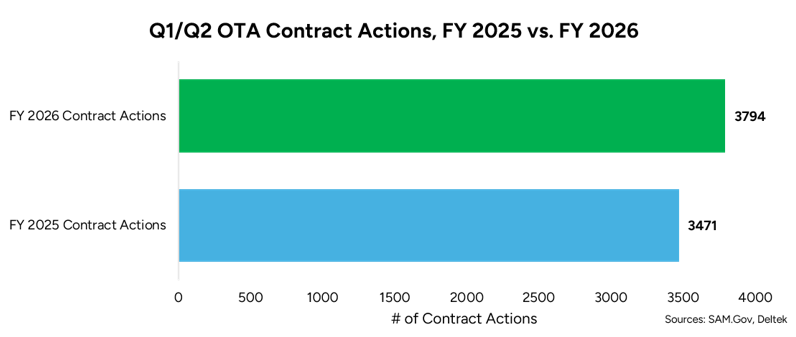
The increase has been most marked among the agencies of the Fourth Estate. Contract actions for them totaled 1,311 in FY 2025. By the end of Q2 FY 2026 that number had risen to 1,642. The Air Force also increased its contracts actions from 611 to 708, while the Navy’s contract actions ticked only slightly upward from 624 to 626. Conversely, the number of contract actions initiatied by Army customers fell from 925 to 818, confirming the stagnation in spending visible in the first chart.
Q1/Q2 OTA Spending by Business Size
When it comes to spending by business size, the data shows that obligations to businesses which are other than small far outpaced those to small businesses in both fiscal years. The gap grew even wider in FY 2026.
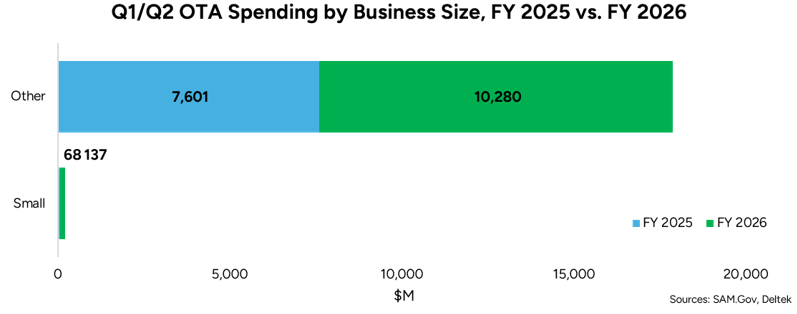
These results are somewhat disturbing given that OTAs were supposed to smooth the entry of innovative small businesses into the defense contracting market. The good news is that at least the amount of spending with small businesses doubled from the first half of FY 2025 to the equivalent period in FY 2026, but the massive discrepancy between spending with smalls and other than smalls makes this improvement feel like damning with faint praise.
Q1/Q2 Top 10 Contractors by OTA Spending, FY 2025 vs. FY 2026
Lastly, here is the data for OTA earnings by top 10 contractors.
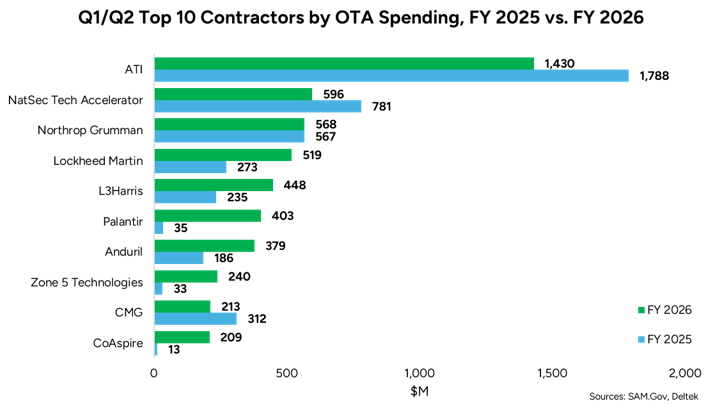
This chart shows to whom the lion’s share of OTA contract obligations are going. These names generally move up and down the list year to year so the data shows the top ten contractors by obligations in Q1/Q2 FY 2026. I then added the Q1/Q2 totals for these same contractors from FY 2025. Doing so reveals the following details.
First, Palantir has become a much bigger name in this space, with its first half OTA obligations totaling only $33M in FY 2025 before blooming to more than $400M in FY 2026. Next, Zone 5 Technologies and CoAspire saw similarly large rises. Anduril also earned more in FY 2026, but less so compared to the aforementioned companies.
By contrast, some of the contractors shown, such as Advanced Technologies International (ATI), the National Security Technology Accelerator, and Consortium Management Group saw their obligation totals fall in the first half of FY 2026 compared to the same period in FY 2025. They nevertheless remained at the top of the group.
Final Thoughts
This data shows, if anything, that the DOD has generally responded to the SecDef’s November directive by increasing the use of and spending on OTAs. Spending by the Army would be the exception, which is strange considering how Army customers have used OTAs more than most of the other parts of the DOD for several years now. Generally speaking, however, it seems clear that the DOD is getting better at awarding and spending on OTAs. This makes paying attention to the advertisement of OTAs critical for contractors who want to compete in this space.