How Are Shutdowns Impacting DHS Contract Spending?
Published: February 20, 2026
Federal Market AnalysisArchitecture, Engineering, and Construction (AEC)Contracting TrendsDHSInformation TechnologySpending Trends
Contract spending data from the first shutdown period of fiscal year 2026 points to the potential implications of the current one that is underway.
The Department of Homeland Security (DHS) and other federal agencies began fiscal year (FY) 2026 under a shutdown that spanned from October 1 to November 12, 2025. As of February 14, 2026, DHS alone is now under its second shutdown, as the debate over funding and policies for the department continues among both parties in Congress and the White House.
DHS Contract Spending and Shutdown Impacts
How do these shutdowns affect contract spending during the shutdown and the period immediately following? Contract spending data gives some insight.
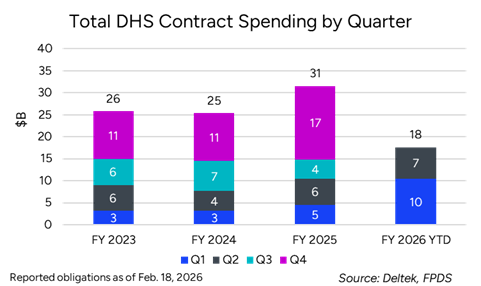
First, the data shows that DHS reported a record level of spending in FY 2025 at $31B in total contract obligations, $17B of which came in Q4. This Q4FY25 jump was driven by nearly $191B in DHS funding provisions in the One Big Beautiful Bill Act (OBBBA), a.k.a. the FY 2025 budget reconciliation bill.
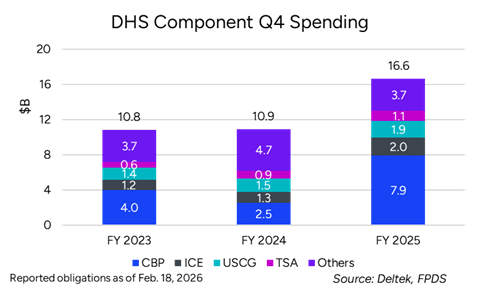
Of the $17B in Q4FY25 spending, Customs and Border Protection (CBP) and Immigration and Customs Enforcement (ICE) accounted for $7.9B and $2B, respectively, which together is 60% of the Q4FY25 total. CBP reported $4.2B in December 2025 alone.
DHS Component Contract Spending In Q1 of FY 2026
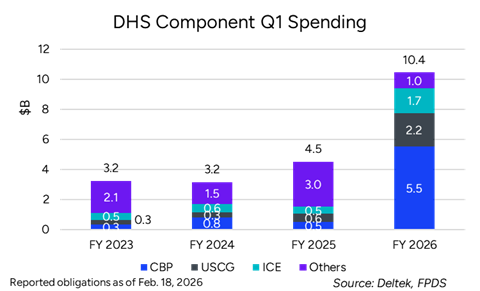
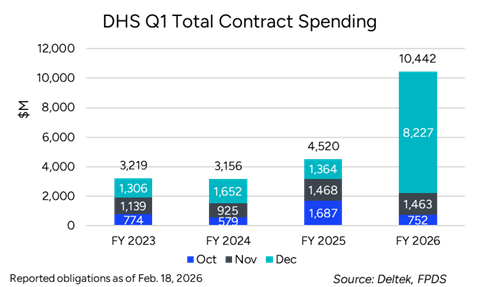
Shifting focus to Q1 of FY 2026, at a high-level DHS spending appears to have sustained the momentum of Q4FY25 and mitigated much of the impacts of the 43-day shutdown, with $10.4B in reported Q1FY26 contract obligations. CBP, US Coast Guard (USCG) and ICE all reported huge spending increases compared to previous Q1s for recent years.
These Q1 spending increases above were all focused on current operational priorities among essential DHS functions:
- CBP spending was focused on Architecture Engineering and Construction work for boarder infrastructure
- USCG spending was focused on ship building
- ICE spending was spread among Professional Services, Information Technology, Operations & Maintenance and Land Vehicles & Equipment.
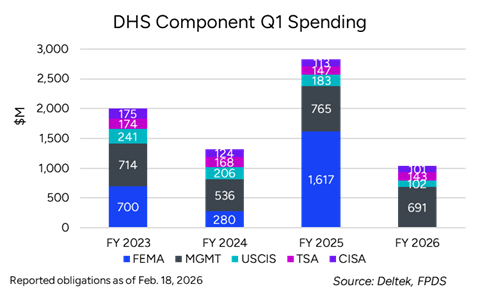
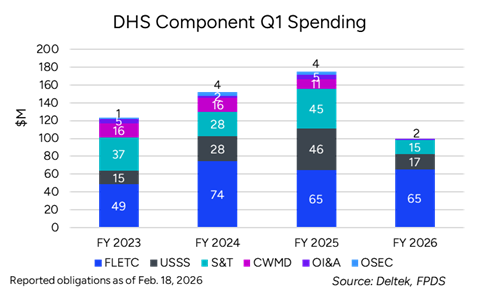
However, the remaining DHS components within the Other category above reported $1B in spending in Q1FY26 – lower Q1 spending than in recent years. Other than FEMA, most non-enforcement agencies reported reductions in contract spending in Q1FY26, albeit most were modest by comparison. The US Customs and Immigration Service (USCIS), US Secret Service (USSS) and Science and Technology (S&T) were among them.
Diving deeper into how spending fell among the three months of the first quarter – October, November and December shows that total DHS spending in October 2026 (during shutdown) was significantly lower than Q1FY25, but on-par with Q1 in FY 2023 and FY 2024 (non-shutdown years).
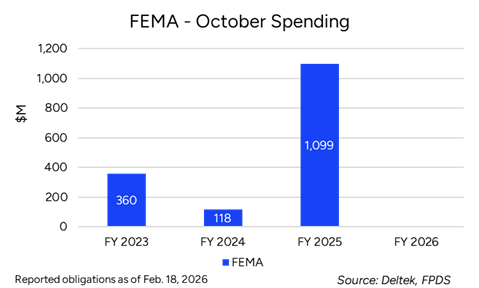
One key caveat is that the Q1 FY 2025 total spending spike was due to $1.1B in FEMA spending, (response to Hurricane Helene, etc.). With that taken into account the Q1 spending level across the four years – including Q1FY26 – is fairly consistent. The spike in December FY 2026 spending (after the shutdown) is a continuation of the CBP, USCG and ICE spending priorities noted above.
Shutdown Impacts on DHS Component Spending
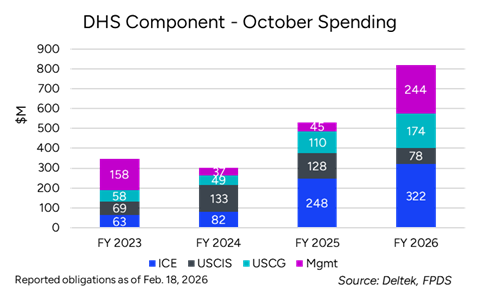
Delving into October spending among the DHS components provides a sense of year-to-year changes, as well as a view into any impacts of shutdown. Given the wide range of spending levels among components, it is beneficial to break them out for clarity.
Among the some of the largest DHS components, October spending in FY 2026 was robust, which reflects both their essential function roles and administration priorities.
The Federal Emergency Management Agency (FEMA) October spending was skewed heavily in FY 2025, due to the significant spending around Hurricane Helene response and other efforts. Therefore, for clarity it is broken out by itself below. October FY 2026 reported contract spending was actually a de-obligation of $61.1M.
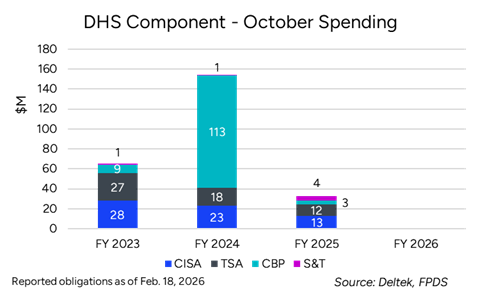
Where the October data gets interesting is around the remaining DHS component agencies. The Cybersecurity & Infrastructure Security Agency (CISA), the Transportation Security Administration (TSA), Customs & Border Protection (CBP) and the Science & Technology Directorate (S&T) each reported zero or negative (de-) obligation amounts for October FY 2026, during the shutdown.
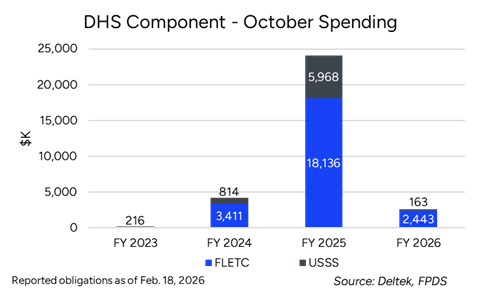
Continuing down the list, the Federal Law Enforcement Training Center (FLETC) and the US Secret Service (USSS) reported some obligations in October FY 2026, but at much lower levels than previous years.
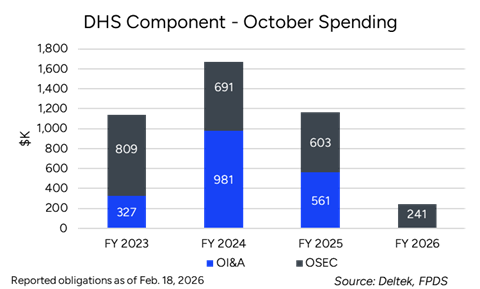
Finally, the Office of Intelligence & Analysis (OI&A) and the Office of the Secretary (OSEC) continued the trend of curtailed spending in October of FY 2026. The FY 2026 DHS budget disbanded the Countering Weapons of Mass Destruction Office (CWMD), shifting its Chemical, biological, radiological, and nuclear defense (CBRNE) responsibilities across components like CISA, CBP, and USCG.
Conclusion
The data shows that federal government shutdowns do impact contracted spending at DHS, although its components and agencies are impacted unevenly. This fits with the nature of these shutdowns.
The essential missions of some of DHS’s largest and most critical components shields them from some of the impacts of these shutdowns, notwithstanding the impacts on personnel who must deal with disrupted payroll and other interrupted functions. The OBBBA sustains funding for the priorities it supports, which shows up in the contracting data.
Where the impacts of the October through mid-November 2025 (Q1FY26) shutdown is most pronounced is among DHS components that largely fall outside the enforcement mission, OBBBA priorities, or are otherwise deemed non-essential contract activities. While most of those agencies made up ground once the shutdown ended, it takes time to catch up, and the spending data cannot accurately account for lost productivity and other impacts.
Expect the current DHS shutdown to have similar impacts to these agencies, with the impact increasing as the duration grows.