NASA's 5-Year Small Business (SB) Performance Outcomes
Published: October 24, 2025
Federal Market AnalysisSmall Business
Small business performance drives planned increases in prime and subcontract awards
Last week I reported on NASA’s plan to increase small business prime and subcontract opportunities over the next three fiscal years. This week, I take a closer look at the space agency’s small business spending trends during the past five fiscal years.
Contract Performance
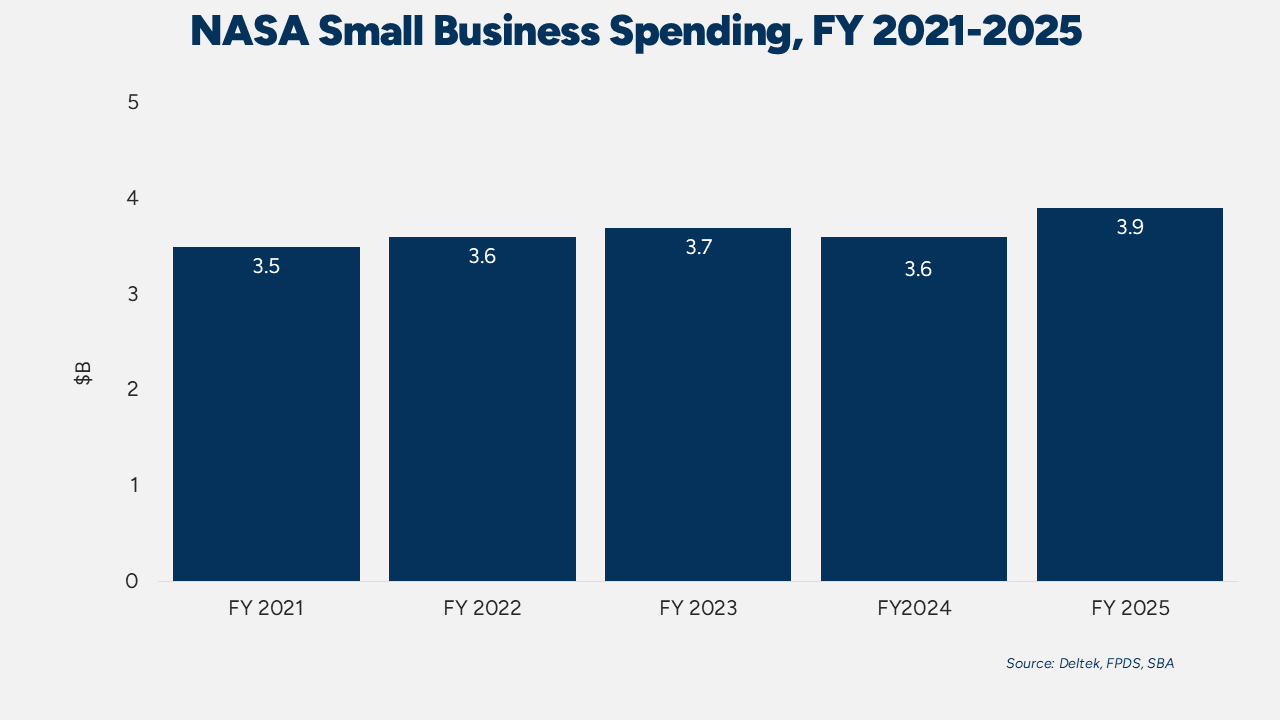
From FY 2021 to 2025, NASA awarded $18.4B to small businesses. Total contracts dollars awarded to small companies grew steadily between FY 2021 and 2023. However, during FY 2024, small business awards dropped by 4.5%, partially attributable to the agency’s transition to the Product Service Lines/Enterprise Service Delivery Model. The consolidation of procurements to a more category-management business model significantly reduced the number of small business opportunities.
Spending rebounded to FY 2023 levels last year, driven by large contract awards, including:
- Electrical Systems Engineering IV (ESES) ($1.1B)
- Combined Operations Services Maintenance and Infrastructure Contract ($823M)
- Mission Technical Integration Contract ($420M)
- Solutions for Enterprisewide Procurement V (SEWP), $25.5B task orders
- GSA’s Consolidated Multiple Award Schedule (MAS) task orders ($10.3B).
Socioeconomic Utilization
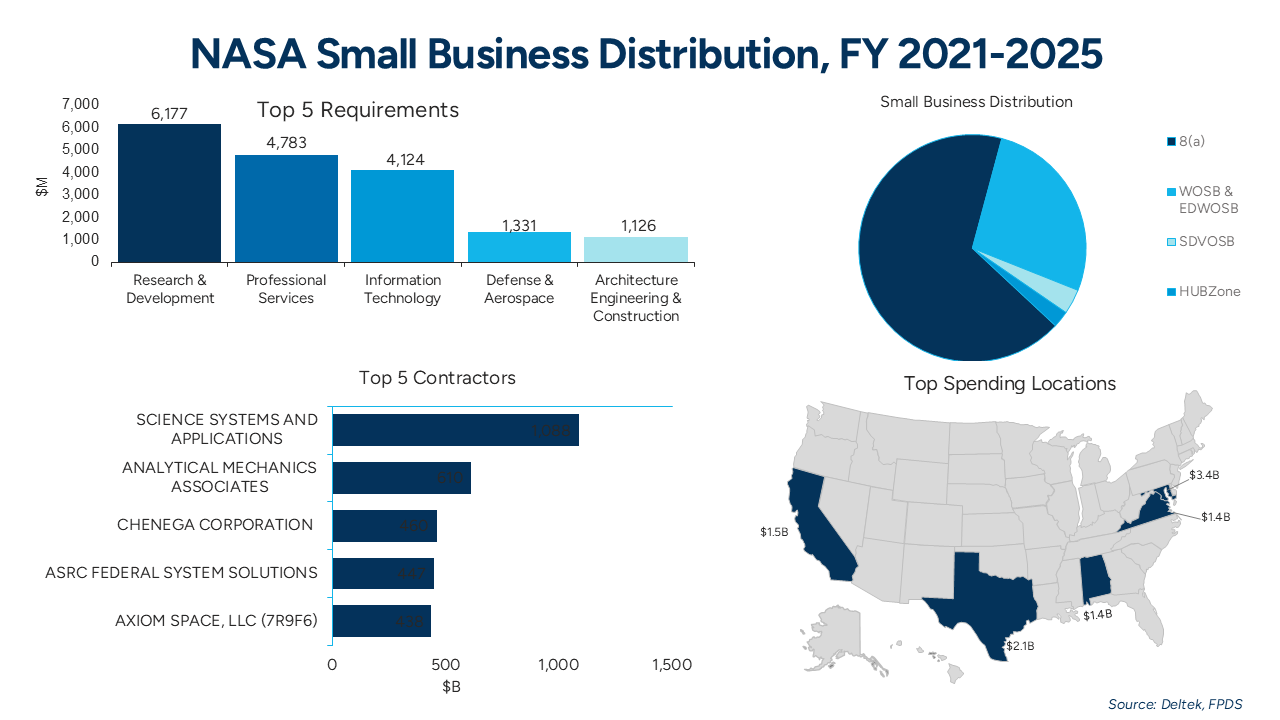
During this period, the agency awarded $4.9B to SB firms in the four SBA-mandated socio-economic categories. Approximately 4% of these were Sole-Source awards. Firms certified under the 8(a) program received the largest share, receiving $3.8B, or 21% of all SB awards.
HUBZone utilization continued to significantly underperform, accounting for less than 2% of total SB spending – falling below the goal for the fifth consecutive year. These trends have prompted NASA’s Office of Small Business Programs (OSBP) to adopt a strategic approach to reinvigorate these programs over the next three years.

Contract Distribution
Primary Requirements:
Research and Development (R&D) programs continued to dominate small business awards, accounting for 44% of contract dollars. Spending among the top R&D contracts included:
- Commercial Lunar Payload Services: $892M
- Hydrosphere Biosphere and Geophysics Support Services II: $316M
- Test Evaluation and Support Team 3: $273M
- Space and Earth Science Data Analysis: $270M
- Langley Research Center’s Research Science and Engineering Services $250M
Information Technology (IT) small business contracting spending was $4.8B and included these top five contracts:
- Electrical Systems Engineering Services III (ESES III): $446M
- Marshall Engineering Technicians and Trade Support Services III (METTS III): $325M
- Human Space Flight Technical Integration Contract (HSFTIC): $308M
- Software Engineering Support II: $208M
- Systems Engineering and Advanced Services: $190M
Task order awards under SEWP V and the GSA Multiple Award Schedule accounted for an additional $1.1B during this time.
From FY 2021 to 2025, the highest volume of awards went to small businesses in Maryland, home of the Goddard Space Flight Center (GSFC), and Texas, the location of the Johnson Space Center (JSC). The Ames Research Center (CA), the Marshall Space Flight Center (AL) and the Langley Research Center (VA) were among the top-performing centers for IT contracts.
Subcontracting Performance:
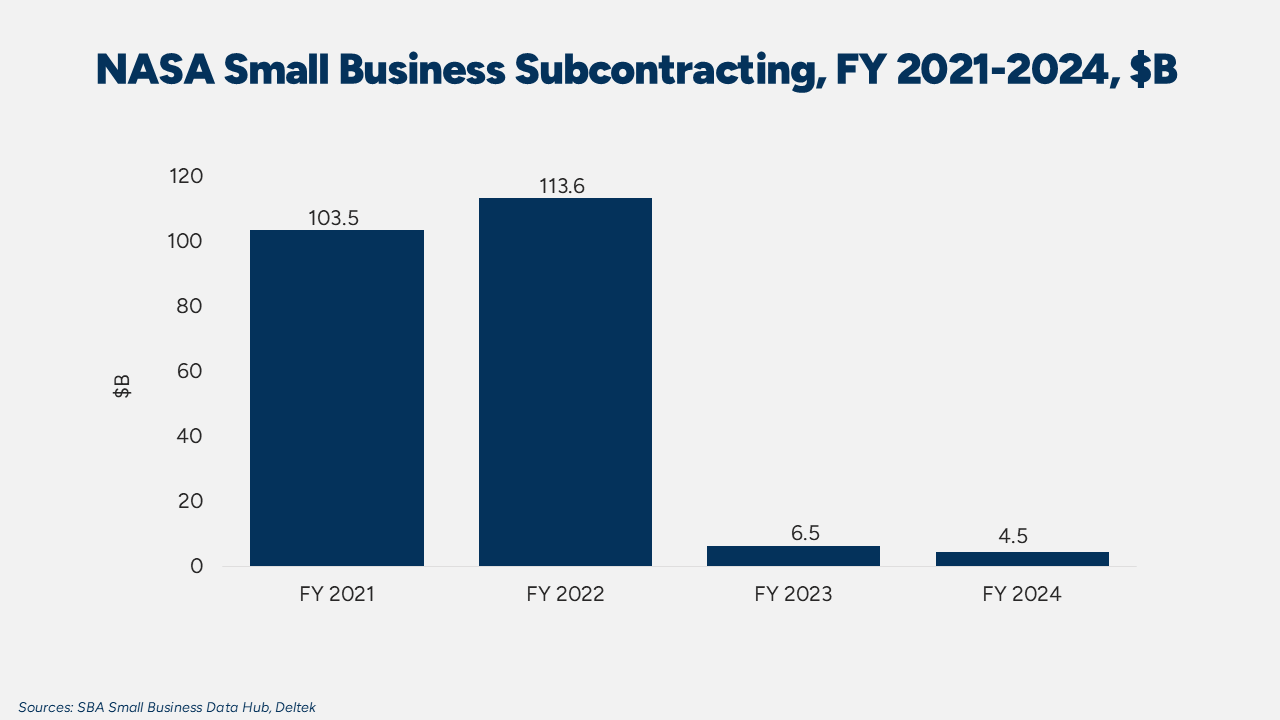
As noted last week’s article, NASA recognizes the need for increased small business subcontracting opportunities. The agency’s FY 2025 subcontracting goal was 40%. Final data has not been released, but reported obligations, as of mid-October, were $474M in small business subcontracting. This continues a trend that began in FY 2023 in which small business subcontracting fell by 95% driving the anticipated increases between FY 2026 and 2028.
Conclusions
Although NASAs has a history of being a proponent of small businesses, ongoing challenges have significantly impacted the agency’s small business utilization in both prime and subcontracting awards. To address this, NASA recently published its Small Business Strategic Priorities for FY 2026 – 2028 and Pathways to Novel Engagement. Both emphasize a renewed focus on engaging the small business community as the agency seeks to expand its industrial base of contractors and subcontractors in achieving mission requirements. NASA offers a wide variety of resources to help small businesses to succeed. Additional information is available on the OSBP website.
Additionally, the large contracts mentioned above and others listed on Deltek’s GovWin IQ provide potential subcontracting opportunities. For more in-depth analysis, check out Deltek’s Federal Market Analysis.