Small Business R&D Funding Programs Remain in Limbo
Published: December 03, 2025
Federal Market AnalysisSBIR/STTRSmall Business
Small Business Innovation Research (SBIR) and Small Business Technology Transfer programs (STTR) funding remains on hold pending final legislation.
On October 1, 2025, authorization lapsed for the Small Business Innovation Research (SBIR) and Small Business Technology Transfer (STTR) programs, creating uncertainty and cash flow risks for small businesses nationwide.
Existing SBIR contracts remain valid for now, but new awards depend on the availability of prior-year funds. At stake is about $3B in annual small business research and development (R&D) funding.
Current Status and Timeline
Industry observers expect Congress to pass reauthorization by year's end, but given Congress's historical pattern of waiting until the last minute, there is no guarantee. However, while the FY 2026 National Defense Authorization Act (NDAA) provides continued funding for defense projects, civilian agencies cannot issue new grant funding opportunities or awards without reauthorization.
Proposed Reauthorization Plans
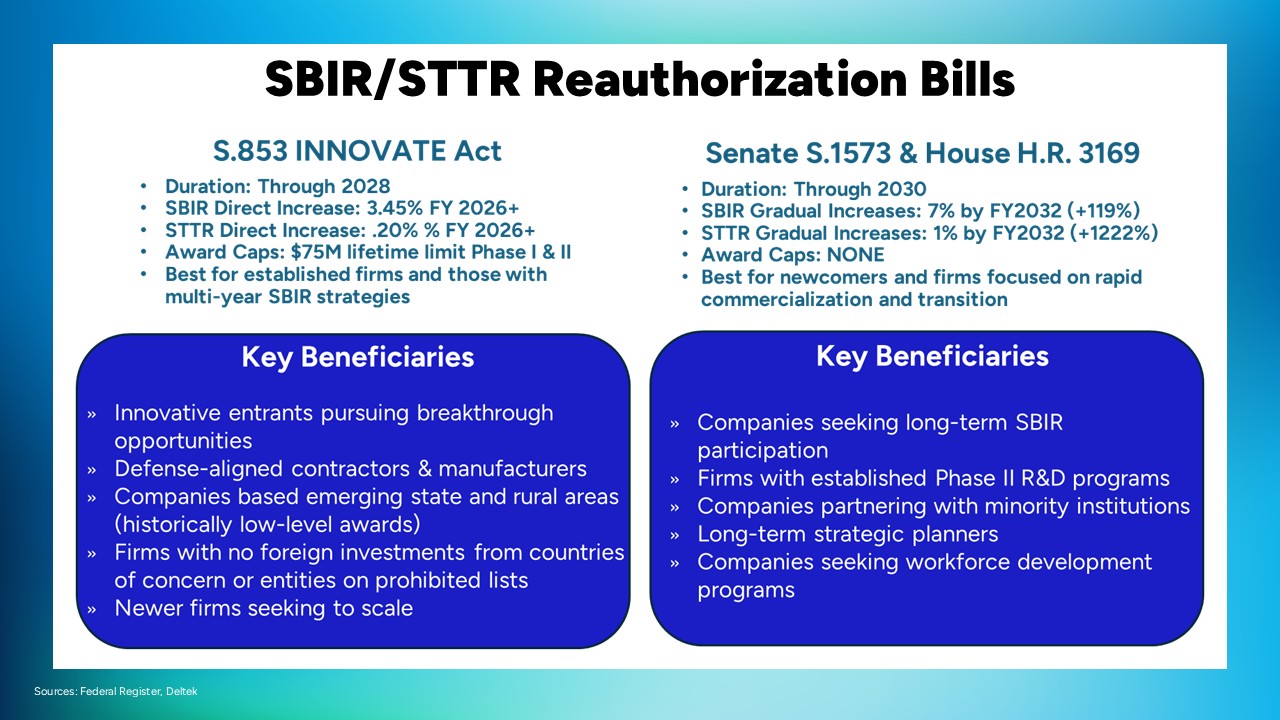
In March, the Senate introduced S. 853, Investing in National Next-Generation Opportunities for Venture Acceleration and Technological Excellence (INNOVATE Act), aimed at increasing new entrants. The proposed legislation would extend the programs through FY 2028 and establish an annual funding allocation at 3.45% of agency extramural research and development (R&D) budgets, a .25% increase above the current level.
On May 1, the House and Senate introduced similar reauthorization bills, H.R. 3169 and S. 1573, respectively. Both extend the programs permanently. Scheduled funding increases through FY 2032 will drive aggressive growth with SBIR funding rising 119% and STTR allocations climbing 122% over seven years.
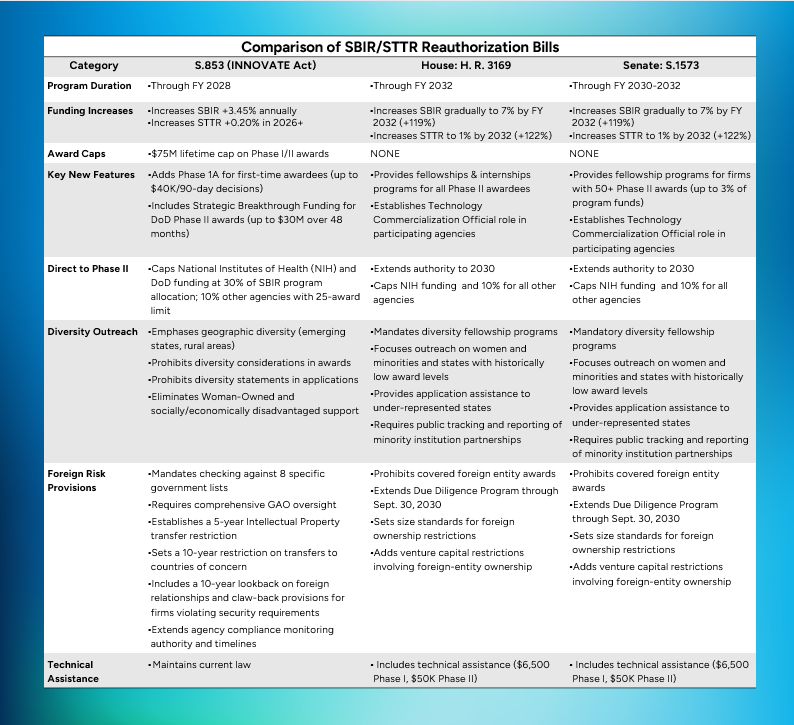
The table below provides a detailed comparison of key features among the three proposed bills.
SBIR/STTR Historical Spending
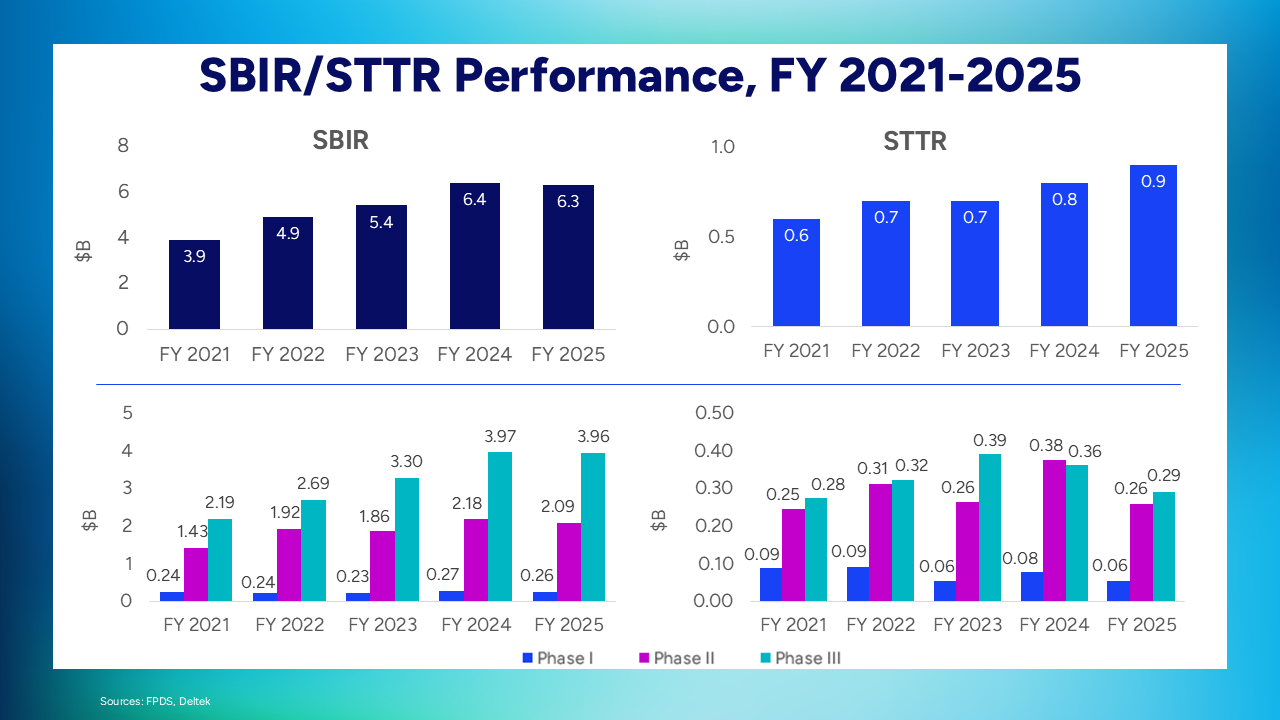
Although final legislation is pending, a five-year analysis highlights the program's proven track record and underscores what's at stake. Historical spending trends reflect steady growth, highlighting the pivotal role SBIR and STTR programs play in federal R&D priorities. From FY 2021 to FY 2025, the federal government invested $30.3B in innovative R&D projects.
Total SBIR spending increased by 64% during this time. SBIR and STTR Phase I awards, which finance the feasibility and proof-of-concept stages, received $1.2B and $367M, respectively. Phase II awards doubled, and Phase III transition-related contracts rose by 81% to a five-year total of $16.1B. STTR spending dipped slightly by 2%, but still accounted for 11% of total program spending.
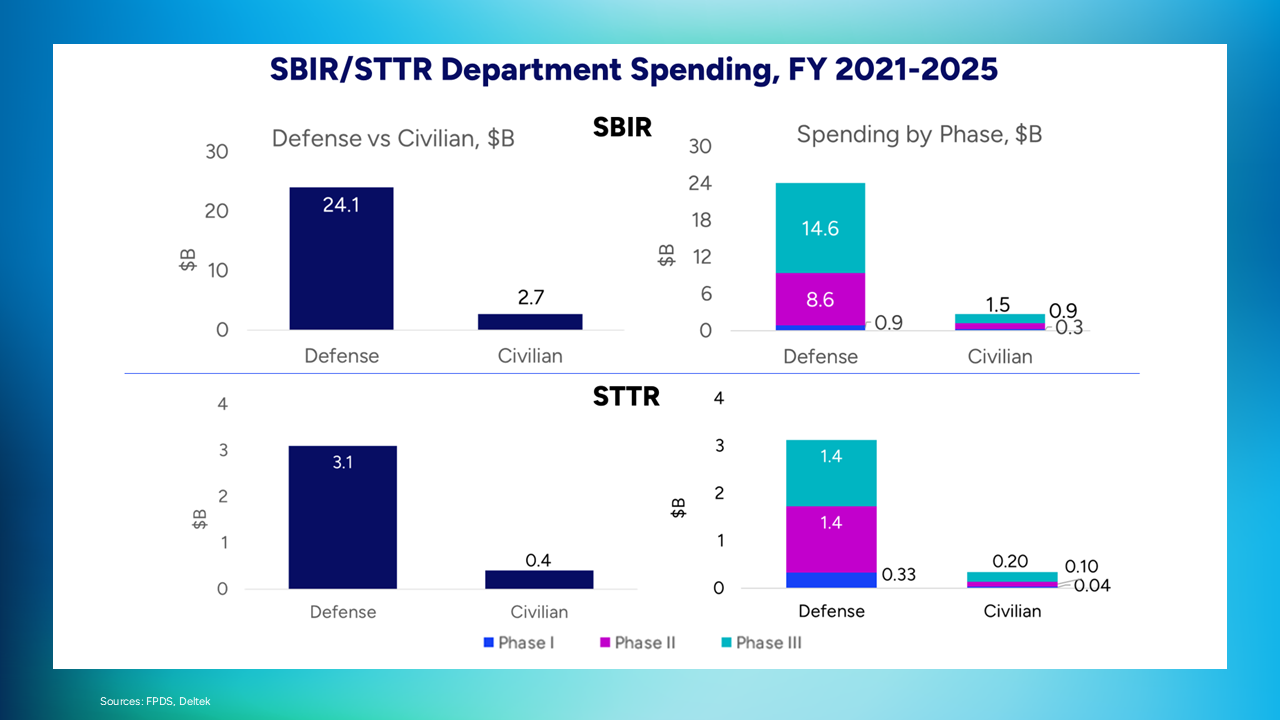
Defense agency awards accounted for 90% of total SBIR/STTR obligations with the Air Force receiving $1.6B in SBIR funding and $10B in STTR awards. NASA received the highest civilian funding at $1.5B for Phase I and II projects during this period. Other leading civilian agencies include the Department of Homeland Security ($740M), Health and Human Services ($328M), Veterans Affairs ($135M), and the Department of Education ($76M).
Conclusions
SBIR and STTR programs remain a critical funding source for innovative small businesses seeking to enter the federal technology marketplace. Under current proposals, funding allocations could increase to 3.45% of agency R&D budgets under the INNOVATE Act or reach 7% for SBIR and 1% for STTR by FY 2032 under S. 1573/H.R. 3169. The final outcome will likely be somewhere in between. The Administration’s emphasis on Artificial Intelligence, quantum computing, space innovations, and the proposed Strategic Breakthrough Funding section under the INNOVATE Act will inform future funding decisions.
In the meantime, new awards remain on hold, and agencies are unable to issue new funding rounds. However, current SBIR contracts remain valid with additional awards proceeding under prior years' funding. Without reauthorization, new firms cannot enter the programs and existing Phase I contractors cannot receive Phase II or Phase III funding. This reduces the number of projects entering the commercialization and production stage under Phase III.
Moving forward, small startup businesses can better position themselves for Phase I awards by aligning their proposals with agency missions. Firms must remain informed on agency utilization as some, like NASA, may restructure their programs. Robust capability statements, precise performance documentation and strategic pricing will also be key factors for existing Phase II contractors seeking Phase III transition and potential sole-source contracts.