Ongoing Changes Reshape 8(a) Small Business Contracting Program
Published: March 17, 2026
Federal Market Analysis8(a) ProgramSmall Business
Audit enforcement, policy changes, and DEI-related executive orders have driven the largest contraction in the program's history — but opportunities remain for firms that adapt.
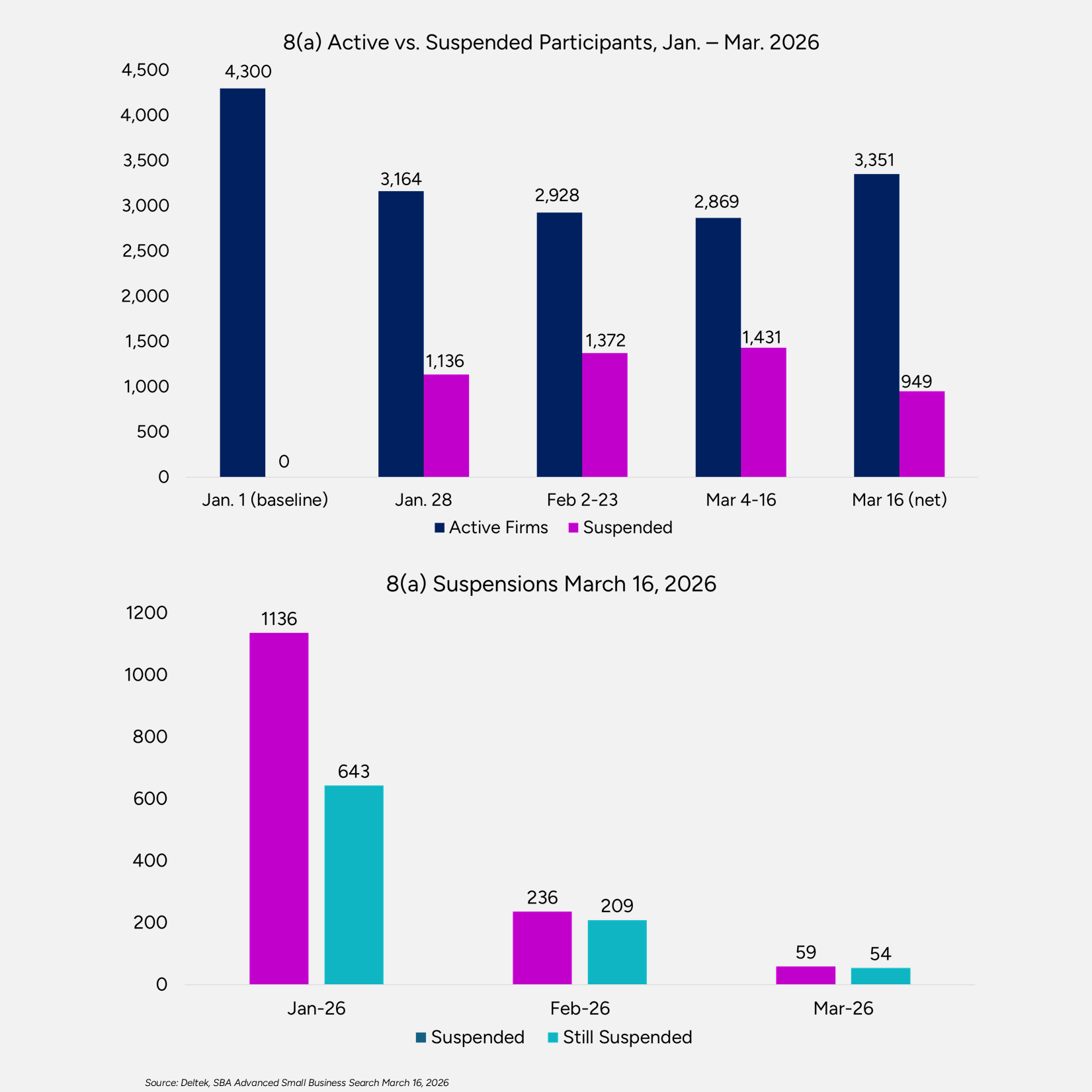
Ongoing Small Business Administration and regulatory changes have reduced the number of 8(a) Small Business Development program participants by 44% since FY 2023 from approximately 5,985 participants in FY 2023 to 3,351 as of March 16, 2026 – a decline 949 firms.
As of March 16, 2026, the SBA certification data included 3,351 active participants following the suspension of 1,431 firms in January and February. To date, 482 (~33.7%) firms have been reinstated either through compliance or appeals; 906 (~69%) remain suspended and subject to enforcement actions; and 43 were listed as “Previously Certified” or exited the program. Reinstatements may increase as the agency continues the reviews and firms appeal the decisions.
Key Actions Driving the 8(a) Contraction: January 2025 – March 2026
Multiple executive orders targeting diversity, equity and inclusion programs and changes under the Federal Acquisition Regulation Overhaul (RFO) also contributed to the decline.
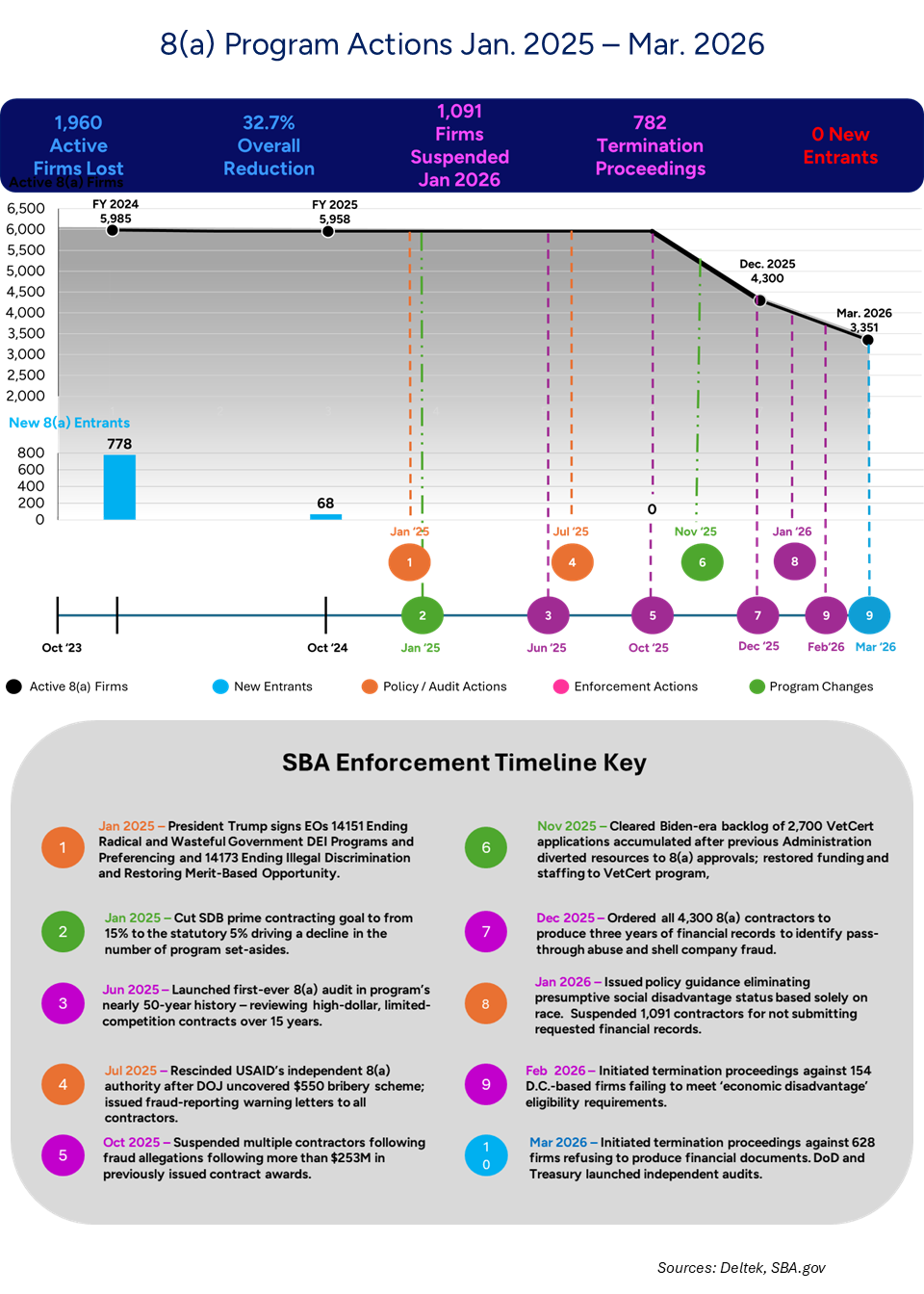
In January 2025, President Trump signed three executive orders (EOs) immediately following his inauguration, laying the foundation for increased scrutiny and changes to the 8(a) program.
- 14151 Ending Radical and Wasteful Government DEI Programs and Preferencing preempted the SBA rollback of race-based 8(a) eligibility standards, targeting federal diversity, equity and inclusion (DEI) programs and informed the reset of Small Disadvantaged Business (SDB) contracting goals.
- 14173 Ending Illegal Discrimination and Restoring Merit-Based Opportunity revoked DEI-related executive orders under previous administrations affecting 8(a) eligibility criteria.
- 14222 Establishing and Implementing the President’s Department of Government Efficiency efforts terminated 2,890 8(a) contracts, concentrating on those associated with DEI set-asides, consulting, climate-related, and other professional services, driving contract cancellations across the 8(a) portfolio and creating uncertainty for existing and prospective participants.
On January 24, 2025, the agency reset the Small Disadvantaged Business (SDB) contracting goal – which includes 8(a) contracts – from 15% to the statutory 5% – driving a decline in the number of program set-asides.
On June 27, 2025, SBA Administrator Kelly Loeffler launched the first program-wide audit of all 8(a) contracts over the past 15 years, including contracts held by firms that had already left the program. The audit was prompted by the discovery of a 10-year, $550M bribery scheme involving 8(a) contracts for the United States Agency for International Development (USAID). In December 2025, the agency ordered all 4,300 participants to submit financial records for the past three years or face suspension.
On January 22, 2026, the SBA issued policy guidance eliminating presumptive social disadvantage status based solely on race, requiring documented evidence of social disadvantage. On January 28, 2026, the agency suspended 1,091 firms for non-compliance with the data call. Of those, 75% were in the transitional stage, 22% in the developmental stage and 3% had left the program. SBA data shows an additional 45 firms suspended in January, possibly from submitting their financial data a day late and before the suspension notices were issued due to errors in the MySBA certification portal.
In February, the SBA initiated proceedings to terminate 154 of those who were based in Washington D.C., for exceeding the statutory net worth limits, adjusted gross income caps or total asset limits within the SDB eligibility criteria. Finally, on March 4, the SBA announced termination of an additional 628 firms for failure to comply with the December data call. Collectively, these 782 firms represent about 20% of the total active participants and more than $2.1B in 8(a) contract obligations, according to Loeffler.
The SBA numbers in the charts above differ from those posted on SAM.gov. Reasons vary, but include possible appeals to SBA's Office of Hearings and Appeals (OHA) that paused proceedings; these remain "active" in SAM.gov. The 30-day suspension window for the February 11 group means final terminations weren't technically effective until around March 11 and could affect the data. SBA offered voluntary withdrawal options alongside the termination letter, and firms choosing that option may appear as “voluntary exits” rather than terminations.
The chart below shows key initiatives affecting the program since January 2025 with the compressed timeline reflecting the SBA audit enforcement activities.
Compounding Factors: Regulatory and Policy Changes Affecting 8(a) Firms
- Compliance Burdens: Elimination of the presumptive self-certification process and the potential for civilian agencies to adopt the Department of Defense's new Cybersecurity Maturity Model Certification (CMMC) requirements can add cost and administrative burdens.
- Federal Acquisition Regulation Overhaul (RFO) Part 19 changes: The RFO Part 19 revision could reduce 8(a) sole-source contract opportunities by $14B by mandating competitive procurements under GWACs for contracts below competitive thresholds. Increased contracting officer discretion to compete follow-on 8(a) contracts under other socioeconomic programs without SBA approval also reduces opportunities.
- Procurement Consolidations: EO 14240 - Eliminating Waste and Saving Taxpayer Dollars by Consolidating Procurement shifted the procurement of common goods and services toward consolidated efforts, such as the GSA OneGov initiative, further narrowing the opportunity pipeline.
- Revised Performance Scorecard Methodology: The SBA is evaluating a new scoring methodology for small business contracting goals. The new grading system emphasizes veteran-owned businesses under a new category, “Serving our Veterans," and weights performance at about 25% of the total scorecard. This includes 15% for the new category, 5% from prime contracts, 2.5% from subcontracting and an undisclosed amount from the competitive value category. If implemented, this will further shift awards from the 8(a) program. Sources reported the FY 2026 Scorecard Factors eight prime contracts at 50%, subcontracts at 25%, veteran-owned performance at 15%, and competitive value at 10%" below. Since these exceed 100% expect adjustments in the adopted version.
Conclusions:
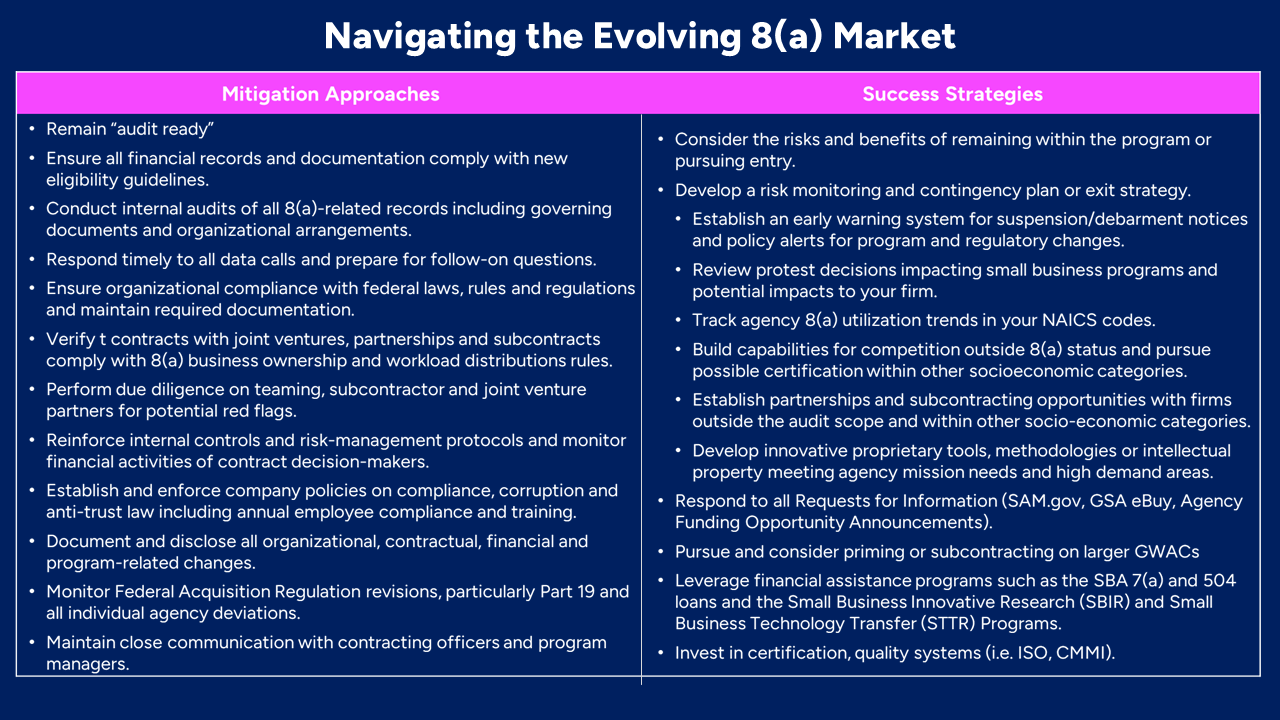
Together, these changes produced the largest participant decline in the program’s history, compressed contract spending, narrowed opportunities and eroded the 8(a) market share. For firms navigating the evolving 8(a) program, the following mitigation approaches and success strategies offer a practical framework for maintaining eligibility and sustaining contract pipelines.
A more in-depth analysis of the Top 8(a) Contracting Trends is available here.