Air Force IT Spending, FY 2023-2025
Published: March 26, 2026
Federal Market AnalysisUSAFForecasts and SpendingInformation TechnologySmall BusinessSpending TrendsUSSF
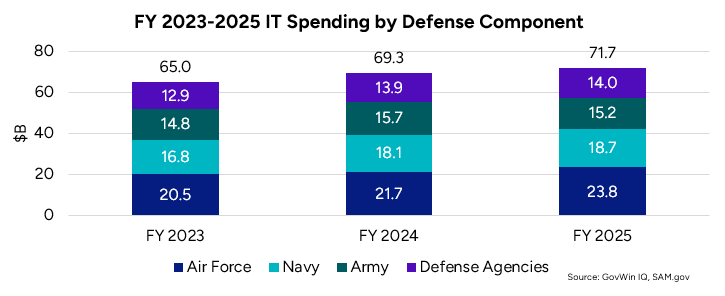
IT spending at the Department of the Air Force grew by 16% over the last three fiscal years.
By most accounts, the federal information technology (IT) contracting market has been challenging over the last year or so, with a variety of changes in policies and priorities at federal agencies that have required adjustments by both agency contracting staff and contractors alike. Now that the contract reporting data updates from the Department of Defense (DoD) have reached beyond the traditional 90-day delays, we should have a clear picture of how fiscal year (FY) 2025 settled out and how it compares to the previous two fiscal years.
Total Air Force IT Spending
According to reported federal contract spending data, a compilation of spending reported under Product Service Codes (PSC) categorized as IT, the Air Force obligated $23.8B for IT goods and services in FY 2025, up from $21.7B in FY 2024 and $20.5B in FY 2023.

This FY 2025 total represents a 16% jump over what the Air Force spent on IT in FY 2023 and 10% more than it spent in FY 2024. That level places the Air Force as the highest spender on IT among the DoD components in FY 2025 as well as the component with the most significant growth.
Spending by Top Air Force Organizations
The reported contracting data shows how the following Air Force components ranked in IT spending from the most to the least from FY 2023 through FY2025.
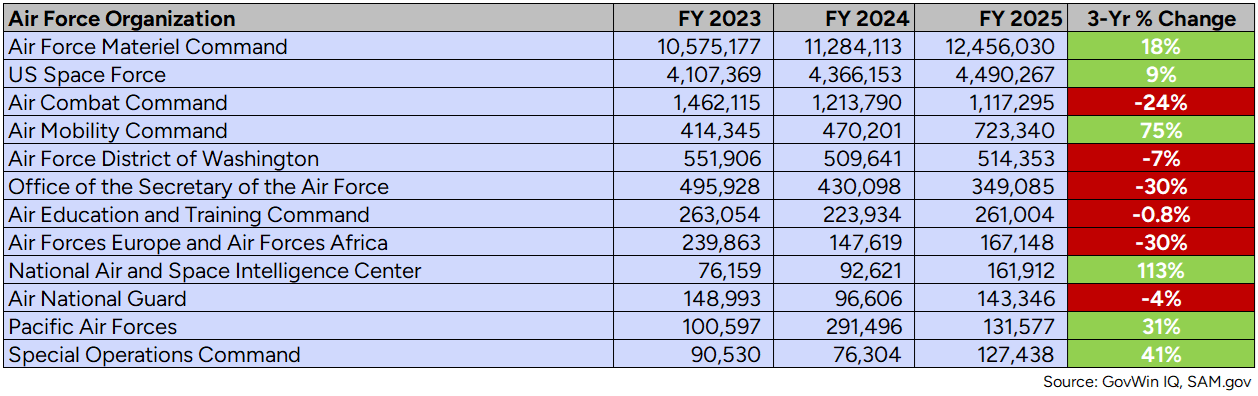
While not an exhaustive list, these top-spending entities account for $20.6B (87%) of the Air Force’s total FY 2025 IT spending. The remaining organizations account for $311M for FY 2025, and there is $2.9B in reported obligations that fail to list a funding organization.
Half of the top 12 entities listed above increased their IT spending over the three years from FY 2023-2025, and of the organizations that show declines, only the Air Combat Command follows a consistent path over the three years. All the others show some rebounding from FY 2024 to FY 2025.
Spending by US Space Force Organizations
Given its growing prominence in the Air Force mission and its proportion of IT spending, the US Space Force bears some additional attention.

The Space Systems Command accounted for more than 90% of Space Force IT spending in FY 2025 and displays 9% growth from FY 2023. Only the Space Development Agency reports a declining IT contracting level, which reflects the ongoing evolution of the Space Force as an organization.
Air Force IT Spending by Business Size
When it comes to increasing its spending with small businesses, the Air Force has made some progress over the last three fiscal years, growing from $5.8B in FY 2023 to $6.4B in FY 2025.
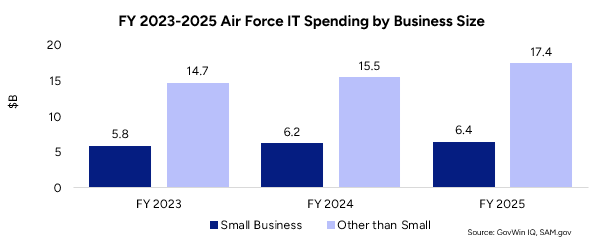
This 10% growth in small business IT contracting may be due in part to greater participation of non-traditional businesses working with the Air Force under Other Transaction Agreements (OTAs) and Commercial Solutions Openings (CSOs) contracting methods. However, spending with companies in the Other than Small category retains the majority portion of Air Force IT spending and outpacing growth at 18% over the three years.
Top Companies by Air Force IT Spending
Looking at the companies which have been garnering the most in Air Force IT contracts reveals a strong connection with firms that are also leading platforms, weapons and aerospace systems manufacturers.
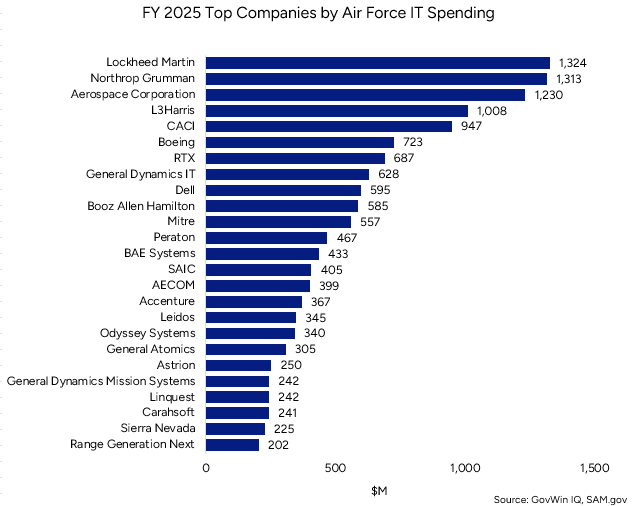
The connection between IT and defense platforms and weapons reflects the increasing extent to which information technology has become embedded in modern warfighting systems and space-based infrastructure.
While most of these firms have some portion of their FY 2025 IT contract dollars with the Space Force, a handful of them have a higher proportion, with Space Force accounting for more than 25% of their FY 2025 Air Force IT contract dollars. This includes:
- The Aerospace Corporation ($1.2B, 100%)
- Lockheed Martin ($557M, 42%)
- L3Harris ($335M, 33%)
- Range Generation Next ($202M, 100%)
- Linquest ($152M, 63%)
- BAE Systems ($146M, 34%)
- General Dynamics Mission Systems ($124M, 51%)
- Astrion ($70M, 28%)
Final Thoughts
After all the uncertainty and fear that IT spending might decline due to contract scrutiny by the DoD, the reality shows that the Air Force (and DoD overall) continued to increase its spending on IT goods and services. This reflects the department’s continued reliance on contractors and suppliers to meet urgent priorities. It also reflects the progressive embedding of IT components and capabilities into warfighting systems, space systems and defense platforms, a trend that will only continue.