Beyond the 8(a) Suspensions: Strategic Guidance for Federal Contractors
Published: February 03, 2026
Federal Market Analysis8(a) ProgramSmall Business
Recent 8(a) contractor suspensions and program reforms create risks and opportunities for federal small business contractors
On January 28, the Small Business Administration (SBA) suspended 1,091 8(a) contractors who missed the agency’s January 19th deadline for submitting financial documents for the past three years.
These firms- representing about 25% of the program’s registered participants - cannot compete for or receive new 8(a) contracts during their suspensions, but may continue performing on existing contracts.
Firms have 45 days to appeal, and while the data submission portal remains open through February 19, the SBA has not guaranteed that late submittals will lift suspensions.
Background
In December 2025, the SBA directed all 4,300 8(a) participants to provide financial information covering the last three fiscal years. The agency warned that noncompliance could result in program removal, further investigations and remedial actions.
This request was part of an ongoing SBA audit of all 8(a) contracts awarded over the past 15 years. The review required all participants – including those who had already graduated from the nine-year program – to self-report on potential misconduct regarding fraud or abuse.
Since the SBA certifies firms as socially and economically disadvantaged under the 8(a) program using diversity, equity and inclusion (DEI) factors, SBA Administrator Kelly Loeffler mandated removing those factors effective January 22. The agency also clarified that membership in a minority group does not automatically guarantee program eligibility. Six days later, the agency announced the suspensions. Although the announcement mentioned efforts to “crack down on the fraud and corruption that proliferates within DEI programs,” it did not correlate the suspensions to DEI status.
Expanding Program Scrutiny
The audit and resulting suspensions follow similar reviews by the Department of Treasury and General Services Administration (GSA) and proposed legislation from the U.S. Senate Committee on Small Business and Entrepreneurship, calling for a moratorium on 8(a) sole source contracts. The committee also sent letters to 22 federal civilian agencies and the Pentagon requesting:
- A temporary pause on 8(a) sole source awards
- Reviews of all agency sole-source 8(a) awards and all 8(a) set-aside contracts awarded since FY 2020
- Reports on violations, fraud activities and false statements about program eligibility and overevaluations of securities
- Documentation of related SBA disciplinary actions over the last 5 years, including suspensions, disbarments, and removals from the 8(a) Program.
More recently, Defense Secretary Pete Hegseth announced a two-phase, line-by-line audit of DoD 8(a) sole source contracts exceeding $20M. Phase one examines whether a contract contributes to military readiness and lethality and eliminates those that do not "help win wars." The second phase reviews contract performance to identify pass-through schemes. Hegseth alleges that the small firms that win contracts are not performing the required amount of work, but are taking an “off the top” fee from the contract, then passing the actual work to a larger partner or subcontractor beyond the allowed percentages.
Additional Program Changes
The Federal Acquisition Regulation (FAR) overhaul (RFO) of Part 19 removed the “once an 8(a) contract always an 8(a) contract” provision and authorizes contracting officers to compete follow-on 8(a) contracts under HUBZone Small Businesses, Woman Owned Small Businesses or Service-Disabled Veteran-Owned Small Businesses without SBA approval. The rewrite also prioritizes competition over 8(a) sole source awards, especially within government-wide acquisition contracts (GWACS).
Finally, new socio-economic recertification criteria require firms to document evidence of personal social disadvantage rather than presumptive eligibility based on self-certification adding extra compliance and potential financial burdens.
Key Takeaways
Ongoing efforts to reduce fraud waste and abuse, eliminate DEI-based incentives, combined intensified contractor oversight is changing the face of federal contracting. Contractors can expect:
- Follow-up questions and requests: Non-suspended 8(a) participants should anticipate potential follow-up questions and additional information requests. Additionally, non-8(a) contractors, subcontractors and partners identified in audit responses may be contacted.
- Additional agency-level audits: Other civilian agencies may launch formal reviews like the Treasury, GSA and the Defense Department.
- Intensified competition: Competition increases among the 3,200 non-suspended participants.
- Improved program integrity: Elimination of fraudulent participants legitimizes competition, providing greater opportunities for qualified and compliant offerors.
- Fewer program entrants: Program uncertainty deters new entrants. Only 65 new firms entered the program in 2025, compared to more than 550 in 2024.
- Potential SB goal reductions: Unannounced 2026 small business goals and possible reductions, similar to the 2025 small disadvantaged business reset from 15% to 5% in 2025, and continued 8(a) program decrease participation.
- Cross-program opportunities: Contracting officer flexibility to compete 8(a) follow-on contracts in other socio-economic categories increases opportunities in those programs. Firms holding multiple certifications but who were previously restricted by their 8(a) program participation can compete for work in those categories.
- Small Business Contracting Growth: Anticipate continued growth in federal small business spending, especially among innovative, emerging technology firms. Federal agencies awarded $195B to small business in FY 2025 – 11% above 2024.
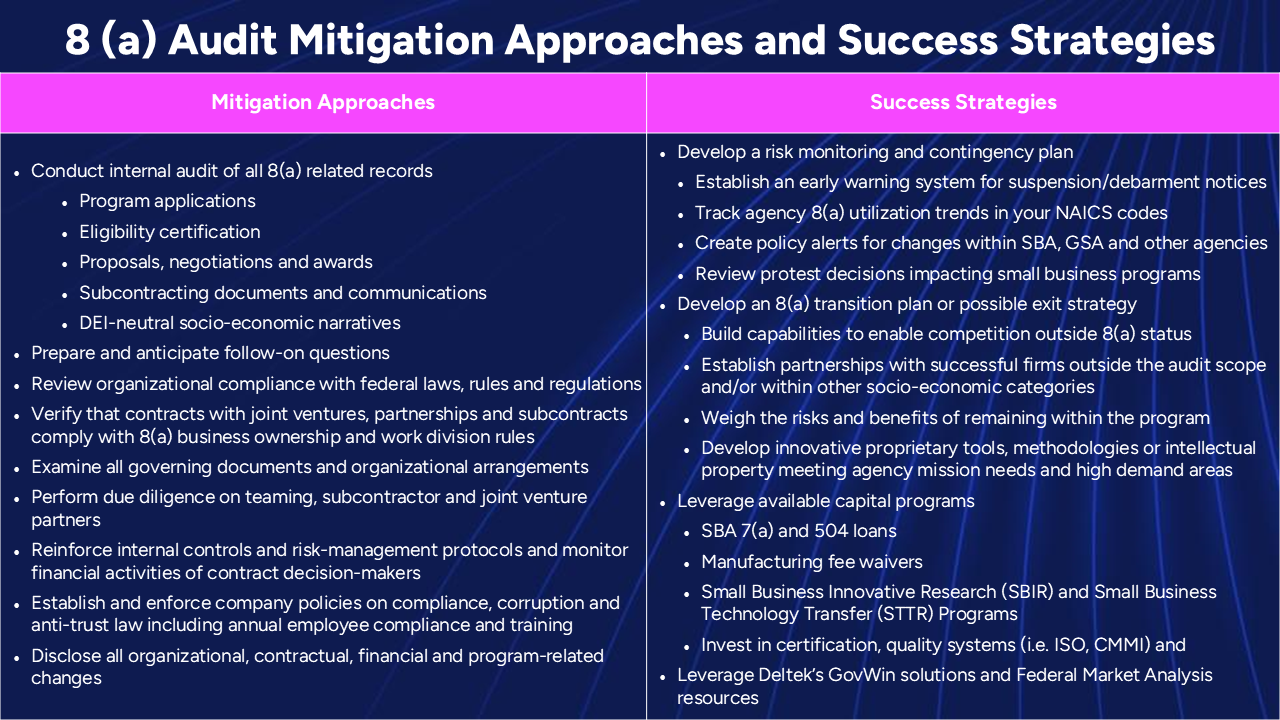
Mitigation Approaches and Success Strategies
For a broader contracting outlook, read John Slye’s recent article, Reasons for Optimism in Federal Contracting Market in 2026.