Department of Commerce FY 2027 Budget Highlights
Published: May 19, 2026
Federal Market AnalysisBudgetCloud ComputingInformation TechnologyMobilityWireless
Increased enforcement, Census modernization, cloud migration and IT infrastructure investments signal a sustained federal contracting pipeline despite budget reductions.
The Department of Commerce FY 2027 budget includes $9.2B in discretionary funding and an additional $5.1B in anticipated patent and trademark fees. The overall $1.7B (11%) decrease from the FY 2026 enacted levels returns the agency to FY 2025 levels.
Budget increases prioritize modernization to strengthen export controls, AI and quantum technologies, and the protection of American manufacturing. Budget reductions reflect agency reorganization, funding transfers and bureau closures. Key changes include:
- A 147% ($179M) increase from the $122M FY 2026 enacted budget for export administration and enforcement activity funding, and 448 new positions
- Termination of NOAA grant programs, including Regional Climate Data and Information, Climate Competitive Research, the National Sea Grant College Program and Sea Grant Aquaculture Research.
- Elimination of the Hollings Manufacturing Extension Program (-$222M) with no successor program mentioned.
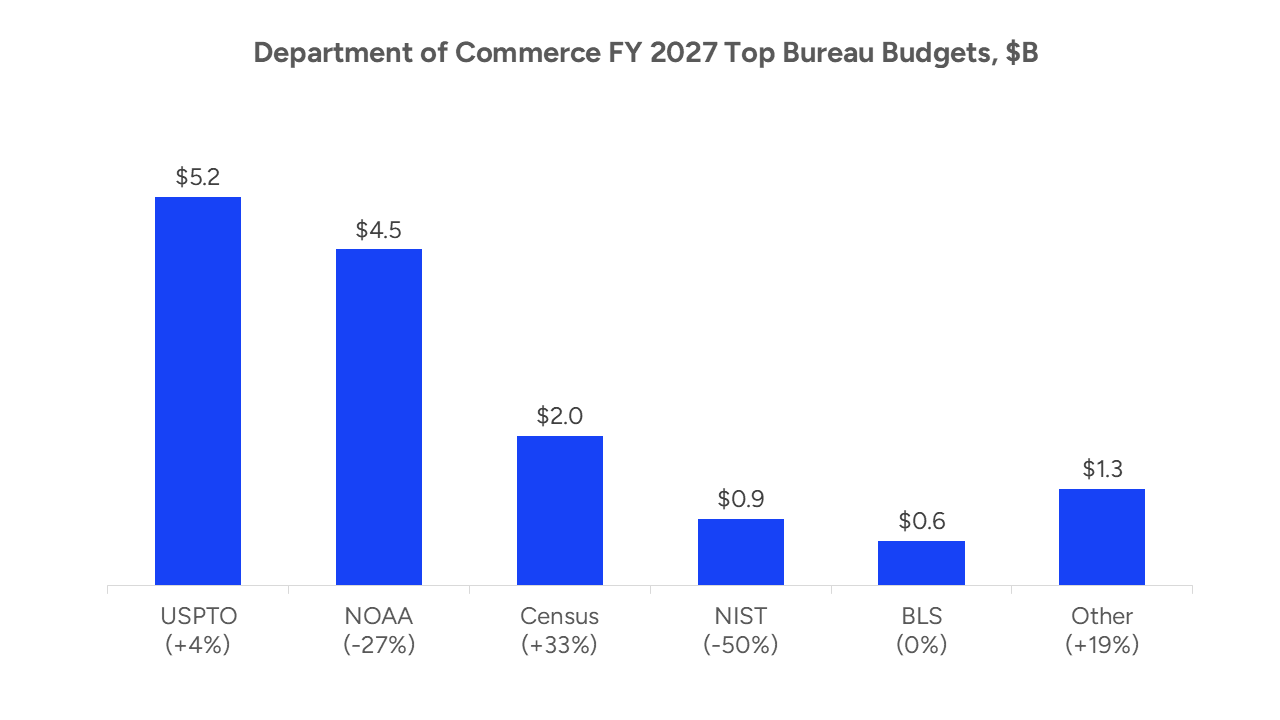
The chart below shows the top five bureau budget requests.
Funding Highlights
Major initiatives for these bureaus include:
- U.S. Patent and Trademark Office (USPTO): Although the USPTO request is the largest, the bureau is actually entirely fee-funded. FY 2027 estimated fee collections are $5.2B, including $4.5B in patent fees and $687M in trademark fees. The budget allocates $569M for the modernization of the patent and trademark examination systems.
- National Oceanic and Atmospheric Administration (NOAA): NOAA requests $4.5B for FY 2027, a $1B (-27%) decrease from FY 2026 enacted. The budget provides a $135M increase for shipbuilding, including $60M for Class C fleet recapitalization and $75M for unmanned systems (UxS) platforms. Next-generation satellite program investments total $625M, including $500M for continued development of the Geostationary Extended Operations (GeoXO) satellite program and $125M for the Near Earth Orbit Network. An additional $140M allocation will maintain minimum support for maritime commerce, navigation and positioning services.
- Census Bureau (CB) requests $2B for FY 2027, a $536M, or 36% increase, with continued emphasis on the upcoming 2030 Census. The budget includes $289M to advance modernization through the integration of administrative and third-party data, open-source technologies, cloud-based processing, and streamlined data collection to enhance efficiency, reduce burden, and increase data usage for current surveys and programs. Program reductions include the Enterprise Data Lake (-$440M), Data Ingest and Collection for the Enterprise (DICE) (-$1M), Enterprise Dissemination Services (-$691K) and Administrative Records Research and Integration (-$156K).
- National Institute of Standards and Technology (NIST) requests $854M, a $993M (54%) decrease from FY 2026. The FY 2027 budget funds two new sublines that focus on AI and quantum sciences, the Critical and Emerging Technology Measurement and Standards ($173M) and Digital Technology Measurements and Standards ($128M). The bureau provides $88M for the construction of research facilities and $37M for the Manufacturing USA Program.
- Bureau of Labor Statistics (BLS), a proposed consolidation of the Department of Labor’s BLS with Commerce’s Bureau of Economic Analysis (BEA) and Census Bureau, receives $600M.
- Bureau of Industry and Security (BIS): In FY 2027, BIS prioritizes improving export control programs. The bureau’s $450M base discretionary budget, included in the “Other” category above, reflects increases to safeguard American technology and supply chains from foreign adversary risks. This adds 448 special agent law enforcement officers, technical and analytical experts to expand investigation capacity, and compliance specialists and analysts for overseas deployment. The International Trade Administration provides an additional $11M for antidumping and countervailing enforcement activities.
Organizational and Programmatic Changes
The FY 2027 budget eliminates Economic Development Administration (EDA), National Technical Information Services (NTIS) and Minority Business Development Agency (MBDA), removes all Oceanic and Atmospheric Research (OAR) program funding and terminates 52 programs. Changes include:
- NOAA: 36 terminations, -1,520 positions, -$1.3B
- EDA: 13 grant program terminations, 0 positions, -$400M
- NIST: Manufacturing Extension Partnership eliminated, -89 positions, -$175M
- NTIS: -13 positions, -$90M
- MBDA: -21 positions, - $47M
Consolidations and transfers include:
- Consolidating the Bureau of Labor Statistics (BLS) from the Department of Labor with the Bureau of Economic Analysis and the Census Bureau; zero funding transfers in FY 2027
- Transitioning $180M from OAR to NOS and NWS. NOS receives $117M for Ocean Exploration and Research, Integrated Ocean Acidification and Sustained Ocean Observations and Monitoring. NWS receives $63M for Research Supercomputing and Central Processing and removes all other funding
- Transferring the National Marine Fisheries Service Endangered Species Act and Marine Mammal Protection Act programs from NOAA to the Department of Interior U.S. Fish and Wildlife Services
- Shifting $53M from NOAA to Departmental Management for the newly elevated Office of Space Commerce, which oversees commercial satellite traffic coordination, Earth imagery licensing and U.S. space commerce policy, to implement Section 6(b) of Executive Order 14335: Enabling Competition in the Commercial Space Industry.
FY 2027 IT Investments
Commerce level-funded IT programs at $3.07B for FY 2027, $3M below FY 2026 enacted levels.
- The National Environmental Satellite, Data, and Information Service (NESDIS) receives $1.6B to expand space-based commercial data acquisition and engagement activities to improve weather forecasting and ensure continuity of operations.
- The Advanced Weather Interactive Processing System (AWIPS) migration to cloud funding increases by $7M for continued activities and decommissioning the legacy system in FY 2028.
- NWS modernization and transformation initiatives include $5M for the Radar Next program for the design and deployment of next-generation weather surveillance radar technology.
- NOAA’s High Performance Computing (HPC) Program receives $45M for supercomputing systems, associated storage devices, advanced data communications, hardware and software engineering services, security, and necessary data center space. This funding will be embedded primarily within the R&D facility budgets. The National Weather Service Oceanic Research Facility (ORF) receives an additional $18M from the Office of Oceanic and Atmospheric Research for HPC initiatives.
- Ocean Exploration and Research (OER) initiatives will expand AI/ML capabilities to improve processing and analysis of oceanographic data, including high-resolution imagery and sensor outputs beginning in FY 2027.
- Census provides $69M for the Data Ingest and Collection for the Enterprise (DICE) Program to complete development and implementation of Phase 3 and migrate 19 priority surveys onto the platform.
- NTIA’s request includes funding for research in Spectrum Management ($7M) support the commercial sector’s development of next-generation wireless services via spectrum reallocation of bandwidth for commercial utilization and $12M Advanced Communications Research supporting exportable applications for AI, 6G and beyond.
- Departmental Management provides $100M for the U.S. Investment Accelerator to strengthen the manufacturing and industrial base and facilitate large-scale investment in semiconductors, energy, robotics, shipbuilding, aerospace, pharmaceuticals and critical minerals.
Conclusions
Although the proposed budget includes significant cuts, increased opportunities remain. Prioritization of export enforcement adds $201M in new program funding and 448 new positions that will require IT support, training, facilities and contract services. Accelerated Census ramp-up activities, cloud, IT and cybersecurity modernization continue driving federal opportunities. Even close-out activities for eliminated offices and programs still require administrative support such as records management, equipment disposition and data migration. Embedded IT services remain woven throughout the agency, funded through the $312M Working Capital Fund, which finances shared services across Commerce bureaus. Contractors holding contracts under the eliminated offices or programs should seek ways to meet these ongoing needs to position themselves for future success. Subscribe to Deltek’s Federal Market Analysis and GovWin IQ to closely monitor upcoming Commerce programs and opportunities.