Federal Officials Share Progress and Plans on 5G and FutureG Efforts
Published: September 16, 2025
Federal Market AnalysisInformation TechnologyMobilityOpen SourceSoftware-Defined InfrastructureWireless
Panel discussion emphasizes open and interoperable network initiatives for federal mobility innovations.
The recently passed FY 2026 National Defense Authorization Act (NDAA) includes provisions for investments 5G and Open Radio Access Network (ORAN) integration.
These technologies were among the topics discussed during the recent Federal News Network Federal Executive Forum 5G Strategies in Government Progress and Best Practices 2025. Featured panelists shared insight into current initiatives and the outlook for federal mobility. Federal participants were:
- Dr. Tom Rondeau, DoD Principal Director for FutureG
- Jason Fox, Director of the Navy’s 5G Implementation Team
- Amanda Toman, Director, National Telecommunications and Information Administration (NTIA) Public Wireless Supply Chain Innovation Fund.
Consistent with the NDAA directives, the DoD, Navy and NTIA are integrating 5G and commercially available wireless capabilities to provide secure, resilient and flexible communication for military operations in an evolving global environment. The technologies discussed included:
- Integration of tactical radios with commercial wireless 5G networks
- Open Radio Access Networks (ORAN)
- Multi-Operator Core Networks (MOCN)
- AI Radio Access Networks (AI-RAN)
- Private Wireless Networks
- Neural Host Models.
Technology Integration Use Cases
The DoD’s Scalable Interoperable Resilient 5G (SURE 5G) program. SURE 5G enables NATO partners to bring their own devices to the network while maintaining their sovereign control on how they manage the users on the network and the way they connect their devices to the network. This flexibility creates a bridge between tactical radios and 5G software-defined capabilities, Rondeau explained. It also enables the military to connect their tactical radios in areas where 5G is safe and secure and switch back to secure tactical systems when necessary.
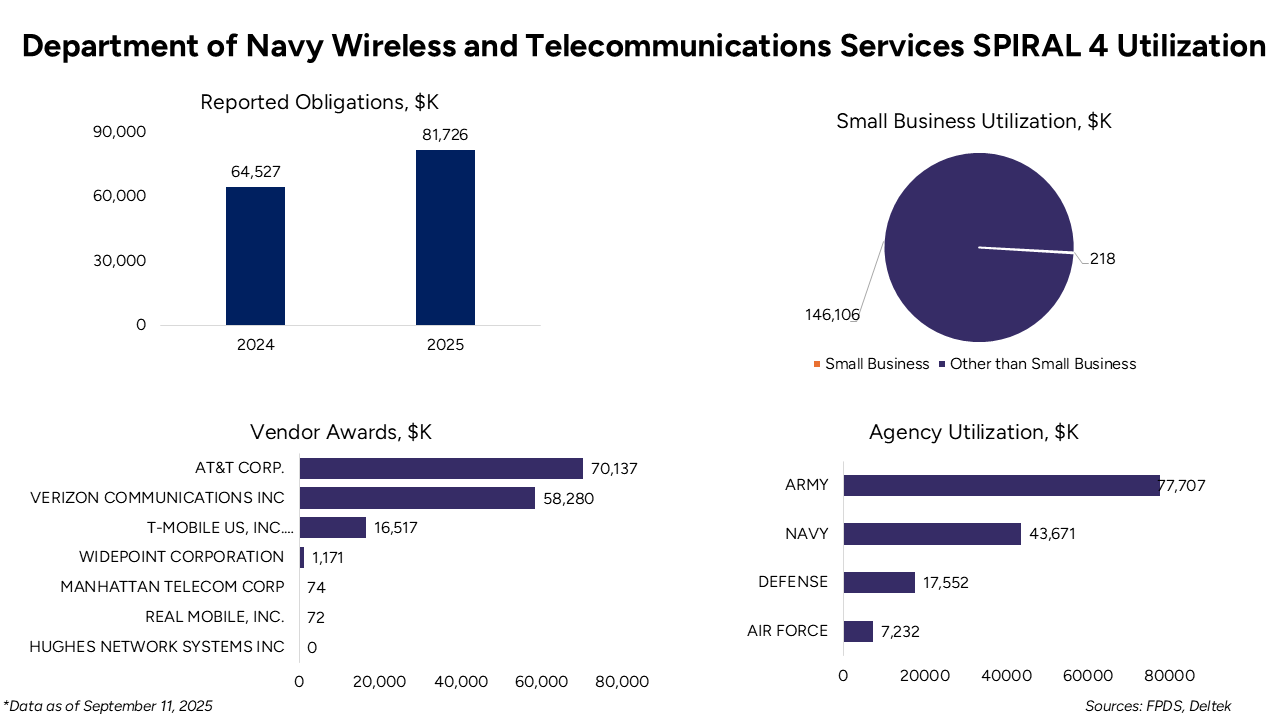
Similarly, the Navy and Marine Corps are providing real-time data sharing and command and control through advanced networking, secure communications and 5G/FutureG technologies utilizing the Navy’s 10-year $2.7B Wireless and Telecommunication Services Spiral 4 indefinite delivery, indefinite quantity contract. The agency is awarding contracts for towers and leveraging Multi-Operator Core Network (MOCN) technologies that allow multiple carriers to broadcast signals over shared infrastructure instead of deploying their own towers and equipment. This accelerates mission timelines and reduces carrier costs. Currently, seven contractors provide services through the Spiral 3 contract. With $146M in reported spending to date, future subcontracting opportunities may exist.
Ongoing 5G projects continue at Naval Air Stations like Whidbey Island. Integration will improve flight lines of the future, provide base protection, enhance range communications and implement sensor integration to enhance situational awareness. This also includes integrating tactical radios with broadband connectivity and utilizing virtualized training through private wireless networks.
Driving U.S. Supply Chain Resiliency and Innovation
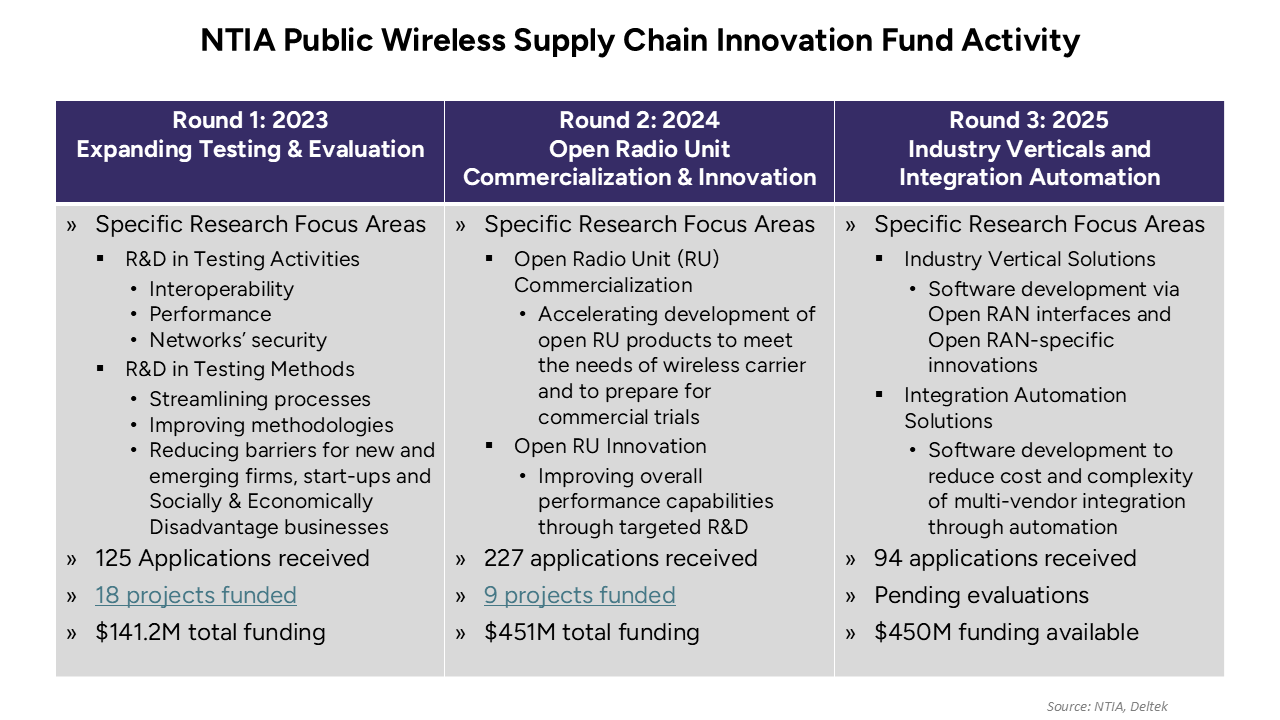
NTIA supports these efforts through the $1.5B Public Wireless Supply Chain Innovation Fund. Investments through contract and grant awards create opportunities for U.S. companies to participate in the 5G ecosystem and inform how the telecommunications infrastructure can leverage AI to achieve automation. NTIA-funded laboratories provide a test and evaluation environment that allows small businesses to complete their applied research, testing and prototype demonstration to bring their products into the 5G market, Toman explained.
“NTIA is trying to drive supply chain resiliency, trying to inject potentially U.S. providers of equipment into the 5G architecture,” she said.
Through two competitive funding “Rounds” to date, NTIA has provided $592M for 27 projects for research and development in testing methodologies and for developing and improving Open Radio Units products and capabilities to meet the needs of wireless carriers. A third Round issued in January will provide up to $450M for exploring the integration of automated solutions for equipment to accelerate the adoption of ORAN technology. NTIA received 94 applications requesting nearly $3B in federal funding and an additional $1.3B proposed by private investors. Proposals are under evaluation.
Future Outlook and Opportunities
While 5G integration continues, the FutureG Office is already exploring 6G technologies. Commercial research on Integrated Sensing and Communications (ISAC) capability indicates using networks as sensors for critical network infrastructure protection. “It’s a mix of radios, spectrum, the networks Artificial Intelligence, microelectronics,” Rondeau explained. “All these things are coming together in order to provide this new idea of sensing.”
However, because of its commercial foundation ISAC brings potential risks of adversarial requiring additional R&D.
“It’s a really, really exciting scalable problem set that we’re going after,” he said. “It’s gonna take a lot of investment. It’s gonna take a lot of work across the US government working with our commercial industry in order to make this happen. But it’s right for US government and its right for US leadership.”
AI-RAN offers an ability to transition from base Open RAN toward future network capabilities. The Open Centralized Unit Distributed Unit (OCUDU) open-source software platform for 6G innovation is creating a space for that openness and innovation, Rondeau explained, comparing OCUDU’s potential impact on telecommunications to that of Linux and Kubernetes on the internet and cloud. Contract negotiations for prototype development are underway with planned execution in late September.
Conclusions and Contractor Implications:
With continued emphasis on 5G integration and exploration into FutureG technologies, firms can expect growth in the federal mobility market. NTIA funding, strategic teaming and partnerships will position small start-up and socially and economically disadvantaged businesses to enter or expand their footprint win the federal mobility ecosystem.