Modernizing Defense Mobility: 5G Integration in the FY 2026 NDAA
Published: September 12, 2025
Federal Market AnalysisInformation TechnologyMobilityNational Defense Authorization Act
The integration of 5G technology outlined in the National Defense Authorization Act (NDAA) for FY 2026 will drive resilient and secure warfighter mobile communications.
Both the House and Senate versions of the FY 2026National Defense Authorization Act (NDAA) include provisions for integrating fifth-generation (5G) tactical radio communications and Open Radio Networks (ORAN) across the Department of Defense (DoD).
House Version – H.R. 3838
Titled “Streamlining Procurement for Effective Execution and Delivery and National Defense Authorization Act for Fiscal Year 2026,” H.R.3838 mandates a report on the military’s current tactical radio capabilities due to concerns that existing systems cannot meet the operational requirements to support resilient, secure battlefield communications. More specifically, the military systems lack sufficient bandwidth and endpoints while commercial capabilities such as scalable, dual-use 5G commercial wireless technologies are available. Those systems, when integrated into the current tactical radio program, could enhance soldiers' and warfighters' ability to communicate across widespread and contested geographic areas.
The report, due by December 1, must include:
- An assessment of current DoD tactical radio capabilities and known limitations
- A summary of completed or ongoing pilot programs, field trials, and evaluations of 5G-based tactical systems
- Potential acquisition and fielding pathways for 5G tactical radio and private wireless technologies
- Estimated costs, schedules, and technical requirements to transition from pilot to program of record
- Any policy, funding, or regulatory barriers to accelerating deployment of 5G tactical edge communications systems.
Senate Version – S.2996
Section 1616 of S.2296, “National Defense Authorization Act for Fiscal Year 2026,” requires each military department to develop a prioritized list of bases needing investments in private 5G information and communication networks. The objective is to address connectivity, performance, coverage areas, storage and logistics, physical and cybersecurity protocols within wireless network services along nine key areas:
- High connection density
- Low latency
- High capacity
- Large geographic coverage
- Enhanced and tailored security, including obscured data transport, within wireless network services
- Base physical security and force protection requiring advanced processing of high-resolution distributed sensor feeds for perimeter monitoring, and detection and tracking of unmanned aerial systems (UAS), including through the potential use of a fifth-generation information and communications network
- Efficient large-scale warehousing and logistics operations
- The use of augmented or virtual reality technology for efficient maintenance and training
- Large-scale and high-tempo flight line operations.
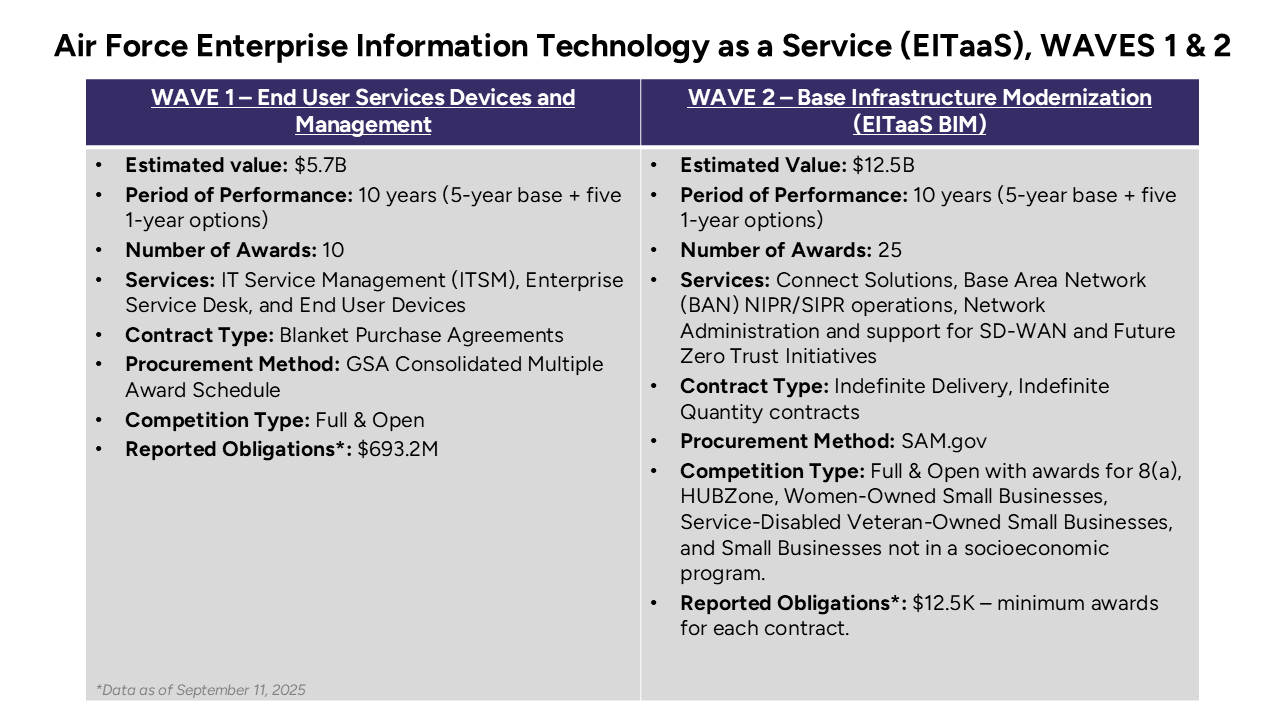
This prioritized list will be used to direct task orders under the Air Force Enterprise Information Technology as a Service (EITaaS) Base Infrastructure Modernization (BIM) program, which is part of the broader EITaaS modernization and transformation program.
Background:
EITaaS defines how the AF acquires IT products and services, secures its applications and data and invests in user experience to improve operational readiness. It also informs infrastructure modernization through resilient solutions and cloud services to establish the foundation for base area network (BAN) multi-domain operations. In February, the AF Chief Information Officer revised the program's Lines of Effort:
- Accelerate Cloud Adoption
- The Future of Cybersecurity
- Workforce Champion
- IT Portfolio Management
- Excellence in Core IT & Mission-Enabling Services
- Data & AI.
The AF awards EITaaS through individual procurements known as WAVEs. To date, only two WAVES have been issued and awarded: WAVE 1 Enterprise Information Technology as a Services End User Services Devices and Management, and WAVE 2 Enterprise Information Technology as a Service Infrastructure Modernization (EITAAS)(BIM), as specified by the NDAA.
(BIM) -bpWm.png)
Contractor Implications:
Although the NDAA only specifies use of the EITaaS BIM, potential use of the EITaaS End User Services BPA (WAVE 1) or via the Navy’s Wireless and Telecommunication Services Spiral 4 contracts vehicle exists. Moreover, while NDAA directs funding for DoD programs, it often influences investment strategies across civilian agencies.
Agencies lagging in 5G implementation integration may adopt the DoD guidelines to accelerate their efforts in FY 2026. Anticipate increased direct and embedded opportunities in civilian 5G and other mobility-related markets for innovative technologies in interoperability, connectivity, multi-operator core networks and neural networks. Expanded subcontracting and teaming opportunities will also likely emerge through expanded federal investment channels.
Conclusions:
Looking ahead, contractors holding EITaaS Wave 1, EITaaS Wave 2 or Spiral 4 contracts should closely monitor their procurement portals and Sam.gov for upcoming opportunities. Contractors with related civilian contracts or those seeking to enter the market should stay abreast of federal procurement forecasts and take advantage of federal and industry information and networking events.
Track these and other opportunities along with in-depth market analyses through Deltek’s GovWin IQ Products.