NASA Is Bringing Work In-House — Contractors Should Take Action Now
Published: February 19, 2026
Federal Market AnalysisContracting TrendsSmall Business
NASA is fundamentally changing how it does business – shifting critical mission-related work from contractors back to its own civilian workforce.
On February 6, NASA Administrator Jared Isaacman put contractors on notice: the agency is taking back its work. His Restoring NASA’s Core Competencies, sets in motion a historical shift in how the space agency meets mission requirements.
Isaacman argued that the agency’s increasing dependence on contractors for core technical and operational expertise, engineering, scientific, manufacturing and mission-critical work contributed to artificial civil servant hiring ceilings and false assumptions that outsourcing provides greater workforce flexibility.
The directive mandates the transition of core functions from contractor-provided to an agency civilian workforce delivery. Objectives include eliminating redundant tasks and granting the agency rights to repair contractor-provided hardware, and establishing agency access to all necessary resources, including intellectual property.
Widespread impacts are expected across multiple market sectors, most significantly in manufacturing, engineering and research and development (R&D). This article focuses on a select group of PSCs and NAICS codes associated with functions identified in the directive. Not all NASA or space-related PSC and NAICS Codes are included in this article or data analyses.
OVERVIEW
The directive requires NASA Center Directors, Mission Directorate leadership and the Office of the Chief Human Capital Officer (CHCO) to evaluate the current workforce and workload within 30 days. The plan must map to core competencies and existing contracts, focusing on solutions that enable mission execution, including:
- Transitioning technical and operational expertise, engineering, scientific, manufacturing, and mission-critical tasks and personnel to the civil servant workforce
- Establishing makerspaces at each center to accelerate prototyping and product development, including identification of funding sources and partner investments
- Executing contract changes, renegotiations, and terminations as required
- Defining timelines and cost implications for each transition phase.
During this period, the Procurement Office must:
- Incorporate right-to-repair provisions in current and future contracts granting NASA access to specifications, parts, tools, schematics, software, and technical documentation necessary for internal manufacturing, repair, and operations.
- Remove all contract clauses requiring the agency to return NASA-fabricated replacement hardware to vendors for inspection after delivery of out-of-spec hardware.
- Assess and recommend modifications to Intellectual Property (IP) restrictions that from performing internal repairs or redesigns, as needed.
Within 60 days, CHCO, Office of Procurement and Office of the Chief Financial Officer must develop a strategic plan to convert and transition core functions and establish a rapid onboarding process with minimal disruption to mission-critical work. Center directors must also develop a plan to create a makerspace at each center to enable rapid prototyping and proposal development. The plan should include an evaluation of possible financing avenues including partner and vendor sponsorships and investments.
NASA CONTRACT PERFORMANCE
NASA spent $45B over the past five years in these top market sectors. Contracts awarded within these sectors and under these top PSC and NAICS Codes could be at risk for contract modifications, renegotiations or terminations.

CONTRACTOR IMPLICATIONS AND MITIGATION APPROACHES
Once implemented, the plan will significantly change the NASA contract landscape, requiring contractors to reassess and adapt their business models and relationships with NASA. The following approaches will help contractors navigate the transition.
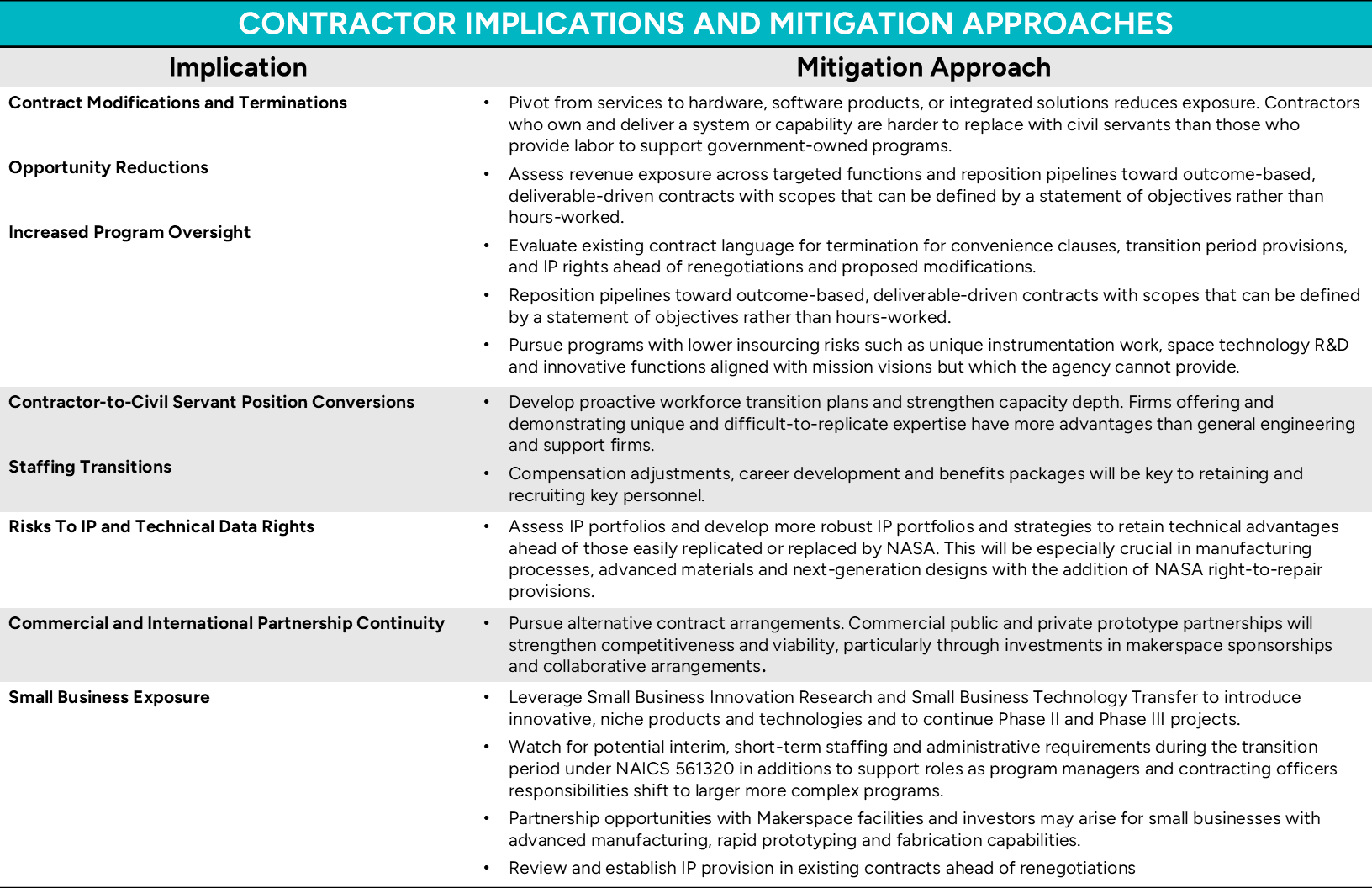
The accompanying risk mitigation matrix identifies PSC and NAICS code functions at elevated risk of contract disruption, modification, or termination — helping contractors assess their exposure and maintain a competitive position.
The bottom line is clear: quality over capacity - firms that offer robust, unique capabilities, differentiated capabilities and flexibility – rather than simply the workforce volume to meet mission requirements – will be more competitively positioned to compete for and retain NASA contracts.