How are Small Businesses Faring in the Federal Cloud Market?
Published: March 30, 2026
Federal Market AnalysisCloud ComputingInformation TechnologySmall BusinessSpending Trends
Federal cloud spending with small businesses is a bright spot in the market.
Last week, I posted an article containing the latest data on federal cloud spending from fiscal year 2023 to 2025. This week dives a bit deeper into the data to show what it says about how small businesses have been doing over that period.
As a reminder, this data comes from an Excel database of cloud contract awards and opportunities maintained by Deltek’s GovWin Federal Market Analysis (FMA) team. We refresh the data early every year to provide topline numbers for cloud spending during the most recently passed fiscal year. FMA strives to account for as much cloud work as possible, but we cannot capture all contractor-addressable spending due to inconsistencies in the way agencies report the details about their programs and projects.
Identifiable Total Cloud Spending with Small Businesses, FY 2023-2025
Identifiable cloud spending with small business partners rose to $4.4B in FY 2025. This total was up $200M from FY 2024 and represents ongoing growth in the market since FY 2023 when spending totaled $3.8B.
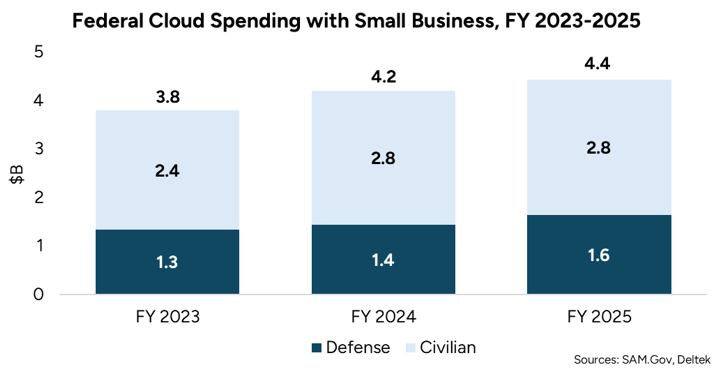
As was the case in the total cloud market data, the civilian sector spent more than the Department of Defense/War (DOD/W). Unfortunately, however, total cloud spending with small businesses in FY 2025 came in flat compared to FY 2024. This is after a sizeable increase of $400M in spending from FY 2023-2024. Spending by the DOD/W continued to increase over all three fiscal years, reflecting how the DOD/W is still ramping up its adoption of cloud-based solutions compared to the civilian sector.
Spending by Market Sector
Concerning the DOD/W specifically, here is the data for the ten organizations that spent the most on cloud services/solutions provided by small businesses over the last three years.
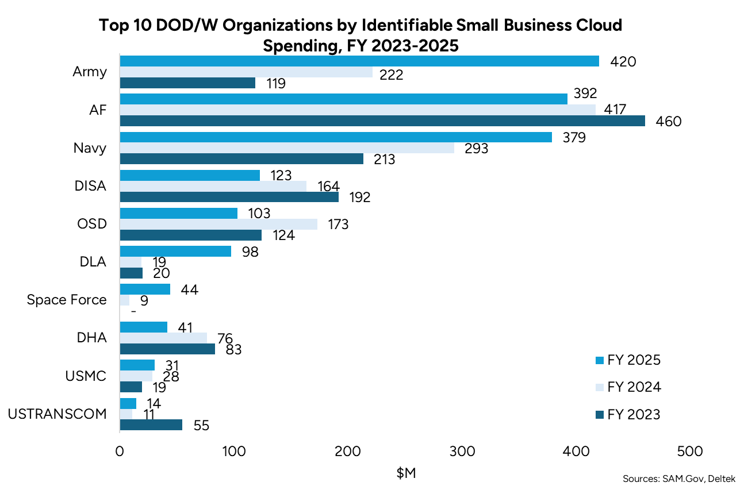
It turns out that the Army led the department in spending, a top spot attained by knocking off the Air Force, which led in the previous year. This said, spending with small businesses increased from FY 2024 to 2025 at only six of the ten organizations presented. This shows there is some volatility in the reliance on small businesses across the DOD/W. Spending fell, for example, at the Defense Health Agency, the Office of the Secretary of Defense, the Defense Information Systems Agency, and the Air Force.
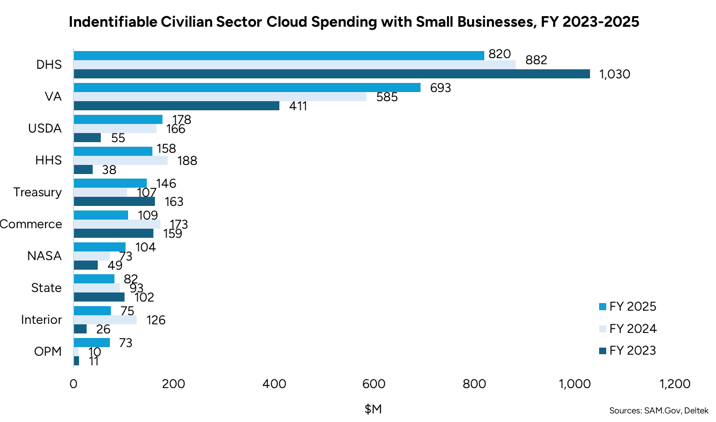
The data shows a similar bifurcation on the civilian side of the market where five out of ten of the agencies listed spent more over the three-year period. Spending fell at Interior, State, Commerce, Health and Human Services, and Homeland Security, while it rose at the other agencies shown.
Why cloud spending might fall at certain agencies while the total market is growing can be explained by the fact that smalls do well in the Software-as-a-Service (SaaS) segment. SaaS is by far the leading type of service delivery used by federal customers. It is easier and more cost-effective for small businesses to provide SaaS capabilities than it is for them to offer the computing power of Infrastructure-as-a-Service or even Platform-as-a-Service.
This benefit that enables higher small business participation, however, is also its greatest weakness. SaaS licenses tend to be short-term, meaning agencies can often shift their spending to newer or less costly capabilities. SaaS capabilities are also subject to pressure from Lowest Price Technically Acceptable acquisitions and the other challenges related to commodity IT, such as license consolidations.
In short, being a small business SaaS provider can be a double-edged sword. The good news remains that providing a SaaS capability offers a good opportunity for small businesses that they might not otherwise have. Just be aware that earning through SaaS can be volatile in a dynamic market.