FY 2027 President’s Budget Request | GovWin FMA’s First Take
Published: April 03, 2026
Federal Market AnalysisBudgetInformation TechnologyPresident Trump
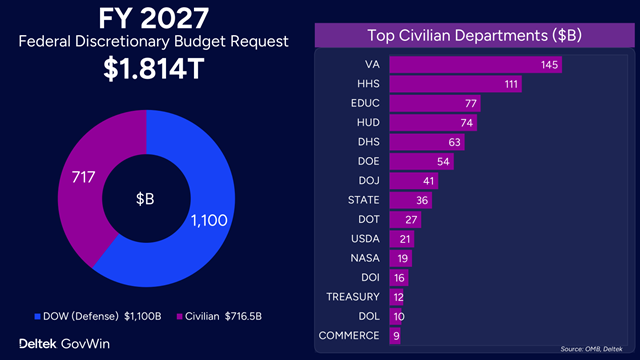
The White House’s FY 2027 Budget Request proposes $1.8T in discretionary funding.
Today, the Office of Management and Budget (OMB) released their Fiscal Year (FY) 2027 Budget Request, detailing the Trump Administration’s budget proposal and priorities for the fiscal year beginning October 1, 2026.
The budget proposes $1.814T in base discretionary budget authority, which includes a 10% reduction in non-defense discretionary spending from the FY 2026 enacted level and $1.5T in total budget for the Department of Defense/War (DOD/W), split between $1.1T in base discretionary authority and $350B in additional mandatory resources.
These figures do not include the $190B+ in multiyear mandatory funding for the Department of Homeland Security (DHS) and the $151.5B in defense-related mandatory funding already appropriated through the Working Families Tax Cut Act (WFTC), a.k.a., the One Big Beautiful Bill Act, enacted in July, 2025.
The GovWin Federal Market Analysis (FMA) team has reviewed the available budget detail to provide first impressions of what we found noteworthy for the largest departments and agencies, concentrating on spending priorities that may lead to potential contractor opportunities or impacts in FY 2027.
The FY 2027 budget documents include six supplemental Fact Sheets covering topline priorities, defense, border security, weaponization, program cuts, and energy. Where Fact Sheet figures differ from or supplement the main budget document, both are noted below.
FY 2027 Budget Developed Under Morphing Circumstances
One key caveat is that much of the agency budgets were prepared while Congress was working on FY 2026 appropriations and some were operating under a continuing resolution (CR), so some agency budget figures (e.g., DHS) reflect annualized CR levels for FY 2026 comparisons.
FY 2027 Discretionary Budget Request | Top Departments
Below are key funding details and initiatives arranged by department.
Department of Defense/War (DOD/W)
The Budget requests $1.1T in base discretionary budget authority for DOD/W in FY 2027, with an additional $350B in mandatory resources proposed through reconciliation, for a total of $1.5T in budgetary resources. This would be a 44% increase from the FY 2026 enacted level.
Funding highlights include:
- Shipbuilding: $65.8B to procure 18 battle force ships and 16 non-battle force ships, including the Trump-class battleship, next-generation frigates, Columbia-class and Virginia-class submarines, amphibious vessels, strategic sealift, and hospital vessels.
- Golden Dome missile defense: Support space-based missile defense sensors and interceptors, kinetic and non-kinetic missile defeat capabilities, and enabling technologies for a layered next-generation homeland missile defense system; builds on a WFTC down payment.
- Artificial intelligence: Provide investments to scale the DOD/W AI ecosystem, including the GenAI.mil platform and new AI infrastructure across the Armed Forces.
- Unmanned and counter-unmanned systems: Make investments to arm combat units with drones and provide protection against adversary unmanned systems.
- F-47 sixth-generation fighter: Continued development and production; first flight projected in 2028.
- DOD/W nuclear enterprise: Increased funding for modernization and diversification of nuclear forces and recapitalization of nuclear command, control, and communications (NC3) capabilities.
Department of Veterans Affairs (VA)
The Budget requests $144.9B in discretionary budget authority for VA, a 9% increase from the FY 2026 enacted level. Total medical care resources (discretionary plus mandatory Toxic Exposures Fund) total $175.5B.
Funding highlights include:
- Medical care: $175.5B total ($123.4B discretionary, $52.1B mandatory Toxic Exposures Fund), including $3.8B for the Homeless Programs Office and $644M for residential rehabilitation treatment programs.
- Electronic Health Record Modernization (EHRM): $4.2B (+$800M) to accelerate deployment of a modern electronic health record system interoperable with DOD/Wand community care providers.
- Information technology systems: $6.3B (+$389M), including $1.3B for healthcare delivery and access capabilities.
- Veterans Benefits Administration automation and AI: $130M for claims processing modernization.
- VA Construction: $3.9B in discretionary funding, including $3.0B for major construction projects and $861M for minor construction projects.
- Total IT Budget: Requests $12.2B in FY 2027, compared to $7.5B requested in FY 2026.
Department of Health and Human Services (HHS)
The Budget requests $111.1B in discretionary budget authority for HHS, a $15.8B or 12.5% decrease from the FY 2026 enacted level. The Budget establishes the Administration for a Healthy America (AHA) through a major departmental reorganization.
Funding highlights include:
- National Institutes of Health (NIH): $41.0B (-$5.0B); three Institutes and Centers eliminated; retains focus on biomedical research, high-performance computing, AI, and quantum information science.
- Behavioral Health Innovation Block Grant: $4.1B (new consolidated grant replacing multiple existing behavioral health programs).
- AHA technology investments: $57M to modernize FDA regulatory capability through AI and machine learning, and develop alternatives to animal testing.
- Agency for Healthcare Research and Quality (AHRQ): $240M (-$129M); priority statistical activities reorganized into new HHS Office of Strategy.
- Administration for Strategic Preparedness and Response (ASPR): $3.3B (-$356M) to refocus agency mission and support biodefense programs, maintain critical supplies in the Strategic National Stockpile, and strengthen domestic pharmaceutical resilience.
- Total IT Budget: Requests $9.5B in FY 2027, compared to $10.4B requested in FY 2026.
Department of Education
The Budget requests $76.5B in discretionary budget authority for Education, a 2.9% decrease from the FY 2026 enacted level. The Budget continues the Department’s path toward elimination.
Funding highlights include:
- Federal Pell Grants: $33.0B (+$10.5B); maximum award of $6,335 maintained.
- New Make Education Great Again (MEGA) Grants: $2.0B, consolidating the majority of existing K-12 grant programs.
- Special Education / IDEA programs: $16.0B (+$539M), including a $489M increase for IDEA State Grants.
- Charter Schools: $500M.
- Higher education program eliminations: $2.7B total, including Minority-Serving Institutions Programs (-$354M), FIPSE (-$136M), and International and Foreign Language Education (-$81M).
- Total IT Budget: Requests $1.3B in FY 2027, compared to $1.3B requested in FY 2026.
Department of Housing and Urban Development (HUD)
The Budget requests $73.5B in discretionary budget authority for HUD, a $10.7B or 13% decrease from the FY 2026 enacted level.
Funding highlights include:
- Replaces the Continuum of Care program as the primary vehicle for homeless assistance by funding the Emergency Solutions Grant program with an additional $4.0B.
- Funds the Federal Housing Administration with $160M for loan processing and risk management.
- Adds $30M to the Program Integrity Initiative combat fraud, waste, and abuse in federal housing programs.
- Eliminates the HOME Investment Partnerships Program, saving $1.3B.
- Eliminates the Housing Opportunities for Persons with AIDS (-$529M).
- Total IT Budget: Requests $700M in FY 2027, compared to $673M requested in FY 2026.
Department of Homeland Security (DHS)
The Budget requests $63B in discretionary budget authority for DHS, a 3.3% decrease from the FY 2026 CR level. WFTC provides $190B+ over five years, with at least $31.4B allocated in FY 2027.
Funding highlights include:
- U.S. Coast Guard operations: Adds $2.1B above the FY 2026 level for USCG operations. WFTC provided $24.6B for fleet assets and infrastructure.
- Customs and Border Protection (CBP): $136M for Automated Commercial Environment (ACE) technology; $322M for counter-drug technology and operations; $243M for Air and Marine Operations assets.
- Immigration and Customs Enforcement (ICE): $2.2B in base funding to maintain 41,500 detention beds; WFTC provided $75B for ICE including $45B for expanded detention capacity.
- U.S. Secret Service (USSS): Adds $36M for protective operations, hiring 852 new positions; WFTC provided $1.2B for protective technology.
- Cybersecurity and Infrastructure Security Agency (CISA): $2.5B (-$707M), refocusing the agency on federal network defense and critical infrastructure protection.
- FEMA non-disaster grant programs: -$1.3B, reducing grants and refocusing FEMA on core emergency management.
- Total IT Budget: Requests $11.7B in FY 2027, compared to $10.7B requested in FY 2026.
Department of Energy (DOE)
The Budget requests $53.9B in discretionary budget authority for DOE, a 10% increase from the FY 2026 enacted level excluding WFTC funding. Of this total, $32.8B is allocated to the National Nuclear Security Administration (NNSA), a 12% increase from the FY 2026 enacted level including WFTC; the remaining $21.1B reflects an 11% reduction.
Funding highlights include:
- NNSA: $32.8B for new warhead development, infrastructure modernization, life extension of existing warheads, and next-generation naval reactor technology.
- Artificial intelligence: $1.2B committed across the DOE enterprise, including seven AI supercomputers at Argonne and Oak Ridge National Laboratories.
- Baseload power deployment: $3.5B to rapidly deploy firm baseload power, repurposed from Biden-era IIJA funding.
- Office of Critical Minerals and Energy Innovation (CMEI): $1.1B for domestic critical minerals supply chains and next-generation energy and advanced manufacturing technologies.
- Critical minerals production: $394M for domestic production and processing pilot scale demonstrations.
- Environmental Management: $8.2B, including $3.0B for cleanup at the Hanford site.
- IIJA funding cancellation: -$15.2B in IIJA funding cancelled for unreliable energy infrastructure and carbon removal technologies.
- Total IT Budget: Requests $5.8B in FY 2027, compared to $5.4B requested in FY 2026.
Department of Justice (DOJ)
The Budget requests $40.8B in discretionary budget authority for DOJ, a $4.7B or 13% increase over the FY 2026 enacted level. WFTC also provided $11.8B in supplemental DOJ resources.
Funding highlights include:
- Federal Bureau of Investigation (FBI): $12.5B (+$1.9B), including investments in Unmanned Aerial Systems (UAS) operations and counterterrorism.
- Law Enforcement Components: $22.2B (+$2.7B), including a new $100M Model Cities Initiative grant program.
- Bureau of Prisons (BOP): $10.1B (+$1.7B), including $152M for the first year of Alcatraz reconstruction.
- Drug Enforcement Administration (DEA): $2.9B (+$362M) to hire over 300 additional agents equipped with advanced drug trafficking network intelligence systems.
- Executive Office for Immigration Review (EOIR): $899M to support the immigration judge corps and expand courtroom capacity.
- National Fraud Division: $30M for investigation and prosecution of complex fraud schemes.
- State and local grant programs: $2.9B (-$1.7B); approximately 30 programs eliminated.
- Total IT Budget: Requests $4.4B in FY 2027, compared to $3.1B requested in FY 2026.
Department of State and International Programs
The Budget requests $35.6B in discretionary budget authority for State and other international programs, a 30% decrease from the FY 2026 enacted level, including $2.3B in rescissions. The Department of State alone receives $33.6B, a 29% decrease.
Funding highlights include:
- America First Opportunity Fund (A1OF): $5.0B: new fund for core national security interests including critical mineral supply chains and countering adversarial expansion.
- Foreign Military Financing (FMF): $5.3B in grant/loan subsidy assistance and $18B in loan authority.
- International Narcotics Control and Law Enforcement (INCLE): $1.2B to counter narco-terrorists, cartels, and transnational criminal organizations.
- Global Health Programs: $5.1B (-$4.3B); restructured around the America First Global Health Strategy.
- Treasury International programs: ($642.4M): includes rescission of $197M for the African Development Fund and $150M for the Global Environment Facility.
- National Endowment for Democracy: -$315M, eliminated.
- Total IT Budget: Requests $3.8B in FY 2027, compared to $3.1B requested in FY 2026.
Department of Transportation (DOT)
The Budget requests $26.6B in discretionary budget authority for DOT, a 6.2% increase from the FY 2026 enacted level.
Funding highlights include:
- Federal Highway Administration: $66.2B, inc. mandatory funding.
- Federal Aviation Administration: $22.4B. Includes $4.0B for Facilities and Equipment and $165M for Research, Engineering and Development.
- Federal Transit Administration: $16.3B. Includes $15.0B for Transit Formula Grants.
- Federal Railroad Administration: $2.8B. Includes $2.1B for Amtrak and $271M for Safety and Operations.
- Maritime Administration: $2.6B. Includes $400.5M for the Maritime Security Program.
- Office of the Secretary of Transportation: $1.1B. Includes $75M for Cybersecurity Initiatives.
- Total IT Budget: Requests $5.7B in FY 2027, compared to $5.7B requested in FY 2026.
Department of Agriculture (USDA)
The Budget requests $20.8B in discretionary budget authority for USDA, a $4.9B or 19% decrease from the FY 2026 enacted level.
Funding highlights include:
- Adds $50M to reorganize USDA components and relocate headquarters employees from the DC metro area to regional hubs.
- Eliminates $82M from Rural Business Service (RBS) funding.
- Cuts $61M from Agricultural Marketing Service funding.
- Funds USDA cybersecurity with $60M, including $261K for Enterprise Cybersecurity Services.
- Provides $867.2M for IT in the Working Capital Fund, up $5.0M compared to the FY 2026 enacted level.
- Total IT Budget: Requests $2.6B in FY 2027, compared to $2.8B requested in FY 2026.
National Aeronautics and Space Administration (NASA)
The Budget requests $18.8B in discretionary budget authority for NASA, a 23% decrease from the FY 2026 enacted level.
Funding highlights include:
- Artemis Moon landing program: $8.5B (+$731M) to land American astronauts on the Moon by end of 2028.
- Lunar Base Camp: $175M (new) for robotic missions to deploy initial elements of a permanent outpost near the lunar south pole.
- Landsat program transition: $109M for phased transition to a commercial satellite solution.
- Science programs: -$3.4B; terminates over 40 low-priority missions. (i.e., Mars Sample Return mission and SERVIR climate program).
- International Space Station (ISS): -$1.1B; accelerates transition to commercial space stations; ISS de-orbit on track for 2030.
- Space Technology: -$297M; refocused on early-stage R&D for future lunar missions and commercial space competitiveness.
- Total IT Budget: Requests $1.4B in FY 2027, compared to $1.8B requested in FY 2026.
Department of the Interior (DOI)
The Budget requests $15.9B in discretionary budget authority for DOI, a 12.9% decrease from the FY 2026 enacted level, accounting for the proposed transfer of wildland fire responsibilities from USDA.
Funding highlights include:
- Presidential Capital Stewardship Program: $10.0B mandatory fund within the National Park Service (NPS) for construction and beautification projects in and around Washington, D.C.
- Great Salt Lake Restoration: $1.0B mandatory for a new federal program to restore water flows, ecosystems, and critical mineral development potential.
- Legacy Restoration Fund: $1.9B per year for 5 years: reauthorized for deferred maintenance on Federal lands.
- U.S. Wildland Fire Service (USWFS): Unification of all federal wildland fire responsibilities, including transfer of USDA Forest Service fire resources; new Wildfire Intelligence Center to centralize and modernize fire intelligence and technology.
- DOI renewable energy programs: -$45M; eliminated.
- Total IT Budget: Requests $1.8B in FY 2027, compared to $2.0B requested in FY 2026.
Department of the Treasury
The Budget requests $11.5B in gross discretionary budget authority for Treasury’s domestic programs, a 12% decrease from the FY 2026 enacted level.
Funding highlights include:
- Internal Revenue Service (IRS): $9.8B (-$1.4B), reflects proposed streamlining through technology improvements.
- Office of Terrorism and Financial Intelligence: $253M (+$15M) for cyber capabilities, sanctions targeting, and combating illicit financial activity.
- Cybersecurity Enhancement Account: $59M to support continued maturation of cybersecurity protections.
- Community Development Financial Institutions (CDFI) Fund: $119M (-$204M), redirected from prior award structure toward rural community capital access.
- Total IT Budget: Requests $6.2B in FY 2027, compared to $4.2B requested in FY 2026.
Department of Labor (DOL)
The Budget requests $9.9B in discretionary budget authority for DOL, a $3.5B or 25.9% decrease from the FY 2026 enacted level.
Funding highlights include:
- Make America Skilled Again (MASA) / Workforce Development: states and localities given flexibility to direct workforce funding; Career and Technical Education transferred from Education to DOL.
- Job Corps: $176M -$1.6B, eliminated.
- Pension Benefit Guaranty Corporation (PBGC): $9.1B (+$441M), additional spending authority for administrative purposes in FY 2027.
- Bureau of Labor Statistics (BLS): $668M (-$41M) to reorganize BLS into Commerce with aims to leverage data collection and analysis to reduce respondent burden.
- Office of Federal Contract Compliance Programs (OFCCP): -$101M, defunded; limited statutory functions transferred to an expanded Office of Civil Rights.
- Bureau of International Labor Affairs (ILAB): $70M (-$46M), reoriented to enforce labor standards in trade agreements.
- Total IT Budget: Requests $759M in FY 2027, compared to $663M requested in FY 2026.
Department of Commerce
The Budget requests $9.2B in discretionary budget authority for Commerce, a $1.3B or 12.2% decrease from the FY 2026 enacted level.
Funding highlights include:
- Bureau of Industry and Security: $215M to support hiring of new Special Agent law enforcement officers and bolster Section 232 investigation capacity.
- U.S. Investment Accelerator: $100M under the International Trade Administration to strengthen the manufacturing and industrial base.
- NOAA shipbuilding and unmanned systems (UxS) programs: $135M to accelerate procurement of new vessel and UxS platforms.
- National Institute of Standards and Technology (NIST): -$993M, eliminates Manufacturing Extension Partnership and climate-related curricula programs.
- National Telecommunications and Information Administration (NTIA): ($2.2B): Digital Equity program funding cancelled.
- Economic Development Administration (EDA): -$449M, eliminated
- Minority Business Development Agency (MBDA): -$47M, eliminated.
- Total IT Budget: Requests $3.1B in FY 2027, compared to $3.1B requested in FY 2026.
Environmental Protection Agency (EPA)
The Budget requests $4.2B in discretionary budget authority for EPA, a 52% decrease from the FY 2026 enacted level.
Funding highlights include:
- Research and Development: $277M for statutorily required research supporting EPA’s core mission.
- Web-based permitting tools (NEPAssist): $14M to reduce infrastructure permitting timelines.
- Environmental Justice program: eliminated.
- Atmospheric Protection Program: -$100M, eliminated.
- Total IT Budget: Requests $301M in FY 2027, compared to $294M requested in FY 2026.
Small Business Administration (SBA)
The Budget requests $329M in discretionary budget authority for SBA, a 67% decrease from the FY 2026 enacted level.
Funding highlights include:
- Salaries and Expenses: $260M (-$170M).
- Veterans support: $21.4M maintained within entrepreneurial development programs.
- Entrepreneurial Development Programs: -$309M, several programs eliminated.
- Business Loan Programs Administrative Expenses: -$158M, new administrative fee proposed on lenders participating in SBA guaranteed lending programs.
- Total IT Budget: Requests $321M in FY 2027, compared to $337M requested in FY 2026.
More Analysis Coming
The budget observations highlighted above are our initial takeaways from the budget documents released by OMB and the various departments and agencies at the time of publication.
In the coming days, as OMB, DOD and other federal departments and agencies release more complete budget documentation, the GovWin Federal Market Analysis team will be publishing more robust analysis of the FY 2027 budget, where we will go into greater detail on the key initiatives, IT investments and contractor implications that will shape the federal IT marketplace as we look to head into FY 2027.