New Executive Order Targets Underperforming Defense Contractors
Published: January 08, 2026
Federal Market AnalysisAcquisition ReformUSAFARMYDEFENSEDefense & AerospaceDefense & AerospaceNAVYPolicy and LegislationProcurementUSSF
Underperforming defense contractors are put on notice.
Signed on January 7, 2026, a new Executive Order (EO) posted by the White House “Prioritizing the Warfighter in Defense Contracting” establishes aggressive new controls over defense contractors' financial activities and executive compensation, linking them directly to performance metrics defined by the Secretary of Defense (referred to as "Secretary of War" in the order).
This post summarizes the contents of the EO and offers some thoughts on the implications for defense contractors.
Key provisions include the following:
Immediate Stock Buyback and Dividend Ban
The order prohibits defense contractors from conducting stock buybacks or paying dividends until they can "produce a superior product, on time and on budget." This is effective immediately and applies broadly to underperforming contractors.
Performance Review Process (30 days)
The Secretary of Defense must identify contractors who are:
- Underperforming on existing contracts.
- Not investing capital in production capacity.
- Not sufficiently prioritizing government contracts.
- Operating at insufficient production speed.
Identified contractors receive notice and have a 15-day window to submit board-approved remediation plans.
Enforcement Mechanisms
The Secretary may use Defense Production Act authority, Defense Federal Acquisition Regulations (DFARS) enforcement tools, and voluntary agreements to compel compliance. The order explicitly considers financial viability when determining enforcement actions.
Future Contract Requirements (60 days)
All new and renewed contracts must include provisions that:
- Prohibit buybacks and dividends during periods of underperformance.
- Tie executive compensation to on-time delivery and production increases rather than financial metrics such as free cash flow.
- Allow the Secretary to cap executive base salaries (adjusted only for inflation) during underperformance periods.
- Enable scrutiny of executive incentive compensation structure.
International Sales Impact
The State and Commerce Departments may cease advocating for underperforming contractors competing for Foreign Military Sales (FMS) or Direct Commercial Sales (DCS).
SEC Regulatory Changes
The SEC Chairman is directed to consider amending Rule 10b-18 to deny safe harbor protections for stock buybacks by identified underperforming contractors.
Implications for Defense Contractors
- Cash management crisis: Contractors identified as underperforming face immediate prohibition on returning capital to shareholders, forcing reallocation of cash flows toward operations, CapEx, or debt reduction.
- Valuation pressure: Public defense contractors may experience stock price volatility as investors reassess return profiles without buyback/dividend programs.
- Credit implications: Changes to capital allocation could affect credit ratings and debt covenants.
Operational & Investment Priorities
- Capital expense (CapEx) acceleration: Contractors must demonstrate investments in production capacity to avoid identification under Section 3.
- Working capital strain: Increased production speed requirements may necessitate inventory buildup and supply chain investments.
- Program prioritization: Companies with diversified portfolios must demonstrate they are prioritizing DOD contracts over commercial work.
Contract Strategy and Compliance
- Changes to the bid/no-bid calculus: Future contracts include onerous performance-based restrictions, potentially making marginal programs economically unviable.
- Existing contract scrutiny: Current underperformance on any contract could trigger cascading restrictions across entire corporate portfolio.
- Remediation planning: Boards must prepare contingency remediation plans that satisfy DOD requirements while maintaining business viability.
Executive Compensation Restructuring
- Immediate compensation review: HR and compensation committees must redesign incentive structures away from financial metrics toward operational KPIs (on-time delivery, production volume, CapEx deployment).
- Base salary caps: Underperformance triggers could freeze executive base salaries indefinitely, complicating retention and recruitment.
- Board governance: Increased board involvement required for remediation plan approval and compensation oversight.
International Business Risk
- FMS/DCS advocacy withdrawal: Underperforming contractors lose critical USG support in international competitions, potentially ceding market share to foreign competitors or better-performing domestic rivals.
- Allied partnership strain: Loss of FMS support affects long-term allied interoperability and partnership programs.
Legal and Compliance Exposure
- Contractual disputes: Broad definitions of "underperformance" and "insufficient" prioritization/investment create subjective enforcement standards.
- DPA authority: Use of Defense Production Act powers could compel specific actions, allocate resources, or impose operating restrictions.
- SEC coordination: Rule 10b-18 amendments could create securities law compliance issues distinct from contract performance.
Strategic Implications
- Mergers and acquisitions activity: Potential consolidation as smaller contractors face capital constraints; larger contractors may divest underperforming divisions.
- Private equity interest: Privately-held defense contractors gain competitive advantage without public market capital return pressures.
- Supply chain impacts: Prime contractors may face subcontractor performance issues that trigger their own identification under Section 3.
Planning Considerations for Deltek Clients
- Track contract vehicle changes to identify new performance-based compensation clauses.
- Assess whether partner/teaming relationships involve contractors at risk of FMS advocacy withdrawal.
- Evaluate competitive positioning if major incumbents face operational or financial constraints.
- Review internal metrics alignment with new DOD priorities (on-time delivery, production capacity, investment levels).
Also monitor which contractors are identified under Section 3 reviews (likely to become public through SEC filings or trade press). Given the language used and reference to the Defense Production Act, Deltek assumes this EO will affect particularly, but certainly not exclusively, defense contractors providing weapons and equipment.
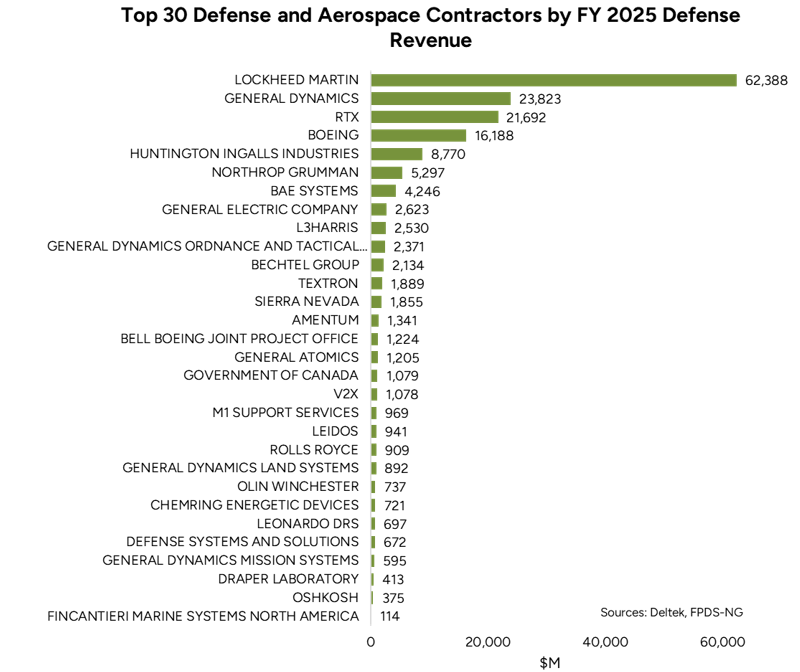
Here is a list of the top earning defense and aerospace companies by FY 2025 defense revenue.
Final Thoughts
This order represents a fundamental shift in defense acquisition policy, prioritizing production capacity and delivery performance over financial engineering. The 30-60 day implementation timelines mean initial impacts will emerge by February-March 2026.