NASA Reorganization Signals Mission Focus Change; Redirected Funding Not Reflected in FY 2027 Budget
Published: June 05, 2026
Federal Market AnalysisBudgetContracting TrendsInformation TechnologySmall Business
NASA’s FY 2027 budget reflects heightened focus on space exploration, but funding remains aligned with the previous organizational structure.
The National Aeronautics and Space Administration’s (NASA) $18.8B FY 2027 discretionary budget reflects a $5.6B (-23%) decrease from the FY 2026 enacted level, prioritizing Exploration over all other mission directorates.
BUDGET HIGHLIGHTS
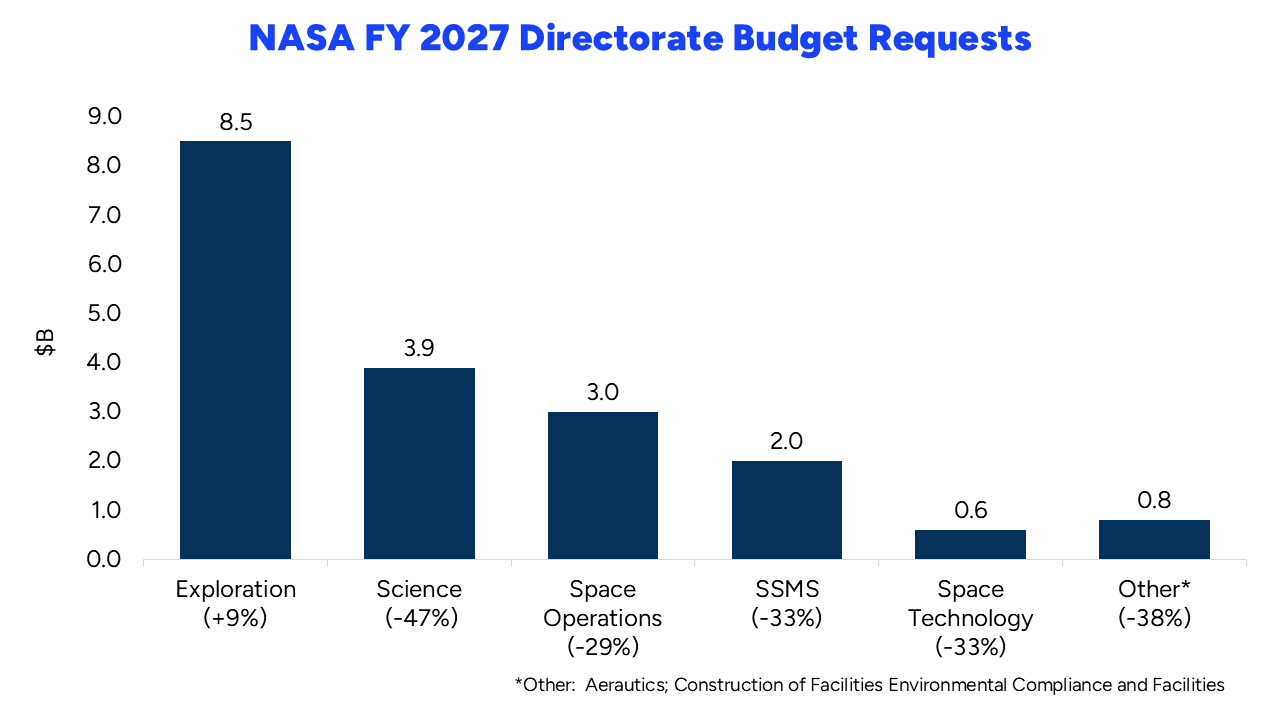
The FY 2027 budget increases Exploration funding by 9% while cutting all other directorate budgets, including Science by nearly half. Highlights include:
- IT/Infrastructure: Appropriates $2B for mission-enabling capabilities such as Information Technology (IT) programs, with $101M for infrastructure modernization and earmarks $1.5B for Mission Services and Capabilities, including $485M to modernize IT capabilities, strengthen cybersecurity posture and provide AI risk management
- Science Missions: Focuses on high-impact missions such as the Nancy Grace Roman Space Telescope, VIPER lunar rover, Dragonfly, and NEO Surveyor asteroid detection while terminating more than 40 lower-priority science missions
- R&D/Technology Development: Prioritizes early-state research and development for technologies required by future lunar missions and to support competitive space missions such as commercial programs to produce rocket fuel on the moon and develop small radioisotope nuclear power systems, despite cutting the Space Technology budget by $297M
- Space Technology and Small Business Programs: Continue support for veteran-owned businesses while eliminating the Entrepreneurial Development Program (-$309M), Service Corps of Retired Executives (SCORE), Community Navigator Pilot Program, Established Program to Stimulate Competitive Research (EPSCoR), Minority University Research and Education Project (MUREP) and the Next Gen STEM Project.
MISSION DIRECTORATE FUNDING
- Exploration, consolidated under the new Human Spaceflight Mission Directorate (HSMD), receives $8.5B and is the only directorate to receive an increase for FY 2027. The Working Families Tax Cut Act (WFTCA) provides an additional $1.8B to enable up to two flights beyond Artemis III and fund the Lunar Gateway program transition to support development of a lunar base camp. Key investments are:
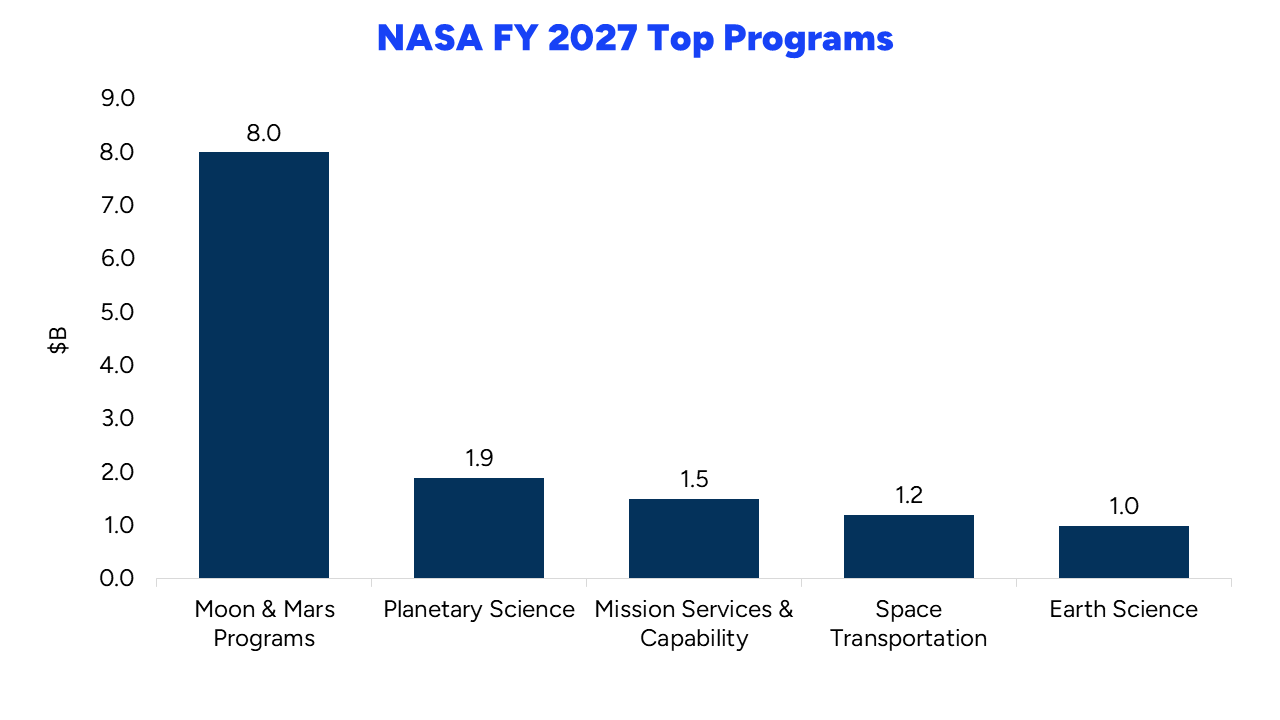
- Moon to Mars (M2M) Transportation System ($4.2B)
- Moon to Mars Systems Development ($3.8B)
- Human Exploration Requirements and Architecture ($485M)
- Space Operations, also merged into HSMD, receives $3B (-29%). Programs include:
- Space Transportation ($1.2B)
- International Space Station ($921M)
- Space and Flight Support ($674M)
- Commercial Low Earth Orbit Development to replace the ISS ($300M).
- Space Technology, consolidated under the new Research and Technology Mission Directorate (RTMD), receives $624M (-33%). Top investments include:
- Small Business Innovation Research and Technology Transfer programs ($169M)
- Catalysts & Innovative Mechanisms ($131M)
- Surface Infrastructure & Exploration (LIVE) ($101M)
- Space Transportation (GO) ($86M).
- Aeronautics, also part of the RTMD, receives $610M (-35%). Funded programs include:
- Advanced Air Vehicles ($191M)
- Integrated Aviation Systems ($152M)
- Airspace Operations and Safety ($87M)
- Aerosciences Evaluation and Test Capabilities ($90M)
- Transformative Aeronautics Concepts ($79M).
- Science, unchanged under the reorganization and the directorate with the largest reduction, receives $3.9B (-47%). Program investments are:
- Planetary Science ($1.9B)
- Earth Science ($1B)
- Astrophysics ($552M)
- Heliophysics ($420M)
- Biological and Physical Sciences ($25M).
- Safety, Security and Mission Services (SSMS), which provides agency-wide Information Technology (IT) support, receives $2B (-33%) including:
- Mission Services and Capabilities ($1.5B)
- Engineering, Safety and Operations ($462M).
IT BUDGET HIGHLIGHTS
Featured FY 2027 IT investments include:
- $485M through SSMS to modernize IT capabilities, provide cybersecurity and AI risk management and enable advanced computing for mission planning and scientific analysis
- $526M under SSMS for Mission Enabling Services (MES) to develop an enterprise approach to managing NASA business operations and mission support activities.
- $453M for communications and navigation technologies supporting Artemis missions, and $59M for the Communications Services Program to evaluate the feasibility of commercial satellite communications for future missions
- $109M for a final Landsat satellite development during transition to a commercial solution through Sustainable Land Imaging funding
- $156M for research supporting modeling and data analysis, AI/ML and commercial cloud computing to accelerate discovery and expand data accessibility within Earth Sciences
- $73M for applied research, modeling and observations to improve space weather forecasting capabilities, protect critical infrastructure and astronauts from solar events and enable transition of scientific advances.
NASA REORGANIZATION
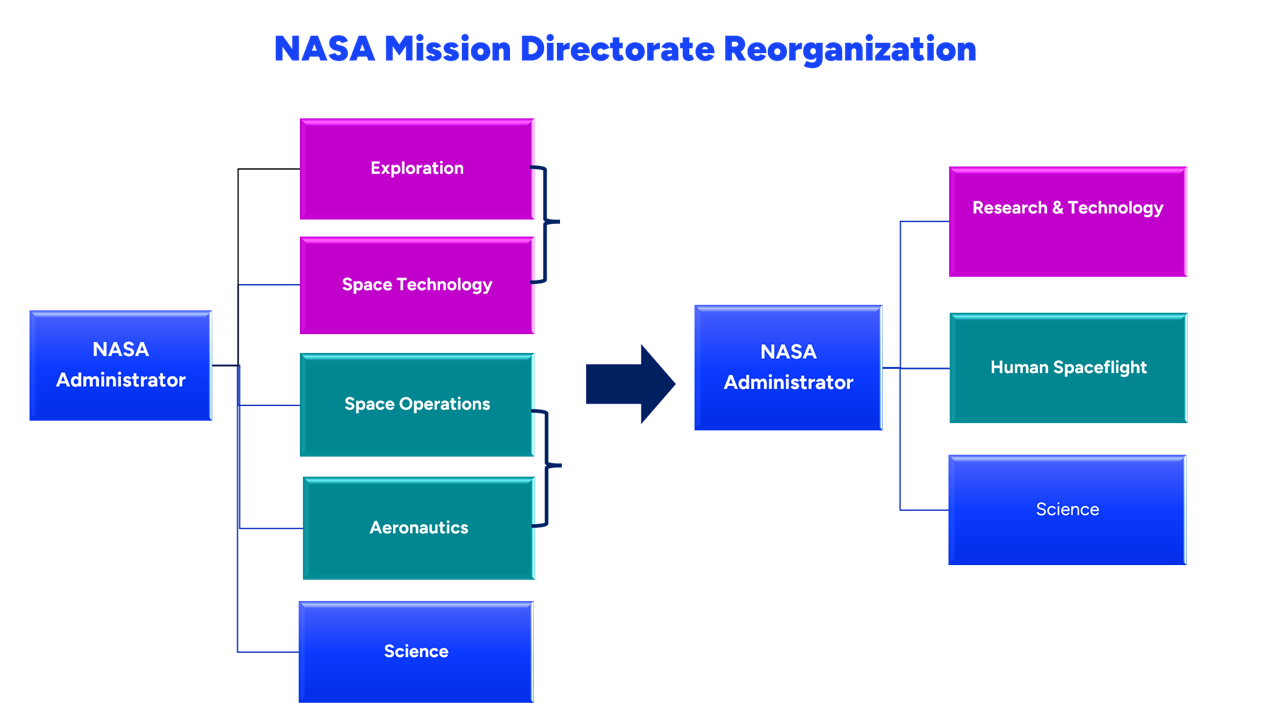
NASA announced plans in late May to reorganize its five mission directorates into three to prioritize the National Space Policy and advance American leadership in space. The FY 2027 discretionary budget request does not reflect the consolidated directorate structure but lists funding under the original organizational framework.
NASA Administrator Jared Isaacman said the reorganization will increase specialization capabilities at NASA centers and focus talent and resources on high-priority missions to increase the delivery of technically excellent work. "There will be no reduction in force, no program cancellations, no closures, but we will achieve cost savings through more efficient execution," he said.
The new Research and Technology Mission Directorate (RTMD), led by James Kenyon, consolidates the Aeronautics Research Mission Directorate and the Space Technology Mission Directorate. RTMD will include these divisions:
- Aeronautics led by Director Laurie Grindle
- Advanced Research and Technology led by Director Greg Stover
- Space Reactor Office led by Acting Director Steve Sinacore
- Space Communications and Navigation program (SCaN) led by Director Kevin Coggins.
The Human Spaceflight Mission Directorate (HSMD), led by Lori Glaze, combines the Exploration Systems Development and the Space Operations Mission Directorates, restoring their 2021 structure. The HSMD includes three divisions:
- Low Earth Orbit led by Program Manager Dana Weigel
- Moon Base led by Program Manager Carlos Garcia-Galan
- Artemis (renamed Moon to Mars) led by Program manager Jeremy Parsons.
The Science Mission Directorate (SMD), which administers planetary science, astrophysics and Earth science missions, remains unchanged under Administrator John Bailey with Nicola Fox serving as associate administrator.
In addition to the consolidations, the effort revised the agency chains of command, including 26 leadership roles associated with the new structure. Center directors will continue reporting to the Associate Administrator Amit Kshatira, who will also serve as the NASA chief engineer. Mission directorates will report directly to Isaacman.
The agency also plans to convert contractor roles to civil servant positions to strengthen its intern pipeline and workforce technical capabilities in coordination with the Office of Personnel Management’s recruiting initiatives
“We aim to rebuild competencies and instill a culture that attracts the best and brightest capable of pursuing the most demanding engineering challenges and moving safely and urgently,” Isaacman said.
The agency has not published a revised organizational chart nor indicated how the change impacts the FY 2027 budget request. The figure below shows the new overall mission directorate structure.
CONTRACTOR IMPLICATIONS
Contractors face dual outcomes from budget reductions and organizational changes. These will directly impact active contracts, eliminate possible recompetes, and require firms to develop transition strategies to replace lost revenue. Smaller firms relying on small business programs will face reduced financial assistance, driving the need to seek alternative investment sources. Organizational changes will drive contract modifications and scope changes for large facility and center contracts and those directly supporting directorate offices. In some cases, this could mean simply remapping existing work to the new structures.
Leadership role changes may create instability in contractor relationships as new leaders acclimate to their new roles and others move to different positions. Conversion of contractor roles to in-house positions will reduce the contractor staffing needs, driving the need to re-evaluate pricing strategies and generate increased competition with NASA for workforce talent.
Despite these pressures, increased Exploration funding will drive growth and creates new opportunities through programs like the Commercial LEO Development and the Lunar Commercial Transport programs. Task orders under large multiple-award contract vehicles and subcontracting opportunities also provide transition paths. IT modernization, AI and cybersecurity projects continue driving contracting opportunities, especially for technologically innovative firms. Firms that map their existing capabilities to NASA’s priorities and align their offerings with the agency’s new directorate structure will be better positioned for success.